
- PRICING
- LIVE QUOTES
- LEARN
- HELP


EN
“Abandon Korea and buy Hong Kong”! Global funds “sharp turn”: Hong Kong stocks welcomed historic short recovery, and the correlation between KOSPI and Hang Seng Technology turned negative
The Zhitong Finance App learned that global capital is staging a rare “big reversal”. At the beginning of this year, global funds were shorting Hong Kong technology stocks one after another, freeing up capital to South Korean chip giants to chase the AI boom. However, as the memory stock bubble burst and Korea's KOSPI index plummeted by nearly 30% in a single month, these funds are closing short positions in Hong Kong at an alarming rate while selling off Korean chip stocks.
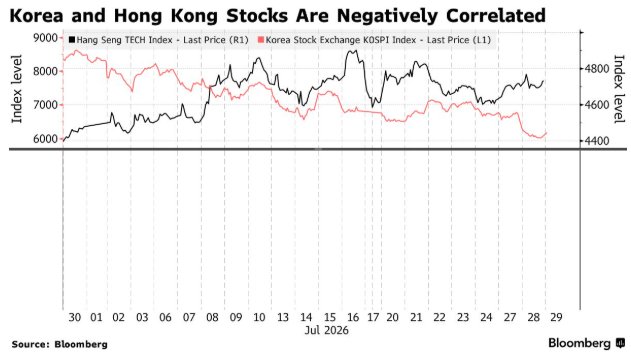
According to the data, the 20-day rolling correlation between Korea's KOSPI Index and the Hang Seng Technology Index has once again turned negative. This negative correlation model means that when global funds sell Korean stocks dominated by Samsung Electronics and SK Hynix, they are also making up for short positions in Hong Kong technology stocks such as Alibaba and Tencent. A capital migration driven by AI fanaticism is accelerating in reverse.
The AI bull market is not over yet, but “the stage of buying all 'shovel sellers' with your eyes closed is over.” The urgent withdrawal of global funds from the “multiple Korean stocks and airport stocks” strategy means that the AI investment logic is shifting from “hardware priority” to “application priority.”
Correlation reversal: from “making airport stocks and buying Korean stocks” to complete reversal
At the beginning of this year, the global fund's operating logic was clear and consistent: shorting Hong Kong technology stocks — Alibaba, Tencent, etc. are viewed as “AI backwards” — to raise capital and fully bet on South Korean memory chip giants SK Hynix and Samsung Electronics. This strategy worked once during the AI hardware bull market.
However, since July, this deal structure has been rapidly disintegrating. The 20-day rolling correlation between KOSPI and the Hang Seng Tech Index turned negative again, meaning that the two indices are in complete opposite direction — this is direct evidence of the reverse operation of global funds. Market participants analyzed that this model reflects that global funds are selling Korean stocks led by chip stocks Samsung Electronics and SK Hynix, while also making up for shortfalls in Hong Kong technology stocks such as Alibaba and Tencent.
Judging from the direction of capital flows, this reversal is even more clear. Since 2026, the net outflow of foreign capital from the Korean stock market has exceeded 100 billion US dollars. Meanwhile, Hong Kong stock bears are making large-scale profits — as of July 3, the amount of outstanding short sales in Hong Kong stocks had reached an all-time high of 2.43% of the total market value; CITIC Securities expects that as incremental capital enters the market, it will trigger bears to close their positions and drive a rebound in the market.
Laura Wang, chief Chinese equity strategist at Morgan Stanley, pointed out in the report that global investors told her that Hong Kong, China and the mainland have always played the role of “financing bears” to fund increased allocations to South Korea, Taiwan, and Japan. And “these recent market adjustments have significantly reduced the pressure on China.”
According to an analysis by CITIC Securities, Hong Kong stocks are becoming one of the main undertakers for global capital switching from crowded transactions to undervalued assets due to their valuation advantages, improved capital structure, and room to make up for bears.
South Korea Stock Market Crash: A Chain Effect of Bursting Memory Bubbles
The trigger for this reversal was the epic collapse of the Korean stock market. On “Black Tuesday” on July 28, South Korea's KOSPI index closed down 10.84% to 6,023.66 points, the biggest one-day decline since the outbreak of the war in Iran on March 4. At one point, it fell 11.3% in the intraday period, triggering the 8th fusing mechanism this year and the 14th in history. KOSPI has fallen 29% so far this month, surpassing the record for the biggest monthly decline of 27% set in October 1997. The index has dropped 34% from its peak of 9,114.55 in June.
The memory chip giant became the center of a sell-off storm. SK Hynix plummeted 14.7% after its ADR fell to a record low in the New York market and fell below the US IPO price. Samsung Electronics fell 14.4%, the biggest one-day decline since October 2008. The combined weight of the two stocks in KOSPI was more than half, amplifying the impact on the overall market. Foreign investors had net sales of 3.7 trillion won (about 2.7 billion US dollars) in a single trading day.
Since SK Hynix's stock price hit a record high in June, its market value has shrunk by about 570 billion US dollars. Micron Technology's stock price fell 35.4% from its high during the year, while SanDisk fell 53.6%.
Furthermore, leveraged ETFs have amplified the downward spiral. In May of this year, the Korea Exchange approved the first batch of 16 single-stock 2-times leveraged ETFs to track SK Hynix and Samsung Electronics. Leveraged products naturally have the property of aiding the decline when the market falls, increasing selling pressure.
Hong Kong becomes the biggest beneficiary: best performance record in 40 years
In this capital reversal, the Hong Kong stock market became the biggest winner. Since July, the Hang Seng Index has risen by about 10%, while KOSPI has plummeted by about 23%. This gap is making the Hang Seng Index expected to set the biggest monthly winning record since KOSPI was launched in 1983. Alibaba, Xiaomi, and Meituan were the biggest winners, with increases of more than 25%. Samsung and SK Hynix declined by at least 25% over the same period.
On July 8, the Hang Seng Technology Index surged 4.97% in a single day, the biggest intraday increase since 2026. Alibaba surged more than 12%. Huatai Securities pointed out that “bears took the initiative to return profits, and there was a technical recovery in the market” this week, and the leading direction for Hong Kong stocks was mainly the industry that accounted for the largest share of unclosed positions and short sales.
Goldman Sachs released a research report on July 13, pointing out that the total market value of China's AI sector accounts for only 10% of the total global AI market value, but it has generated 16% of the world's AI-related revenue; while the global fund allocates only 1.2% of its positions in Chinese AI stocks. This means that Hong Kong technology stocks are still seriously undervalued, and there is room for continuous recovery. Hong Kong is becoming a major beneficiary of capital fleeing from chipmakers.
According to the data, after Hong Kong stock short selling activity hit a monthly high in early to mid-July, short selling activity for various stocks generally cooled down significantly in late July. The cumulative net inflow of southbound capital for the week of July 6 to 10 was HK$39.1 billion, a new weekly high since April.
The essence of this wave of rebound is that a major restructuring of the global capital arbitrage model has triggered a major liquidation of hedge fund “matchmaking transactions.” Chen Weiming, an analyst at Yaocai Securities, pointed out that market concerns about excess AI hardware are dragging down the Japanese and South Korean stock markets, but it has triggered hedge funds to close positions and adjust positions to buy back Hong Kong Tech Online stocks that had been excessively borrowed and short sold earlier.
Wall Street buzz: the “five major catalysts” that caused the AI chip bubble to burst
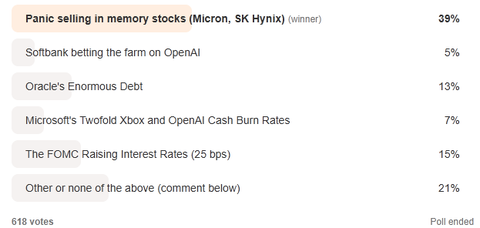
According to a poll of 618 institutions and active investors launched by Seeking Alpha in mid-July, the Nasdaq 100 ETF (QQQ) has retreated from a high level of volatility. The market is closely evaluating potential catalysts that may cause AI computing power and hardware chain squeezing bubbles:
1. Panic sell-off of memory chips and hidden order concerns
Nearly 40% of respondents believe that the sell-off of memory chips will be the first domino to trigger the AI valuation tsunami.
Micron Technology (MU.US): The stock price has slipped from a high of $1,048 on the June 24 earnings day to around $800. Micron's Chief Commercial Officer Sumit Sadana clearly indicated during the conference call that a strategic customer's five-year prepayment agreement totaling 22 billion US dollars “will be refunded if terminated due to the terms of the agreement.” If large customers reduce cooperation, Micron will have to lower profit expectations, impacting its previously maintained “A” forward valuation score.
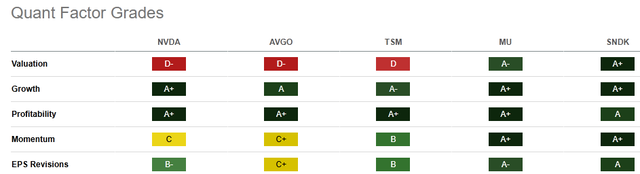
SK Hynix (SKHY.US) and SanDisk (SNDK.US): Recent valuations are under pressure, while the Quant valuation ratings of front-end chip giants such as Nvidia (NVDA.US), Broadcom (AVGO.US), and TSM.US (TSM.US) have dropped to “D” or lower, indicating that hardware valuation premiums are extremely weak.
2. Cloud giants (Hyperscalers) capital expenditure (CapEx) fatigue is beginning to show signs
Last week, the second-quarter data released by Alphabet (GOOGL.US) showed that its capital expenditure skyrocketed to 44.9 billion US dollars, exceeding operating cash flow of 39.1 billion US dollars, causing free cash flow to turn negative. Alphabet's stock price then dived from $348 to $328 (July 28). The market is concerned that if Microsoft (MSFT.US), Meta (META.US), and Amazon (AMZN.US) follow up and announce CapEx that exceeds expectations, it will further trigger a sell-off. Apple's (AAPL.US) hedging strategy: In contrast, by focusing on on-device AI (on-device AI) and introducing Google Gemini to handle high computing power requests, Apple only undertook moderate expenses, driving its market value to the historic $5 trillion mark in one fell swoop.
Moreover, Nvidia's “revolving financing” is fueling fears of an AI bubble. According to reports, Nvidia is discussing a financing guarantee of about 250 billion US dollars for the OpenAI large-scale data center project, as well as a chip procurement financing arrangement of up to 350 billion US dollars. The news raised deep concerns in the market about the “circular financing model” — investment between chip companies, cloud computing companies, and AI companies continues to expand, but it is still unknown whether the final return can match such huge capital investment. “Greed has turned into fear of AI-related semiconductor stocks,” said Vey—Sern Ling, managing director of AIA Bank.
3. Data center approval met with community boycotts and environmental bans
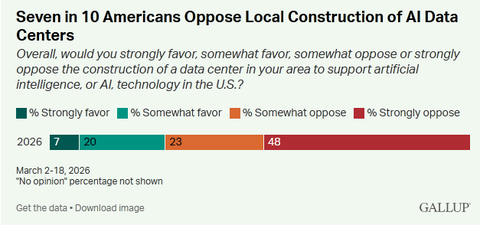
According to a March poll, 70% of Americans oppose building AI data centers locally.
Policy red line: On July 14, New York State officially issued a moratorium (moratorium) on new data center licenses of 50 megawatts (MW) or more.
Downstream impact: Affected by the blocking of the implementation of computing power infrastructure, downstream optical fiber and equipment suppliers have been hit hard. Corning (GLW.US) plummeted 18% in a single day due to poor performance, while Ciena (CIEN.US) and Lumentum (LITE.US) also fell sharply at the same time.
4. China's open source big model (such as Kimi K3) reconstructs AI computing power and cost performance
China's AI lab Moonshot AI (Moonshot AI) officially released the open weight model Kimi K3.
Business model impact: Kimi K3 supports free local deployment and operation, drastically reducing AI implementation costs for enterprise software service providers, but it has put a huge squeeze on closed source business models such as Anthropic, OpenAI, and Microsoft CoPilot that rely on high subscription fees.
Software stocks surged: The move benefited the application-side and cybersecurity sector. CrowdStrike (CRWD.US) and software giants such as SAP (SAP.US), CRM.US (CRM.US), Adobe (ADBE.US), and ServiceNow (NOW.US) ushered in a collective surge on Monday.
Furthermore, the rise of semiconductors in China has triggered competitive revaluation. Changxin Storage (CXMT), the fourth largest memory chip manufacturer in China, went public on Monday and raised about US$8.6 billion. After the transaction ended on the first day, it became one of the listed companies with the highest market capitalization in China. Future Asset Securities analyst Kim Seok-hwan said, “The focus of market concerns is not on Changxin Technology's current profit situation, but on the possibility of accelerating capacity expansion and competition with Korean companies after the IPO.” Meanwhile, there are reports that Chinese companies have begun large-scale production of immersive deep ultraviolet (DUV) lithography machines, and Asmack's stock price plummeted 8.5% in response.
5. Supersized IPOs have a liquidity drain effect
SpaceX (SPCX.US) completed its IPO with an ultra-high valuation of 2 trillion US dollars, absorbing a large amount of marginal liquidity in the market. However, its stock price fell all the way from opening to $135 (close to a 52-week low of $107.02), and the upcoming Lockup Expiry (Lockup Expiry) period (Lockup Expiry) in August will release more chips.
As the Nasdaq Index forcibly absorbs SPCX, passive funds are forced to take over at any price. The market is worried that if Anthropic and OpenAI, which plans to launch in 2027, follow up with a giant IPO, the chatbot concept that lacks performance support will face severe liquidity tests.