
- PRICING
- LIVE QUOTES
- LEARN
- HELP


EN
The biggest increase in half a month was nearly 320%. Why did Jiangxi Biotech (06915) move from a broken listing to a violent rise?
From breaking up immediately after listing, and the stock price plummeted by more than 60% from the issue price within a week to now surpassing the issue price and reaching a new high, Jiangxi Biotech (06915) experienced a roller coaster of “Deep V” within a month of listing.
The Zhitong Finance App observed that on June 30 of this year, Jiangxi Biotech officially entered the Hong Kong stock market with the leading domestic tetanus antitoxin segment.
As almost the only company in the world that can simultaneously build anti-serum products for human and veterinary infectious diseases, the scarcity of Jiangxi Biotech itself is unquestionable. However, its first listing price fell below the issue price of HK$11.20 when it opened, and the closing drop was 12.68%.
Within a week of listing, Jiangxi Biotech's stock price fell all the way down. On July 9, the company's stock price closed down 4.28%, hitting an intraday low of HK$3.95, down 64.73% from the issue price. For a new stock company, this is tantamount to “the beginning of a collapse.”
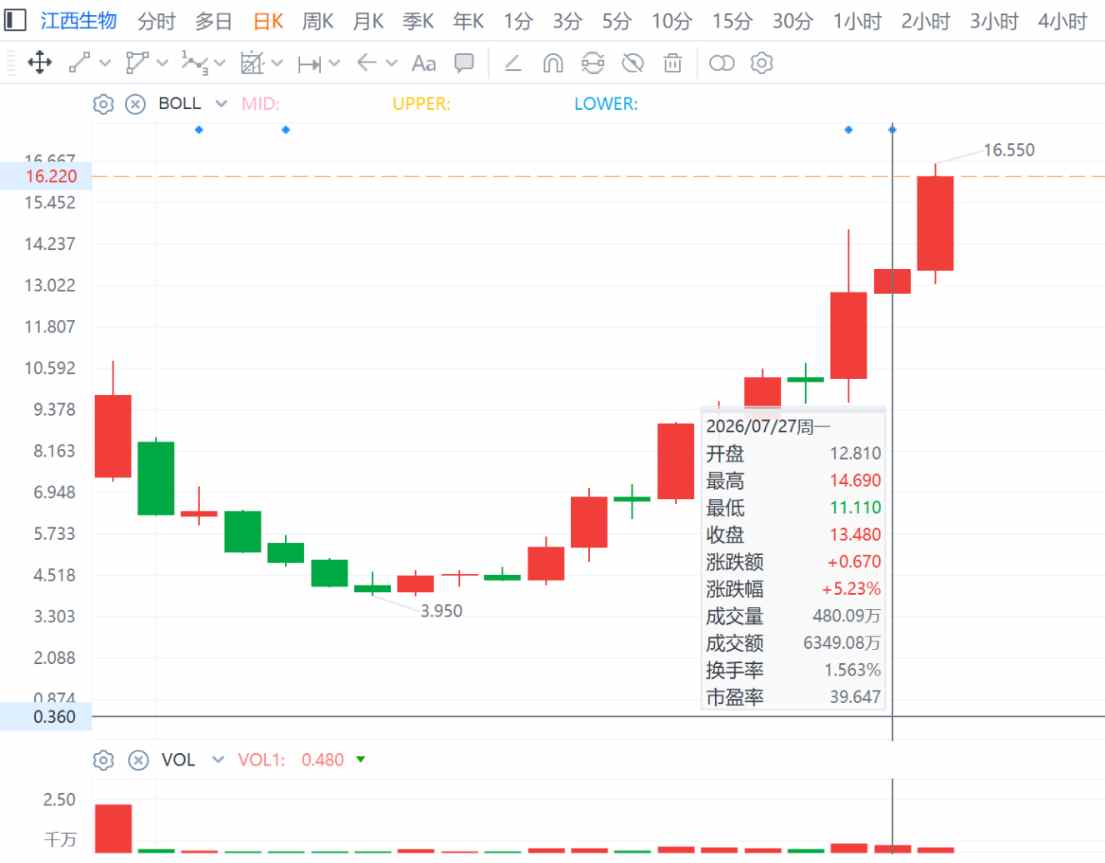
However, after that, Jiangxi Biotech's stock price reversed. On July 10, the company's stock price closed up sharply by 11.41%, and the next day's market saw a low Doji star indicating a reversal in the market; next, Jiangxi Biotech began a round of continuous increase: starting July 15, the company's stock price continued to rise, and the market continued to rise. HK$16.55 in the July 28 intraday market once again hit a new high.
If we calculate the lowest intraday price of HK$3.95 on July 9, the biggest increase in Jiangxi Biotech's stock price within 20 days reached 318.99%.
What is behind a round of explosive “overfall and rebound”
Recently, the market's focus on Jiangxi Biotech has mainly focused on its strong stock price rebound, but a strong rebound is often preceded by a significant overfall. However, the sharp drop in Jiangxi Biotech's stock price began with a dark market before the first listing.
On the day before Jiangxi Biotech was officially listed, there were a total of 4 undercover IPOs. At the end of the new Hong Kong Stock Connect review period, these 4 stocks emerged from extreme market differentiation. Among them, True Health Medical-B was the only “real leader” of the day, strengthening unilaterally throughout the dark market, and Phillip's dark market surged 177.18%; while Sturgeon Technology and Laifu Harmonic, as the steady targets of the second tier, experienced fluctuations and adjustments after the opening of the dark market, but in the end they closed by 38.41% and 7.78% respectively.
Meanwhile, Jiangxi Biotech got out of the roller coaster market in the midst of extreme differences in the field.
As one of the only pharmaceutical stocks on the same day, the market was not always bearish. After falling to the lowest price of about HK$7, the stock price immediately surged, with a large amount of short-term capital; however, differences among funders in the market increased significantly, and the upward retracement performance prompted many winning retail investors to choose to settle in their pockets, which later triggered continuous diving in the market. The biggest drop in the market was more than 30%; however, after falling to the lowest price of about HK$7, Jiangxi Biotech Market showed clear signs of bottoming out at the end of the market, and finally closed down only 3. 48%
This undermarket performance almost set the tone for Jiangxi Biotech's stock price performance on the day of the first listing. This is also one of the important reasons why its stock price broke on the first day and fell for a week. Due to the breaking of the listing on June 30, Jiangxi Biotech directly announced that it had missed the current Hong Kong Stock Connect list, compounding the fears of the previous day's dark market. Jiangxi Biotech's stock price fell all the way to the lowest intraday price of HK$3.95 on July 9.
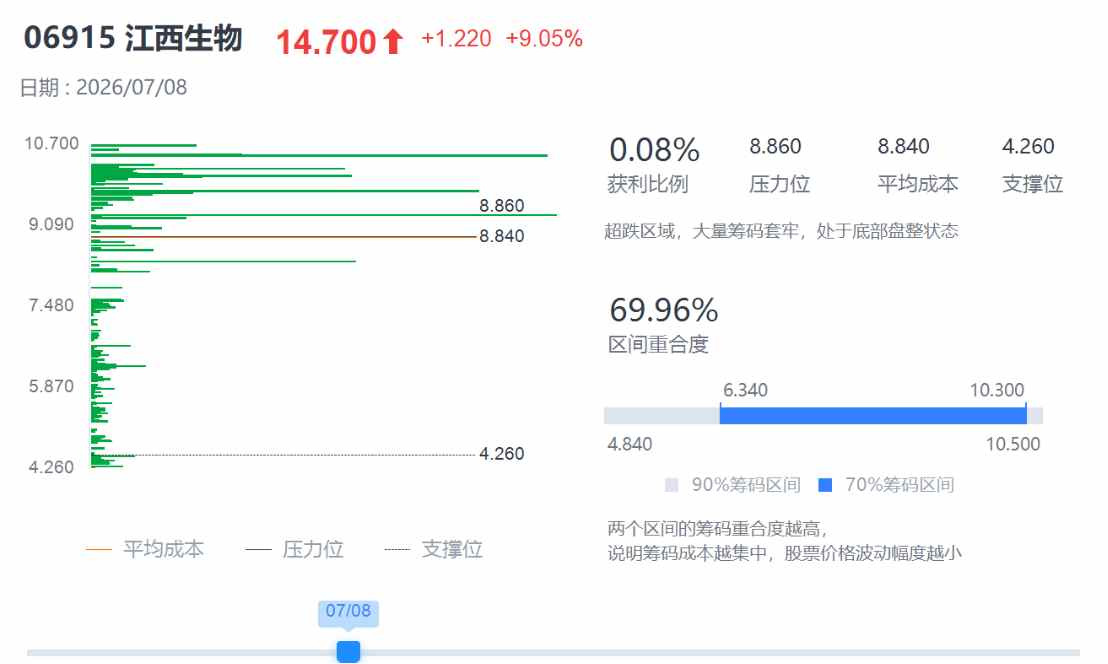
From a technical perspective, Jiangxi Biotech's RSI index had already fallen to a record breaking 1.09, and on-market chip profits were as low as 0.08% on July 8, and its single-day trading volume fell below 1 million shares in a week of decline. This also indicates that the market fundraisers have gone from being extremely divided on the first day of listing to the extreme agreement, and PE performance corresponding to 12.38 times is already lower than the industry average of 21.85 times the performance. The above multiple reasons became an important factor in the subsequent sharp decline in Jiangxi Biotech's stock price and rebound.
What contributed to this round of nearly 320% rebound?
After receiving technical support and market sentiment, Jiangxi Biotech welcomed beta support from the Hong Kong pharmaceutical sector, which also became the core catalytic factor for eventually achieving an explosive rebound in stock prices.
Since June of this year, the US dollar has continued to strengthen. The US dollar index has risen 2.24% monthly. Since May-July, it has broken out of three consecutive monthly highs. Compared to the previous sharp rise and fall, the relatively moderate rise in the US dollar in recent months has not triggered a clear rise in US bond yields or the tightening of global liquidity, and the market's focus is more on improving the global economy and recovering corporate profits.
Under this level of transmission, the capital rotation of Hong Kong stocks also followed the trend from the hot semiconductor/AI sector to the pharmaceutical sector, which has been recovering for a long time.
The Zhitong Finance App learned that since June of this year, a number of public funding institutions, including E-Fangda Fund, Huaxia Fund, Wells Fargo Fund, and Huitianfu Fund, have intensively increased their holdings of Hong Kong stocks and pharmaceutical stocks. After 4 individual pharmaceutical stocks were increased, the shareholding ratio of public equity institutions hit or exceeded the statutory listing line of 5%, and the shareholding ratio of some target public institutions reached about 7%.
Under the influence of the weather vane, there has been a marked rebound in the innovative medicine sector of Hong Kong stocks since late June. According to Wind data, since the launch of the market on June 29, the Hong Kong Stock Innovative Drug Index has increased by more than 20% in the range.
Among them, on July 15, the Hang Seng Biotech Index rose more than 2% in early trading, and its pharmaceutical sector rose 4.79% during the day. The recovery in market sentiment provided clear sector beta support for individual stocks. And this day was the start of the “explosive rebound” in Jiangxi Biotech's stock price.
As mentioned earlier, since the listing on June 30, Jiangxi Biotech's stock price range fell by the biggest drop of 56.70%. The ultimate market consistency provided clear market sentiment support for the company's overfalling stock price. On the same day, the volume ratio reached 1.83, with a turnover of HK$3.38 million, showing clear characteristics of a volume rebound.
Driven by many parties in the market, Jiangxi Biotech's stock price once again reached a new high on July 28. The timesharing chart shows that the company's stock price began to gain strength at 2:30 p.m. on the same day, and the stock price accelerated to a maximum of HK$16.55.
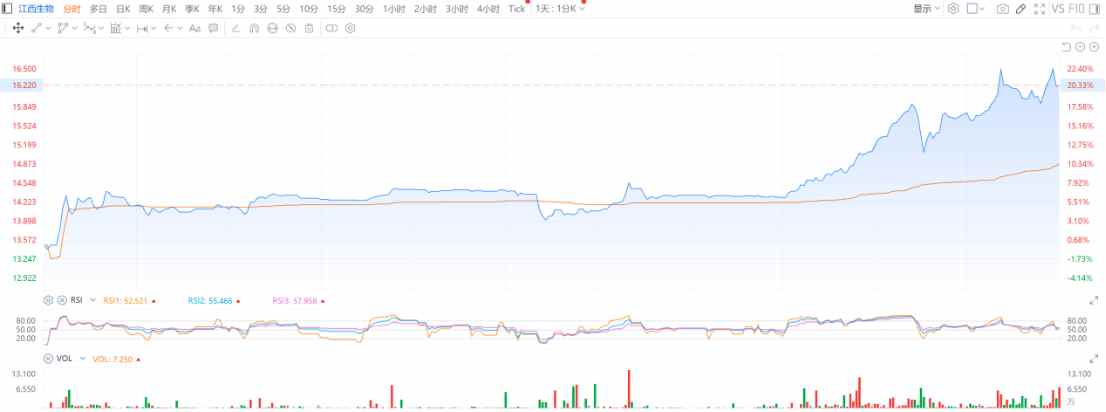
However, it is worth noting that on July 28, Jiangxi Biotech's stock price showed a clear contraction and acceleration. The stock trading volume for the same day was 3.429,900 shares. This is the second consecutive day of decline in trading volume, which is significantly lower than the trading volume performance of 6.015 million shares on July 24.
Looking at the RSI index, after half a month of rising stock prices, Jiangxi Biotech's RSI index has reached 95.07, which has changed from being oversold at the beginning to a significant overbought signal; at the same time, after 2 consecutive weeks of net inflows, Jiangxi Biotech's main capital had a net outflow of HK$3,522 million this week. Behind the oversold signal and the divergence between high volume and price, there is also a signal that many parties within the Jiangxi Biological Farm are about to “run out”.