
- PRICING
- LIVE QUOTES
- LEARN
- HELP


EN
When the digital asset reserve company model went bad, many companies turned to AI to help themselves, and investors still didn't buy it
The Zhitong Finance App learned that as cryptocurrency prices continued to fall, the once highly sought after digital asset reserve company (DAT) model rapidly cooled down, and more and more related companies began to switch to the field of artificial intelligence (AI), hoping to win back the favor of investors. However, judging from current market performance, this transformation has yet to achieve significant results.
K Wave Media's (KWM.US) stock price dropped 71% after announcing a shift from the Bitcoin reserve business to data center development in May of this year. After AlphaTON Capital, which holds alternative cryptocurrency assets, changed its name to Alpha Compute Corp. (ALP.US) in April this year and switched to the AI business, the stock price also fell 33% cumulatively.
According to statistics, in recent months, at least 10 digital asset reserve companies have begun to set up AI-related businesses to cope with the continued downturn in the cryptocurrency market.
Toufic Adlouni, managing partner at Canadian law firm Renno & Co, said that currently the market has strong interest in AI, and more and more companies want to move to a circuit with more potential for growth. He pointed out that the vast majority of digital asset reserve companies are either seeking transformation or are already in trouble with their operations.
Digital asset reserve companies were one of the hottest concepts in the capital market last year. Such companies usually buy digital assets such as Bitcoin by issuing shares or using balance sheet financing. During the cryptocurrency bull market, their stock price increased even more than the crypto assets themselves.
However, with the sharp decline in the cryptocurrency market, the stock prices of many DAT companies have fallen below the net asset value of their holdings, and management has begun to abandon this business model one after another.
At the same time, AI infrastructure construction continues to attract large inflows of capital.
Tech giants such as Alphabet (GOOGL.US) and Microsoft (MSFT.US), as well as AI companies such as OpenAI and Anthropic, continue to expand data center investments, making the data center industry chain one of the strongest performing sectors in US stocks this year.
Almost all of the top ten best-performing individual stocks in the S&P 500 index this year are related to data center construction, including SanDisk (SNDK.US), which rose more than 500%, as well as companies such as Dell Technologies (DELL.US), Intel (INTC.US), and Micron (MU.US).
In contrast, as of July 24, Bitcoin had a cumulative decline of 49% from its high in October last year, with a decline of 27% during the year; Ethereum had a cumulative decline of 38% this year, down 62% from its all-time high in August 2025.
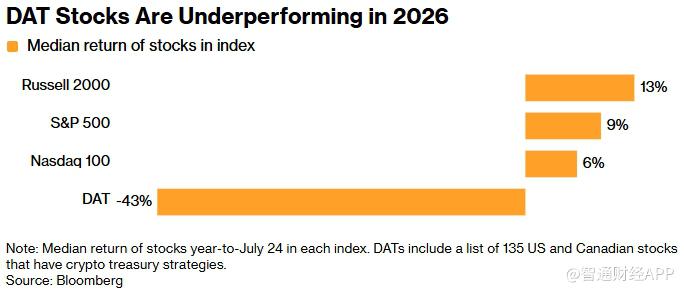
Affected by this, DAT concept stocks as a whole suffered a severe setback. According to media statistics, the median decline in US and Canadian digital asset reserve company stocks has reached 43% since this year.
Gregory Sichenzia, founding partner of Sichenzia Ross Ference Carmel Law Firm, said that digital asset reserve companies had almost no disadvantages last year, but now this business model has rapidly lost its market appeal.
He revealed that his law firm participated in a number of private equity financing projects for DAT companies last year, but since October of last year, it has not received related financing services. Instead, more and more companies are consulting on AI-related industry opportunities such as AI data centers, space exploration, and small nuclear reactors.
The digital asset reserve model was first adopted by Strategy (MSTR.US) Chairman Saylor in 2020. By continuing to buy Bitcoin, the company deeply binds stock prices to cryptocurrency prices. Benefiting from the continuous rise in the price of Bitcoin to a high of about 125,000 US dollars in October 2024, Strategy's stock price has accumulated a cumulative increase of more than 3000% compared to the end of 2019.
However, since then, as the price of Bitcoin declined, Strategy's stock price fell by a cumulative total of about 81%, and the company also began to gradually reduce its Bitcoin holdings.
It's worth noting that not all companies transforming AI are underperforming.
CoreWeave (CRWV.US), which was involved in the Bitcoin mining business, successfully transformed into an AI cloud computing service. Currently, the market value has reached about 40 billion US dollars, and its stock price has increased by about 80% since its listing in March 2025.
In addition, Bitcoin mining companies such as Hut 8 (HUT.US), Iren (IREN.US), and TeraWulf (WULF.US) have regained the attention of some investors by transforming their data centers for AI computing power services, and their stock prices have rebounded.
However, there are also industry insiders who believe that the crypto industry has not completely lost its appeal.
Lowenstein Sandler partner Daniel Forman said that currently investors are still interested in other application fields of blockchain technology, but market enthusiasm for the digital asset reserve business model has clearly cooled down. He said, “Looking at it now, the DAT model we are familiar with may have come to an end.”