
- PRICING
- LIVE QUOTES
- LEARN
- HELP


EN
The second stage of AI has started! Morgan Stanley screens beneficiary stocks, and traditional industries such as Halliburton and Bank of America welcome AI profit dividends
The Zhitong Finance App learned that as the second-quarter earnings season for US stocks enters its busiest week, the latest research report by Michael Wilson (Michael Wilson), chief US stock strategist at Morgan Stanley, points out that US companies actively integrating artificial intelligence (AI) technology capabilities are ushering in substantial improvements in profitability, and AI applications have clearly moved from a “testing phase” to a “quantifiable corporate value creation stage.”
Wilson's team said that for companies with AI as the core investment logic and pricing capabilities at a neutral to strong level, the market's expectations for profit margins “have improved most clearly.” He expects that by 2027, the widespread adoption of AI will bring about a net profit margin expansion of about 100 basis points for related companies.
“The prospects for businesses that embrace AI are becoming increasingly attractive,” Wilson wrote in the report. In particular, he pointed out that industries that are generally regarded as “weak”, such as transportation, software and services, and professional services, have shown high appeal among AI users.
Which stocks are the main beneficiaries of AI adoption?
According to Morgan Stanley's analysis, companies such as Halliburton (HAL.US), Bank of America (BAC.US), Cervis Health (CVS.US), and New Era Energy (NEE.US) are expected to be the main beneficiaries of adopting AI. Meanwhile, tech giants such as Alphabet (GOOGL.US), Meta Platforms (META.US), and NVDA.US (NVDA.US), which led the rise in the first round of the AI market, still performed prominently in Wilson's latest screening.
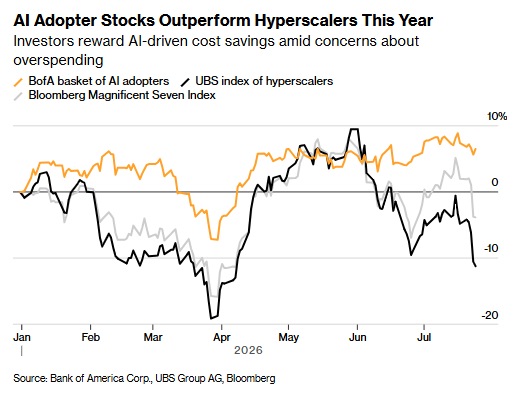
In fact, a basket of AI adopter stocks compiled by Bank of America has surpassed the performance of so-called “hyperscalers” (hyperscalers) this year. Meanwhile, semiconductor-related stocks, which had previously had strong gains, recently showed a correction due to concerns about overvaluation.
Wilson believes this trend is likely to continue because “AI applications are clearly shifting from the experimental stage to the stage of quantifiable enterprise value creation.”
Quarterly earnings data confirm that AI dividends are being realized
Wilson's optimistic judgment was supported by the latest financial data. Morgan Stanley's analysis of more than 17,000 corporate earnings conference calls and conference presentations found that so far this earnings season, about 40% of AI users have mentioned at least one quantifiable AI benefit, almost double that of 21% a year ago. Among the broader S&P 500 constituents, about a quarter of companies discussed quantifiable AI benefits, which rose significantly to 25% from 14% a year ago.
In terms of benefit categories, financial benefits — including increased revenue, lower operating costs, and increased capital efficiency — accounted for the largest share of AI-related reviews, followed by productivity gains. Tech companies are still the most passionate group to talk about quantifiable AI benefits (51%), followed by communications service companies (44%) and financial companies (37%), reflecting the spread of AI adoption from traditional technology to a wider range of industries.
Wilson also pointed out that in the past year, companies reported an average net increase of nearly 10% in productivity, mainly driven by software development, customer service, finance, and operations. “We still see AI adoption as an important source for driving profit growth and increasing operating leverage,” Wilson said.
AI spending controversy: a tug-of-war between trillions of dollars invested and profit cashing
Despite the positive profit prospects of AI adopters, market concerns about the huge capital expenditure on AI have not dissipated, and investors have become more cautious in screening potential winners.
The Bank for International Settlements (BIS) previously warned in its latest annual economic report that the world's five largest cloud service providers expect the cumulative AI-related capital expenditure to exceed 1 trillion US dollars between 2025 and 2026. This scale has clearly exceeded the growth rate of corporate profits and free cash flow, and some companies have begun to rely on debt financing. BIS specifically warns that concentrated investment driven by competition for market dominance is highly similar in model to historical canal fanaticism, railway speculation, and internet bubbles.
Goldman Sachs strategists have also warned that investors' expectations for AI transactions may be ahead of reality, and “the tension between favorable fundamentals and high valuations continues to increase.” Goldman Sachs expects S&P 500's profit to grow at a year-on-year rate of about 22% in the second quarter, with the AI infrastructure sector contributing nearly two-thirds of the increase.
According to compiled data, the current market's expectations for the net profit margin of S&P 500 constituent stocks are at their highest level in more than 10 years, so the focus of the second quarter earnings season is also clearly focused on profitability.
This week, companies that account for about one-third of the total market value of the S&P 500 index are expected to release results, making it the busiest week of this earnings season. Tech giants such as Apple (AAPL.US), Microsoft (MSFT.US), Amazon (AMZN.US), and Meta will release financial reports one after another, and investors will focus on whether these companies' huge investment in AI can be reflected in profits.