
- PRICING
- LIVE QUOTES
- LEARN
- HELP


EN
Seven consecutive Bitcoin ETF inflows have come to an end! The shadow of interest rate hikes overshadowed favorable regulations, and the “digital gold” narrative was once again questioned by the market
The Zhitong Finance App learned that in the latter half of last week, Bitcoin exchange-traded funds (that is, Bitcoin ETF products) that are publicly traded on the US stock market experienced large-scale capital outflows, highlighting the extreme fragility of this cryptocurrency's recent price recovery trajectory. Bitcoin is currently reporting around $65,600, down about 48% from its all-time high of about $126,300 in October 2025. This round of Bitcoin's decline is probably the “most dangerous and deepest” in Bitcoin trading history, that is, probably the most hidden and difficult type of bear market to clear quickly. This weak trajectory, which is not driven by a single black swan, means there is no clear “bad news run out” point. Selling pressure comes from the combination of ETF redemptions, actual interest rates, technology asset deleveraging, regulatory delays, and long-term cash flow constraints from treasury companies such as Strategy.
The latest market statistics show that on July 23 and July 24, the total outflow of funds from spot market ETFs tracking Bitcoin assets exceeded US$465 million, ending the net capital inflow trend of Bitcoin ETFs for seven consecutive trading days. Market concerns that the Federal Reserve may return to interest rate hikes have overshadowed the recent positive upward momentum surrounding the CLARITY Act (the “Digital Asset Market Clarity Act”). The bill is the long-awaited cryptocurrency market structure legislation for the US cryptocurrency market.
In recent days, the situation in the Middle East has been constantly changing, which has also increased Bitcoin's volatility. In early Asian trading on Monday, the earliest cryptocurrency rose again above $65,000, picking up along with other risk assets, and at one point rose by about 2%. Cryptocurrency such as Bitcoin generally rose slightly on Monday, mainly due to the fact that the US and Iran previously extended arrangements to suspend mutual retaliatory attacks, easing concerns that regional energy supply may be severely disrupted after the recent escalation of the geopolitical conflict in the Middle East.
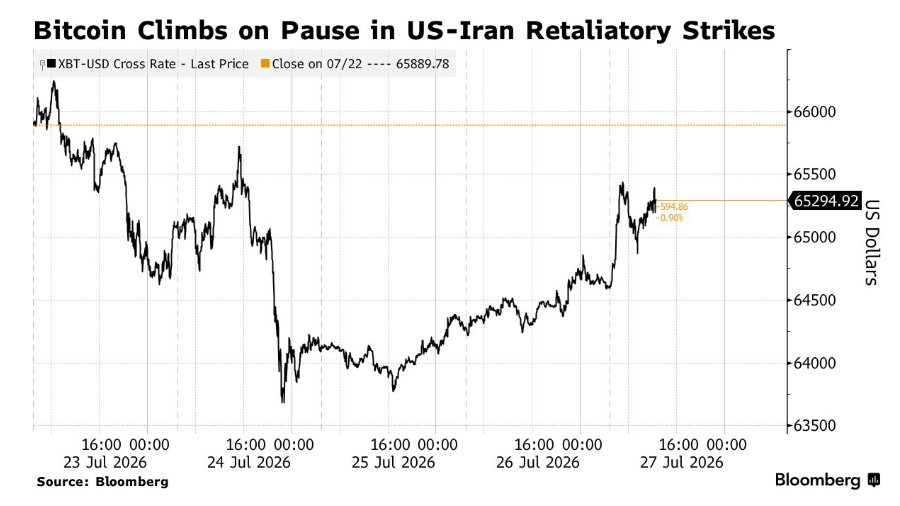
As shown in the chart above, the US and Iran suspended retaliatory attacks, and Bitcoin rose slightly in response.
Ivan Lim, a senior derivatives trader from FalconX, said: “We expect macro-driven uncertainty to continue this week, but our outlook for Bitcoin remains structurally bullish. The recent outflow of Bitcoin ETF funds and weak market sentiment is mainly a negative reaction to the waiting period for the “CLARITY Act” legislation and the rapid escalation of expectations of the Federal Reserve's interest rate hike.”
The US banking industry strongly opposes any move that allows stablecoins to pay interest. Democratic lawmakers, on the other hand, are generally reluctant to approve legislation that could stimulate demand for cryptocurrencies and could further benefit Trump and other officials who hold large amounts of crypto assets.
The Code of Ethics provision remains one of the main points of disagreement surrounding the CLARITY Act. US lawmakers are trying to get enough Democratic votes before the August recess. Democrats are generally calling for stricter regulatory language to prevent US President Donald Trump from profiting from the cryptocurrency industry dominated by his administration. According to recent market disclosure data, he received a surprise profit of 1.4 billion US dollars from the cryptocurrency business last year, which further intensified the bipartisan dispute in Congress.
The Clarity Act (Clarity Act) divides formal supervision of cryptocurrency assets between the US Commodity Futures Trading Commission and the US Securities and Exchange Commission based on whether a token is recognized as a commodity or a specific securities asset. The bill was originally planned to build on last year's GENIUS Act. The latter first established regulatory rules for the issuance and use of stablecoins — a type of cryptocurrency that maintains the stable value of fiat money. The Clarity Act targets other cryptocurrencies in the broad sense of the word, and will eventually clarify the regulatory jurisdiction for tokens such as Bitcoin.
Despite a surge in divestment in the last two trading days, the Bitcoin ETF product line traded on the US stock market recorded $33.8 million in capital inflows throughout the week. This was the third consecutive week of net inflows; previously, for eight consecutive weeks, investors had withdrawn a total of 8.3 billion US dollars from these ETF funds traded in US stocks on a large scale.
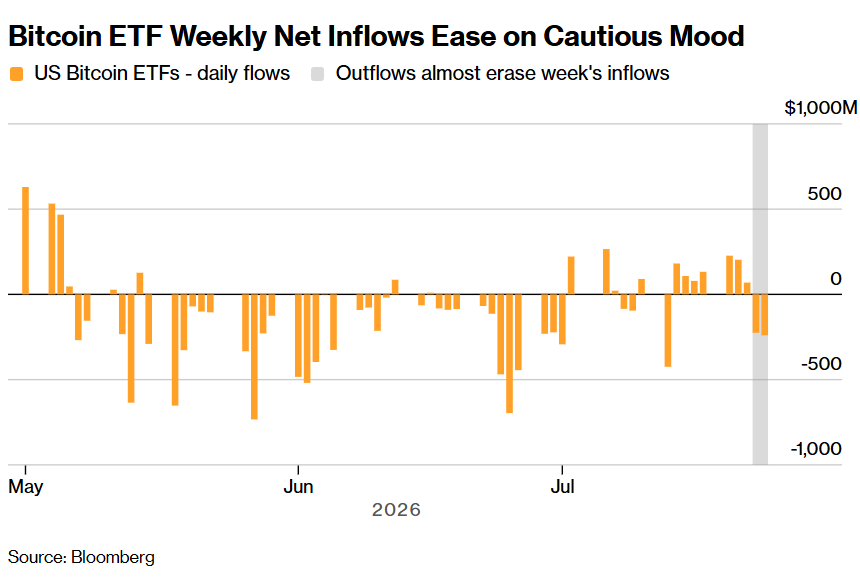
As shown in the chart above, market caution is heating up, and the weekly net inflow of Bitcoin ETFs in the US stock market has slowed significantly.
Funds were withdrawn from a Bitcoin ETF issued by BlackRock in the latter half of last week — the code is led by IBIT's Bitcoin ETF. This indicates that although Wall Street institutional investors have begun to selectively return after a long period of redemptions in cryptocurrencies such as Bitcoin, overall bullish confidence is still insufficient. The latest data shows that once market sentiment worsens, investors will quickly settle profits or significantly reduce their risk exposure.
BTC Markets analyst Rachael Lucas said: “The next few trading days will be critical. If the flow of capital clearly stabilizes, it means that this is only a temporary pause in sentiment driven by geopolitical events; if there is a large-scale outflow of capital for the second week in a row, the situation will be much more serious.”
As expectations of interest rate hikes heat up, ETFs are cut off, technology stocks stall, and Strategy plans to open the doors to sell coins: Bitcoin returns from “digital gold” to the global liquidity pressure gauge
From July 23 to 24, the total outflow of US spot Bitcoin ETFs exceeded 465 million US dollars, ending seven consecutive trading days of inflows; although there was still a slight net inflow of US$33.8 million throughout the week, after the cumulative outflow of 8.3 billion US dollars for the previous eight consecutive weeks, this shows that institutional capital was only a tactical recovery, not a stable strategic increase. The Middle East conflict has boosted oil prices and inflationary risks, and has also forced the market to adjust the probability that the Fed will raise interest rates.
At the macro level, the key to this round of adjustments is not the bankruptcy of an exchange, but rather the further integration of Bitcoin into the asset allocation framework of traditional finance. The Middle East conflict has boosted the risk of oil prices and inflation, prompting the market to reevaluate the possibility of the Fed raising interest rates and “higher and longer”; as an asset that does not generate interest or operating cash flow, Bitcoin's opportunity cost rises as real returns rise. For Bitcoin, which itself does not generate cash flow or interest, the strengthening of the US dollar, rising treasury yields, and rising financing costs will simultaneously reduce spot valuations, base difference arbitrage returns, and leveraged long-term carrying capacity. The suspension of retaliatory attacks by the US and Iran could push Bitcoin back to $65,000 for a short time, but it is closer to a return in the geographical risk premium rather than a trend return of capital.
Weakness in technology stocks is transmitted to the crypto market through risk budgets, collateral values, and quantitative model factors, rather than directly altering the fundamentals of the Bitcoin network. At a time when the return on AI capital expenditure is being questioned and semiconductor momentum trading is being rapidly deleveraged, the NASDAQ and Philadelphia Semiconductor Index are under pressure; on July 24, the NASDAQ fell 0.64%, and the Philadelphia Semiconductor Index fell 4.5% in a single day.
Since spot ETFs have deeply embedded Bitcoin into traditional brokerage accounts, macro funds, and multi-asset portfolios, Bitcoin is becoming more and more like a high-beta technology asset: when institutions cut AI, chip, and growth stock positions, they also often simultaneously reduce crypto exposure, redeem ETFs, or close perpetual contracts. It is worth noting that Bitcoin once performed better than chip stocks in July, indicating that the two did not mechanically rise and fall at the same time; however, their common driving force was risk appetite and liquidity, rather than Bitcoin having recovered its “safe-haven asset” attributes independent of the stock market.
The most significant impact on the cryptocurrency industry at the micro level comes from Strategy's shift from a “permanent buyer” to a potential marginal seller. The company has sold approximately $218 million worth of bitcoin in 2026, of which it sold 3,588 units at one time, cashed out approximately $216 million to pay dividends on preferred shares and replenish dollar reserves, and authorized future sales of up to $1.25 billion in bitcoin. Compared to the 840,000 bitcoins it still holds, the actual sell-off scale is not enough to determine market supply and demand alone, but its narrative impact far exceeds the quantitative impact: it breaks the market's belief that Strategy only buys or doesn't sell, and reveals the negative feedback mechanism of the digital asset treasury model — falling currency prices reduce net asset value premiums and equity financing capabilities, and the decline in financing capacity also forces companies to use Bitcoin to pay fixed dividends and debt costs, thus transforming the original structured buying into potential supply in a stressful environment.
Is the current round of Bitcoin's sharp decline more dangerous than the “cold winter of 2022”?
Bitcoin's current weakness is not due to the fundamental destruction of blockchain security, computing power, or agreement value; rather, macro-austerity expectations, technology asset deleveraging, and insufficient confidence in ETF funds resonate with pressure on treasury companies' financing models. All of this means that this round of Bitcoin's decline is probably the “most dangerous and deepest” in the history of Bitcoin transactions, that is, it is likely the most hidden and difficult type of bear market to clear out quickly.
If the “CLARITY Act” progresses, it can improve long-term institutional premiums, but it will be difficult to offset the suppression of oil prices, interest rates, and capital flows in the short term. A truly lasting reversal signal should be the ETF's return to net inflows for several weeks, interest rate hike expectations and real interest rates peaking, technology stock risk budgets stabilizing, and large treasury companies such as Strategy returning to net buyers; before these conditions are formed, Bitcoin is more likely to recover liquidity within a high fluctuation range, rather than confirmation of a new round of unilateral bull markets.
Judging from the extent of the decline and systemic explosion, this round cannot yet be called the most dangerous in history: Bitcoin has experienced four times of retracement of more than 50% since 2014, the three biggest declines averaging close to 80%, and 2022 was also accompanied by the bankruptcy and chain liquidity crisis of institutions such as Terra, Three Arrows Capital, and FTX. There are currently no credit chain breakdowns of the same magnitude, and there is no evidence that the Bitcoin protocol itself has been disrupted. However, judging from the duration, narrative damage, and demand structure, this round of decline is likely to be more difficult.
Overall, there is no single black swan in Bitcoin's weak trajectory, which means there is no clear “bad news out” point. Selling pressure comes from the long-term combination of ETF redemptions, actual interest rates, technology asset deleveraging, regulatory delays, and treasury companies' cash flow constraints. The real reversal signal is not that it has broken through 65,000 or $70,000 once, but rather that ETFs have continuously recovered significant net inflows, Strategy has re-emerged as a net buyer, technology stock risk budgets stabilized, and regulatory legislation changed from expectations to enforceable rules; before that, this was more like a bear market with a slow decline in demand. The danger was not necessarily a single-day sharp decline, but a continuous decline in holders' beliefs.