
- PRICING
- LIVE QUOTES
- LEARN
- HELP


EN
Cui Dongshu: The automobile industry's profit margin of 3.8% in January-June is still low compared to the average profit margin of 6.5% for downstream industrial companies
The Zhitong Finance App learned that from January to June 2026, Cui Dongshu, Secretary General of the China Transport Association, published an article stating that from January to June 2026, in the face of multiple challenges such as the complex evolution of the international environment and domestic transformation pressure, the national economy started well, quality and efficiency improved, profits in the equipment and high-tech manufacturing industries grew rapidly, and profits in the raw materials manufacturing industry grew by double digits, laying a solid foundation for the smooth operation of the economy throughout the year. From January to June 2026, automobile production was 15.1 million units, a year-on-year decrease of 4%. The automobile industry's revenue from January to June 2026 was 5189.3 billion yuan, up 1.8% year on year; costs were 4610 billion yuan, up 2.8%; profit was 195.4 billion yuan, down 20% year on year; the profit margin of the automobile industry was 3.8%, compared with the average profit margin of 6.5% of downstream industrial enterprises, the automobile industry is still low.
The industry's sales margin of 3.8% from January to June 2026 and 5.2% in June was better than the monthly performance of 3.7% in March-April. Profit margins were generally high in June of previous years, and were at an abnormally high level in June of this year. Recently, with the increase in the production scale of the car market, PPI, profits in the upstream nonferrous and petroleum mining industries have skyrocketed. The price of lithium titanate was nearly 200,000 yuan, the unit price of lithium battery export tons fell 12% from January to June '26 (down 26% in 24 years and 21% in 25 years). Domestic battery prices are strong. Listed lithium battery companies have a payable period of 200 days and a payable period of 60 days. The problem of car companies' profits continue to decline.
In 2026, all regions will vigorously promote the implementation of the “two new” policies to gradually and effectively release the vitality of domestic demand. However, the improvement in efficiency in the automobile industry clearly lags behind other consumer goods. As the country's anti-domestic countervailing efforts continue to advance, the automobile industry is being severely squeezed upstream. The price problem is serious. Oil prices have skyrocketed, profits from non-ferrous metals and semiconductors have skyrocketed, end users have a serious wait-and-see mentality when buying cars, the operating pressure on car companies continues to increase, and high-quality development has been greatly impacted upstream.
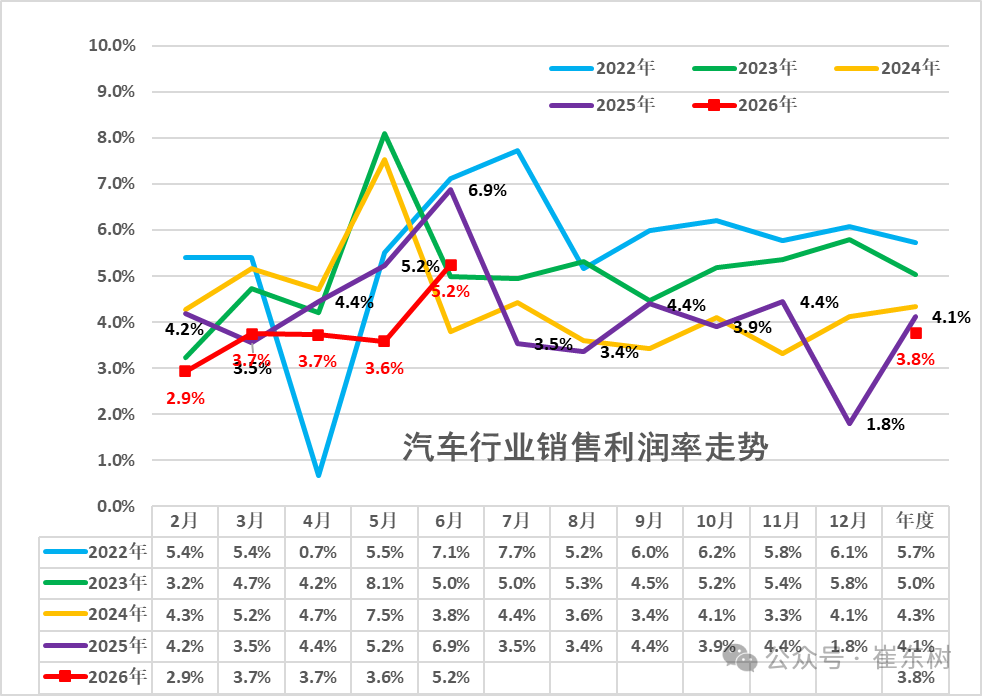
Judging from sales margin trends over the years, the profit performance of the automobile industry has weakened in 2024. The sales margin was only 4.3%, a sharp drop from the historical normal level; in 2025, the industry's sales margin fell to 4.1%. The industry's sales margin fell further to 3.8% from January to June 2026, and 5.2% in June, better than the 3.7% performance in March-April. June of previous years was generally a time when profit margins were high. In June of this year, the sprint for high-end cars was extremely intense, export demand surged, and the profit-driving effect was prominent.
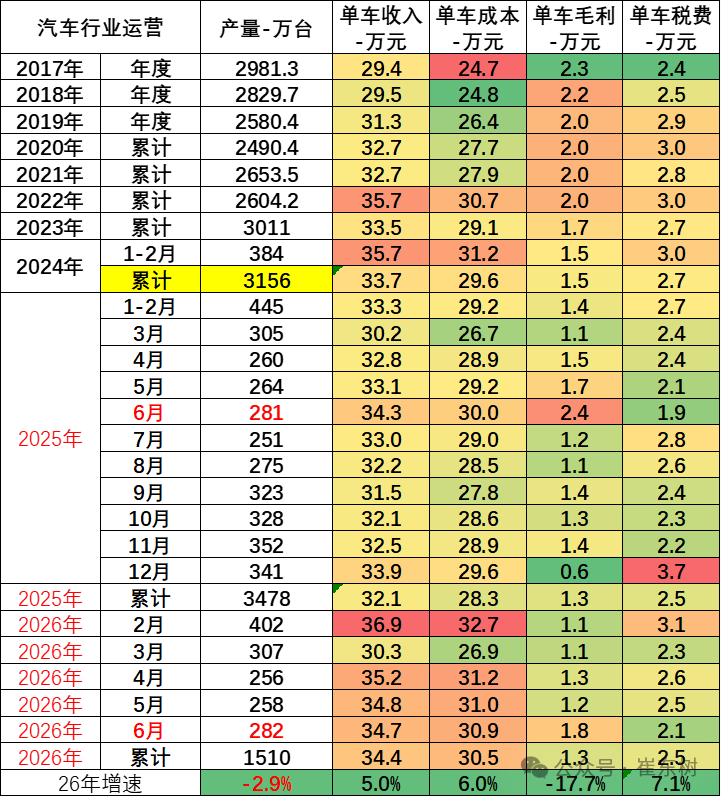
Since production and sales in the automobile industry are basically the same, the statistical caliber is consistent, and there is not much gap between production and sales, we use the output of the National Bureau of Statistics to estimate the Bureau of Statistics's bicycle economic indicators.
From January to June, overall industrial enterprise unit costs were under high pressure to increase. The price of lithium carbonate has doubled, commodity prices are running high, and the pressure on raw material costs in the middle and downstream industries has increased. From January to June, the overall bicycle revenue of the automobile industry chain increased by 5% to 344,000 yuan (with repeated calculation of the industry chain), bicycle costs increased by 305,000 yuan by 6%, bicycle taxes by 25,000 yuan increased by 7.1%, and gross bicycle profit of the industry chain of 13,000 yuan decreased by 17.7%.
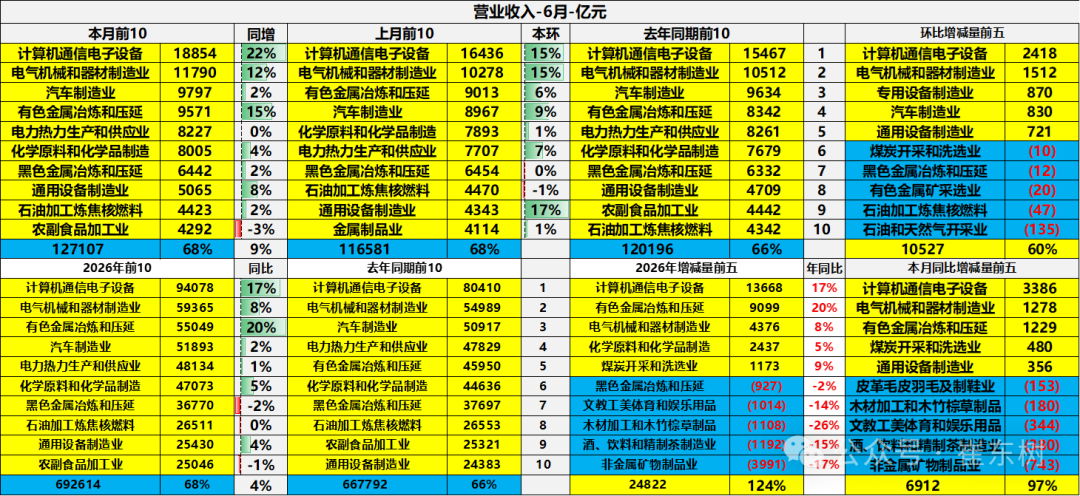
The top ten industries with industrial revenue above the June scale totaled 12.71 trillion yuan. The electronics manufacturing, electrical machinery, and automobile manufacturing industries steadily ranked in the top three of the month. The electronics industry's monthly revenue of 188.54 billion yuan surged 22% year on year, becoming the main driving force; the automobile manufacturing industry's revenue for the month was 979.7 billion yuan, an increase of only 2% year on year, and the growth rate was relatively flat. The month-on-month dimension of electronics, electricity, and special equipment led the increase, while industries such as coal, ferrous metal smelting, and oil and gas extraction experienced a month-on-month decline in revenue, and the short-term prosperity of the industry was clearly divided.
The cumulative revenue of the top ten industries in the first six months of 2026 was 69.26 trillion yuan. Nonferrous smelting performed well with a cumulative year-on-year growth rate of 20%, and the automobile manufacturing industry had a cumulative growth rate of only 2%. The highest growth throughout the year was concentrated in high-tech manufacturing and basic raw materials, and the cumulative revenue growth of industries such as ferrous metal smelting, recreational products, and non-metallic mineral products was negative year-on-year. Overall, the high-end equipment and electronic information industries continue to grow rapidly, the recovery of traditional heavy industries is weak, and the characteristics of the conversion between old and new kinetic energy are outstanding.
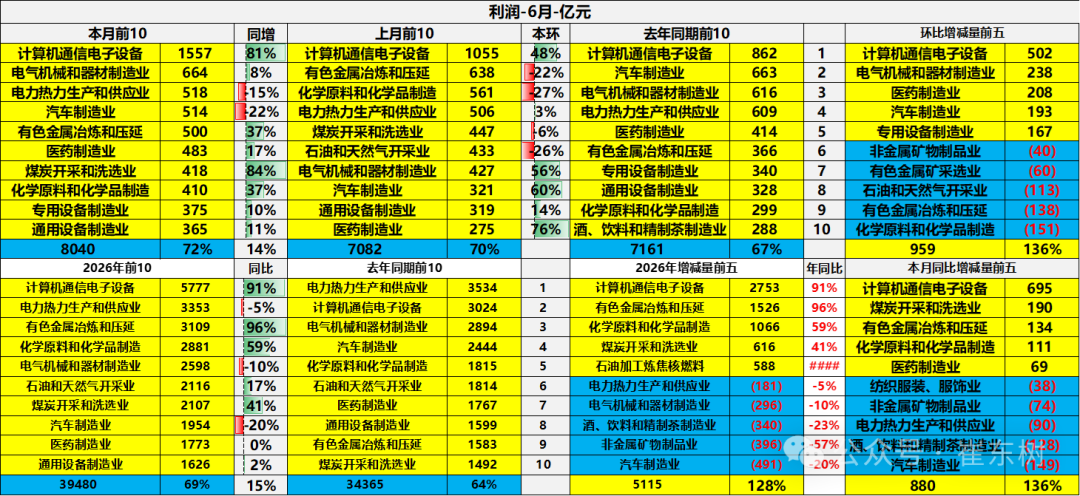
The total profit of the top ten profitable industries above scale in June was 804 billion yuan. Computer communication and electronic equipment became the core driving force for the month's profit with an ultra-high year-on-year growth rate of 81%. Profits from coal mining and non-ferrous metal smelting also rose sharply year on year; automobile manufacturing and electric thermal profits fell 22% and 15% year on year, respectively, putting pressure on profits. Looking at the month-on-month increase in electronics and electrical machinery profits, chemical and non-ferrous smelting profits contracted month-on-month, and the profit boom of the industry diverged markedly in the short term.
The cumulative profit of the top ten profitable industries in the first half of 2026 was 3948 billion yuan. Computer communication electronic equipment and non-ferrous metal smelting increased by 91% and 96% year-on-year respectively, supporting profit growth in the first half of the year. Automobile manufacturing profits fell 20% year-on-year, and profits from electrical machinery and electricity and thermal power weakened simultaneously. The overall pattern showed a pattern of strong recovery in high-tech industries and the differentiation of old and new kinetic energy between traditional equipment and weak profits in the automobile industry.
II. Specific analysis
1. Revenue and profit structure of various economies
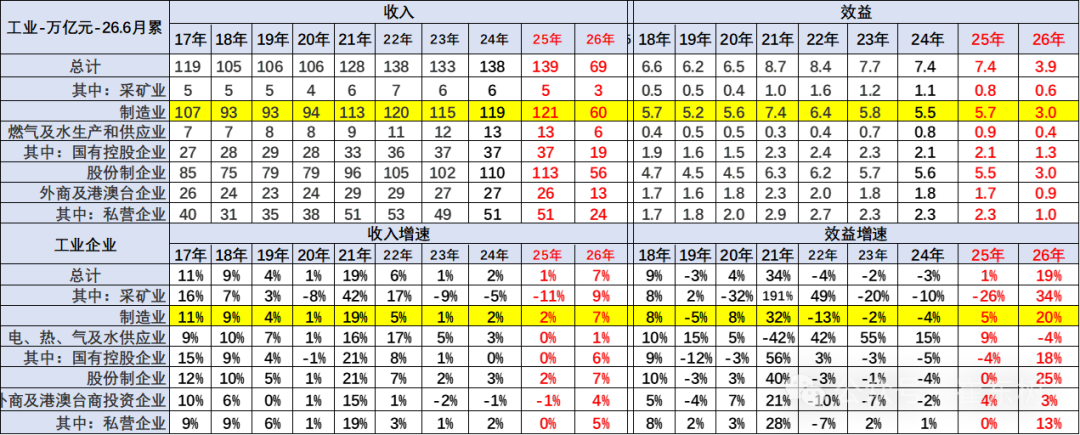
On the profit and efficiency side, the overall efficiency of the industry fluctuated between 6.2-8.7 trillion yuan from 2018 to 2025, and fell back to 3.9 trillion yuan in the first half of 2026, but the efficiency growth rate rebounded sharply to 19%. Among them, the efficiency growth rate of the manufacturing industry reached 20%, becoming the core of profit repair. By sector, the efficiency growth rate of the mining industry was as high as 34%, and the electricity, heat, and water supply industry turned slightly negative; in terms of ownership, the profit growth rate of joint-stock enterprises led by 25%, while profits of state-owned enterprises and private enterprises picked up at the same time. The growth rate of foreign-invested enterprises was only 3%, and the profit recovery efforts of different entities were clearly divided.
Revenue growth in the overall industrial sector has been steady this year, and profit performance has also been relatively divided. Among them, the revenue and profits of state-owned enterprises have fluctuated greatly in recent years. Upstream profits are squeezing downstream, mining companies are performing well, and profit growth is very strong.
Note: Interpretation of basic data
The growth rate of indicators such as total profit and operating income of industrial enterprises above scale is calculated on a comparable scale. There are incomparable factors between the data for the reporting period and the same indicator data released last year, and the growth rate cannot be directly compared. The main reason for this is: (1) According to the statistical system, the survey scope of industrial enterprises above scale is adjusted regularly every year. Every year, some enterprises meet the scale standard and are included in the scope of the investigation, others withdraw from the scope of the investigation due to a decrease in scale, and there are also changes such as new enterprises that have been put into operation, bankruptcy, and sales (suspension) sales enterprises. (2) Statistical law enforcement has been strengthened, enterprises found during statistical enforcement inspections that do not meet the requirements of industrial statistics above scale have been cleaned up, and the relevant base figures have been revised in accordance with regulations. (3) Strengthen data quality management and eliminate repeated statistics across regions and industries. According to the latest survey of enterprise organization structures carried out by the National Bureau of Statistics, starting in the fourth quarter of 2017, the repeated calculation of enterprise groups (companies) across regions and industries was examined. (4) After the implementation of the “business to increase” policy, service enterprises switched to value-added tax and the tax rate was lower. Industrial enterprises gradually divested internal non-industrial production and operation activities and switched to the service industry, which reduced the financial data of industrial enterprises. (5) According to the results of the comprehensive survey of the units in the fourth national economic survey, the survey units of industrial enterprises above the scale were verified and adjusted.
2. Changes in revenue and profit structure
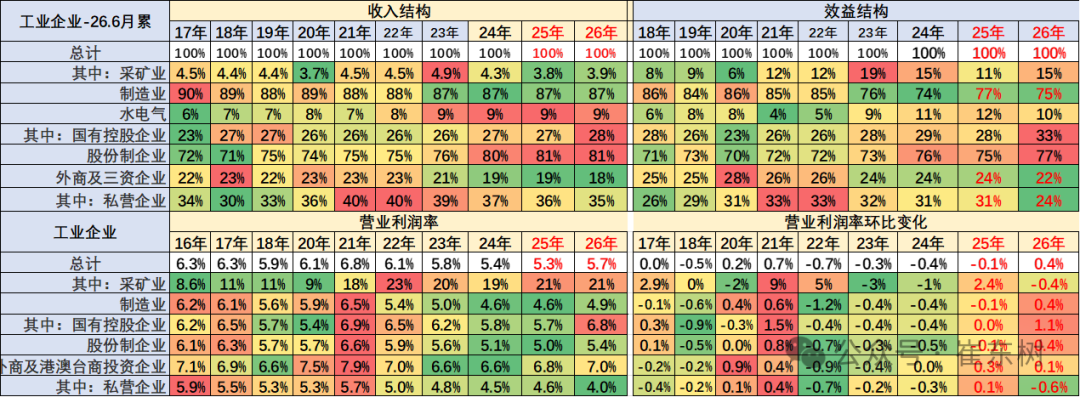
Looking at the current performance of state-owned enterprises, the share of revenue and profit continues to grow. The share of profit has reached 33%, an increase of 5 points; the profit share of private enterprises has reached 24%, down 7 points, and the profit margin on sales is lower at the level of 4%. The decline in profits of private enterprises is quite obvious compared to last year.
K-type differentiation of profit margin indicators for operating income is mainly due to the high index values of the mining industry and state-owned enterprises such as coal, hydropower, etc. The profit margin of private enterprises is very poor. The profit margin of the manufacturing industry accounts for 75%. Excluding semiconductors, there has been a marked decline recently.
III. Specific industry analysis
1. Profit differentiation in the mining industry
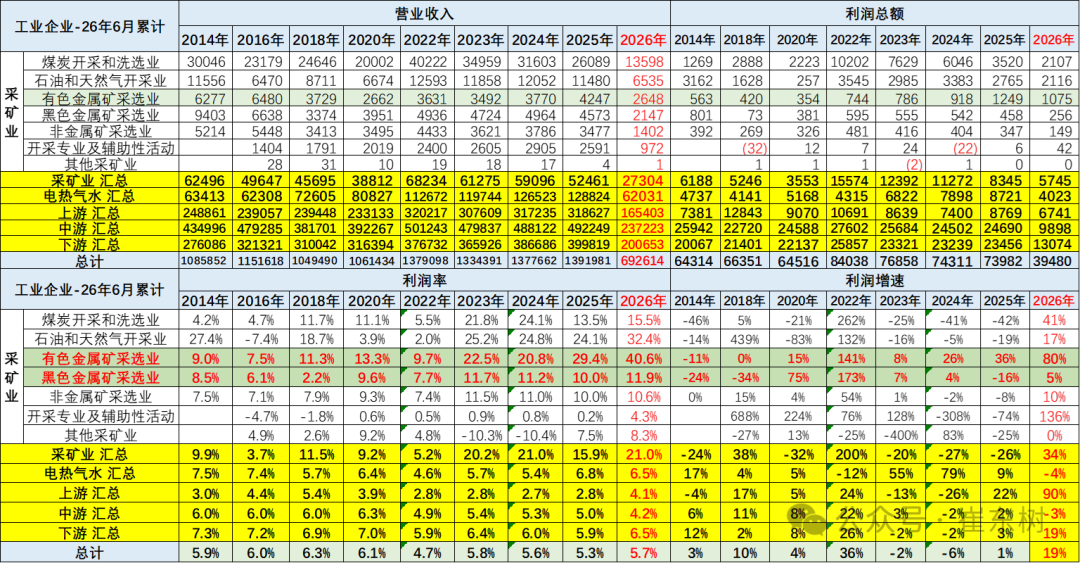
With a high base and rising prices from January to June 2026, mining profits increased by 34%, and there are still very good profits. The profit margin of the mining industry in January-June was also very good at 21%.
From January to June 2026, the profit of the non-ferrous industry surged to 40.6%, and the profit margin of the petroleum industry to 32.4%. The recent increase in profit margins in the petroleum industry is astonishing. Overall mining industry profits remain high. The impact on the downstream is huge.
3. The profit of the water and electricity industry remains high
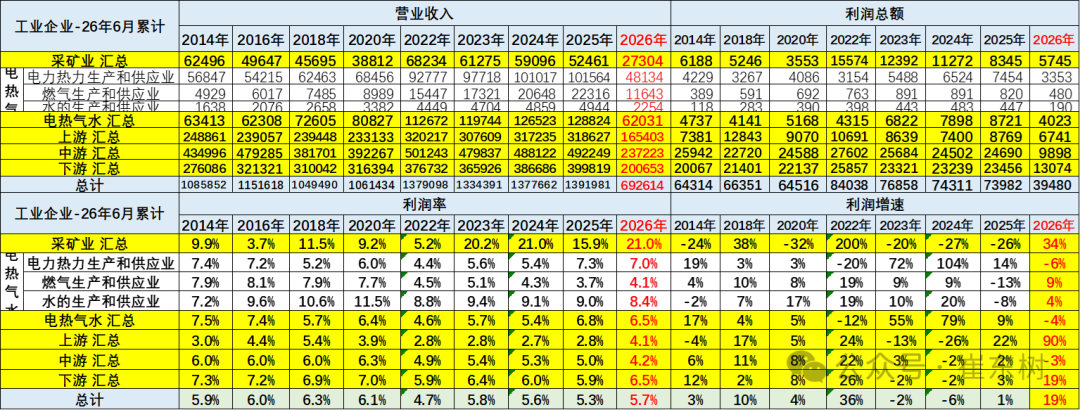
Electric heating and water is a highly profitable service industry, with a profit margin of 5.7% in 2026. The profit decline of 6% in the power industry is at an all-time high, the profit of the water treatment industry increased 4%, the profit of the gas industry increased 9% in 2026, and the profit of the electricity industry fell 6% in 2025.
3. Upstream profit improvement
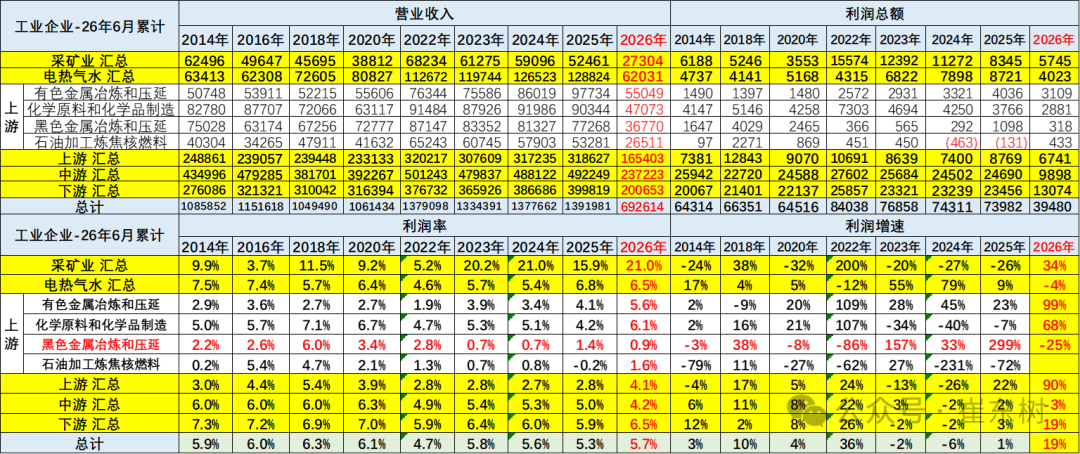
In 2026, the upstream industry experienced high sales revenue and profit growth. In particular, profit margins rebounded to 4.1%. Among them, sales margins, represented by non-ferrous metals, etc., have gradually reached a high level. Steel is still poor from huge losses at the beginning of last year to this year. The profits of industries such as chemical raw materials and non-ferrous metal smelting are quite good.
4. The midstream profit performance is relatively good
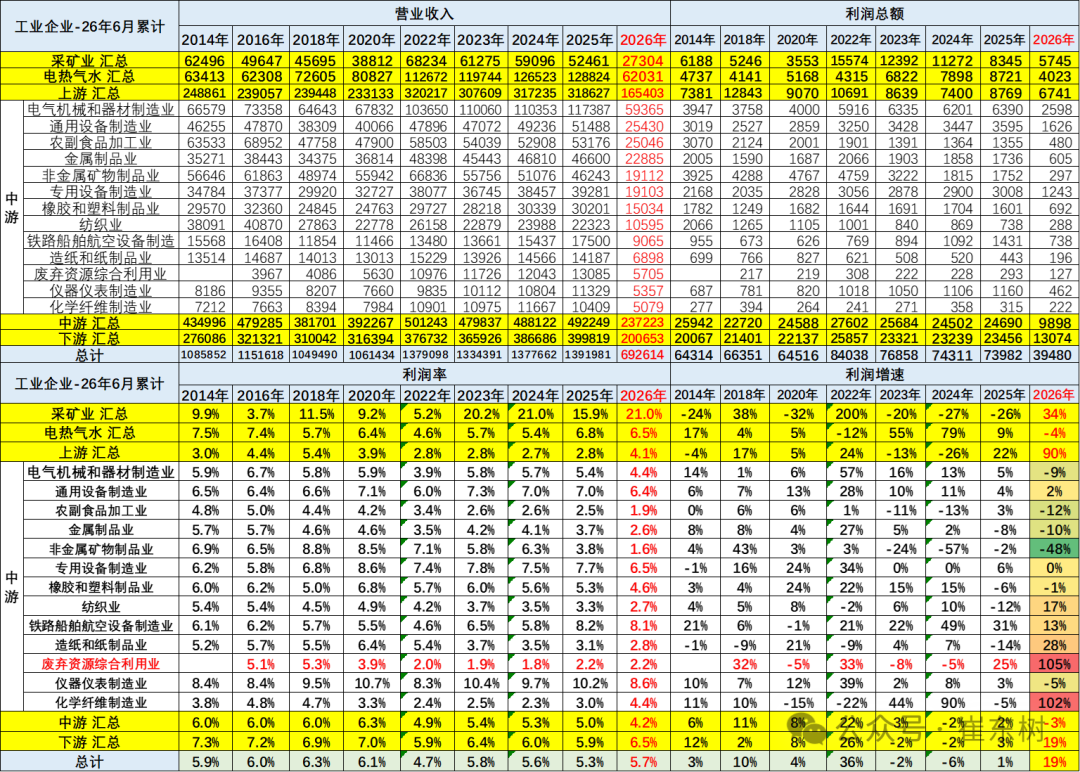
Sales revenue and profit growth in the midstream industry was good from January to June 2026. The sales margin of the midstream industry fell from 6% in 2018 to 4.2% in 2026, and has stabilized recently. Sales margins in major midstream industries have also declined in 2026, and benefits such as shipbuilding and railways are good. Scrap and renewal subsidies have led to a significant increase in profits in the use of waste materials and the non-metallic mineral products industry.
5. Gradual improvement of downstream profits
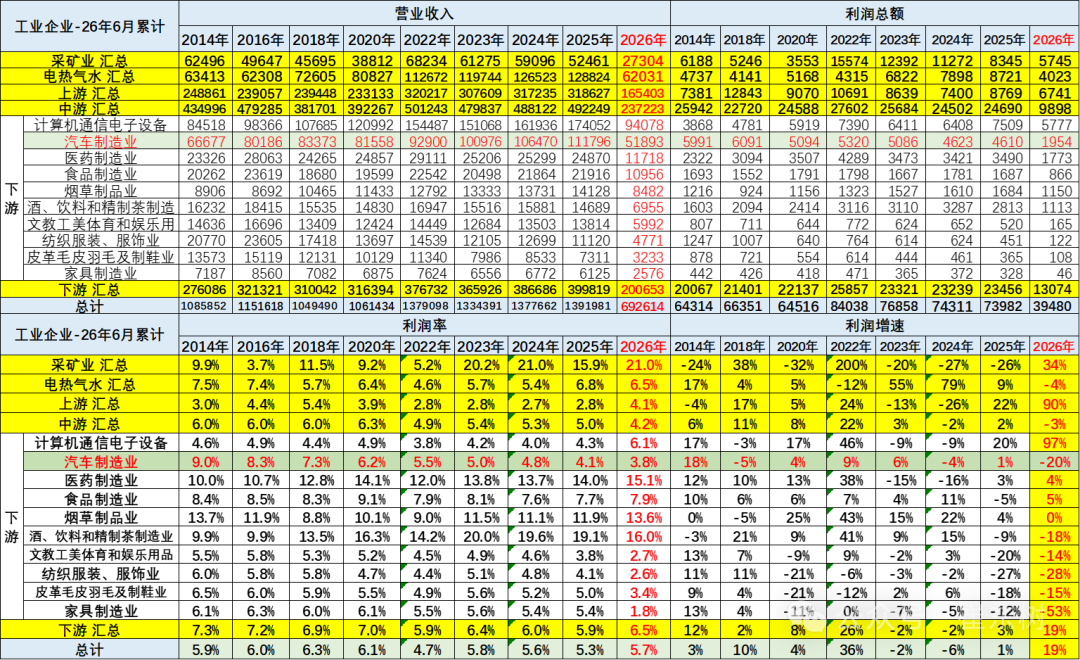
From January to June 2026, the overall profit of the downstream industry increased by 19%, and the profit of the computer communications industry showed an unusually good growth trend of 97%. However, the automobile industry's profit fell 20%, and the sales profit margin was 3.8% (9% in 2014), which is still lower than the overall downstream profit level of 6.5%, and also significantly lower than other downstream companies such as tobacco, alcohol, and pharmaceuticals.
Currently, the main high-profit industries are the tobacco, alcohol, and pharmaceutical industries, and the profits of the alcohol industry are much higher than those of other industries. Profits in the food industry are not strong, but there is also a marked increase over the same period last year.
IV. Analysis of the automotive industry
1. The scale of the automobile industry continues to expand
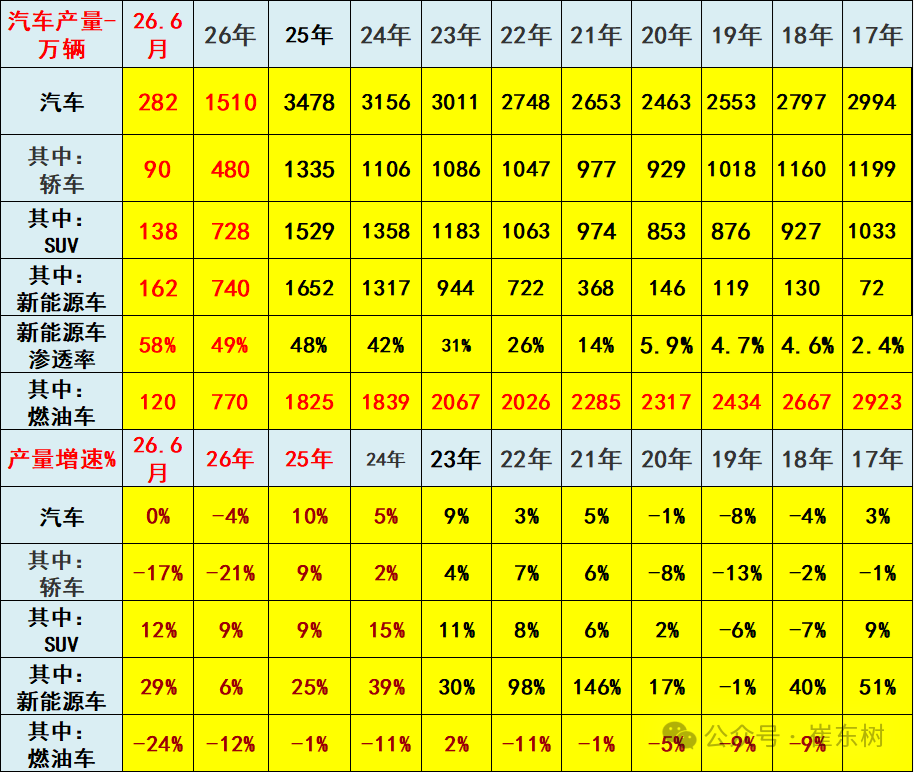
In 2022, automobile production was 27.48 million units, with a year-on-year increase of 3%; production of new energy vehicles was 7.22 million, an increase of 98%, with a penetration rate of 26%; production of fuel vehicles was 2.06 million units, a decrease of 11%.
In 2023, automobile production was 30.11 million units, up 9% year on year; new energy vehicle production was 9.44 million units, up 30% year on year, penetration rate 31%; fuel vehicle production was 20.67 million units, up 2% year on year.
In 2024, automobile production was 31.56 million units, up 5% year on year; new energy vehicle production was 13.17 million units, up 39% year on year, penetration rate 42%; fuel vehicle production was 18.39 million units, down 11%.
In 2025, automobile production was 34.78 million units, up 10% year on year; new energy vehicle production was 16.52 million units, up 25% year on year, penetration rate 48%; fuel vehicle production was 18.25 million units, down 1% year on year.
From January to June 2026, automobile production was 15.1 million units, down 4% year on year; new energy vehicle production was 7.4 million units, up 6% year on year, penetration rate 49%; fuel vehicle production was 7.7 million units, down 12% year on year.
In June 2026, automobile production was 2.82 million units, down 0% year on year; new energy vehicle production was 1.62 million units, up 29% year on year, penetration rate 58%; fuel vehicle production was 1.2 million units, down 24% year on year.
2. The automobile industry is under high pressure on efficiency
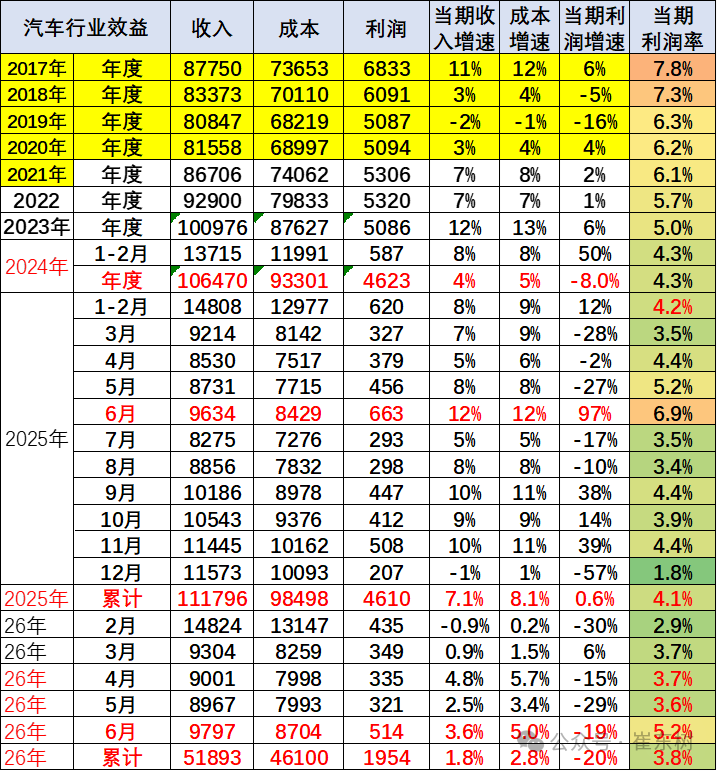
From January to June 2026, automobile production was 15.1 million units, down 4% year on year; new energy vehicle production was 7.4 million units, up 6% year on year. The automobile industry's revenue from January to June 2026 was 5189.3 billion yuan, up 1.8% year on year; cost was 4610 billion yuan, up 2.8%; profit was 195.4 billion yuan, down 20% year on year; the profit margin of the automobile industry was 3.8%. Compared with the average profit margin of 6.5% of downstream industrial enterprises, the automobile industry is still low.
The export price of lithium batteries has continued to decline in recent years. No matter how the price of lithium carbonate changes, the export price of lithium batteries continues to drop. The export price of lithium batteries fell 26% from 142,900 yuan in 2024 to 112,300 yuan in 25, a decrease of 21%. In '26, 104,800 yuan fell 12%. Among them, the average price of batteries exported from China in June was 104,900 yuan, down 4% year on year. The price reduction after tax rebates were reduced in April-6 was a significant improvement over last year. The price of lithium batteries exported by China to the European Union fell rapidly, falling 25% from 153,400 yuan in 2024 to 125,500 yuan in 25, a decrease of 18%. In June '26, the average price of batteries exported by China to the EU was 11.02 yuan/ton, a decrease of 18%.
Recently, as the scale of production in the car market expands, PPI rises, upstream lithium carbonate costs rise, lithium battery export prices continue to drop, domestic battery prices have skyrocketed, the problem of car companies not making batteries is serious, and car companies' profits have continued to decline.
Looking at the downward trend in profit margins in previous years, profits in the automobile industry have declined significantly recently, and the advantages of new energy policies with policy support are obvious. Since automakers generally don't make batteries and have no say, the profit pressure on mainstream car companies will continue to increase dramatically. As the country's anti-domestic countervailing efforts continue to advance, more automakers aim to become major international companies in the future, and car companies' battery manufacturing will inevitably accelerate. In the future, vehicles will be king, and the efficiency of car companies will gradually improve.