
- PRICING
- LIVE QUOTES
- LEARN
- HELP


EN
A super big week for US stocks is coming! The financial reports of the big four tech giants and the Federal Reserve's interest rate decisions explode, and the easing of the situation in the US and Iran seriously dampens oil prices
The Zhitong Finance App learned that US stocks have just finished a turbulent week, and the three major indices have closed down overall throughout the week. Meanwhile, the new week will usher in the most information-intensive trading window of the quarter: the four major tech giants will release financial reports, and the Federal Reserve will hold an interest rate meeting. Furthermore, the geographical tension in the Middle East has eased, and international oil prices have dropped sharply from the 100 yuan mark.
The S&P 500 closed up 0.05% on Friday, with a cumulative decline of 0.6% for the week; the Dow closed up 0.46% on Friday, with a cumulative decrease of 0.4%; the Nasdaq Composite closed down 0.64% on Friday, with a cumulative decline of 2.1% for the week.
Four tech giants intensively release financial reports, AI capital expenditure becomes the biggest torture
The US stock earnings season reached its climax this week, and the performance of four of the “Big Seven Tech Giants” became the focus of the market: Microsoft (MSFT.US) and Meta (META.US) will release financial reports on Wednesday; Apple (AAPL.US) and Amazon (AMZN.US) will release financial reports on Thursday.
Like last week's earnings reports for Alphabet (GOOGL.US, GOOG.US) and Tesla (TSLA.US), the core focus of the market is whether huge AI capital expenses can deliver real returns.
Google's parent company Alphabet's second-quarter performance data itself was not bad: both revenue and net profit exceeded market expectations, and Google Cloud business grew 82% year over year. Even in the face of the diversion of competitors such as ChatGPT and Claude, the search business growth was still resilient.
However, Alphabet raised its 2026 capital expenditure forecast from 180 billion to 190 billion US dollars to 1950 billion to 205 billion US dollars, and expects further capital expenditure to increase in 2027. Meanwhile, Alphabet's quarterly free cash flow fell to a negative value for the first time since listing.
Tesla's earnings report also showed that free cash flow turned negative, while capital expenditure increased sharply. After the results were released, the stock prices of the two companies both plummeted last Thursday. The total market value evaporated by about 500 billion US dollars, and the technology sector was also affected.
Storsten Slock, chief economist at Apollo Global Management, said bluntly that the current market is no longer satisfied with companies simply announcing “increased investment in AI,” and investors need a clear answer: Can massive capital expenditure drive profits and accelerate return on investment at the same time?
Deutsche Bank released a forward-looking report on Microsoft, pointing out that the bearish logic focuses on three points: prices of upstream components such as memory and chips continue to rise, and companies have to continue to increase expenses to implement AI deployments; long-term returns from huge AI platform investments are questionable, and free cash flow continues to be eroded by capital expenditure; the business is highly dependent on OpenAI, and there is a risk of order concentration.
Deutsche Bank predicts that Microsoft will raise the 2026 capital expenditure guideline from the previous $215 billion to $238 billion, and free cash flow will remain barely flat throughout the year.
Analysts said the market's scrutiny of the huge investment was “understandable” because just a few years ago, Microsoft's free cash flow was over $70 billion. However, for Microsoft, and for the “Big Seven” as a whole, these concerns may have been exaggerated.
Analysts at Deutsche Bank said, “It seems too pessimistic to think that Microsoft will have little way to offset these losses in the next few quarters.”
Heavy financial reports and intensive economic data are coming
In addition to the four tech giants this week, various industry leaders also focused on disclosing financial reports, covering the semiconductor, consumer, aviation, pharmaceutical, and energy sectors:
AstraZeneca (AZN.US) will release financial reports on Monday, Coca Cola (KO.US), Boeing (BA.US), etc. will release financial reports on Tuesday, Fanlin Group (LRCX.US), Qualcomm (QCOM.US) and Starbucks (SBUX.US) will release financial reports on Wednesday. Mastercard (MA.US), Shell (SHEL.US) and Bud.US (BUD.US) will release financial reports on Thursday; on Friday, US energy giants ExxonMobil (XOM.US) and SBUX.US (XOM.US) will release financial reports Veron (CVX.US), pharmaceutical giant AbbVie ( ABBV.US) and electricity giant Eaton (ETN.US) will release financial reports to put an end to a busy earnings week.
It is worth noting that SK Hynix (SKHY.US) will announce its first financial report since the US stock listing. According to reports, South Korea's presidential adviser Kim Yong-beom revealed on Saturday that Samsung Electronics and SK Hynix will reach a memory chip supply cooperation with a total value of up to 950 billion US dollars with major US technology companies, including Nvidia. Among them, SK Hynix will provide US companies with long-term memory chips worth 750 billion US dollars, while Samsung Electronics will supply chips worth 200 billion US dollars to Broadcom. Meanwhile, Nvidia and SK Group further announced an AI infrastructure plan worth over $500 billion.
In addition, the US GDP and the June PCE price index will be announced on Thursday. The market expects the US GDP to grow at an annualized rate of 2.1% in the second quarter, driven by consumer and business investment. Another report is expected to show that PCE, a key inflation indicator, will slow down in June due to falling gasoline prices, but gasoline prices have risen again since then.
When the Federal Reserve's interest rate decision hits, the market begins to prepare for two outcomes
The Federal Reserve will hold an interest rate meeting from July 28 to 29. Investors generally expect the central bank to stay on hold, but the risk of unexpected interest rate hikes cannot be ignored. Furthermore, the Bank of England and the Bank of Japan will also announce interest rate decisions.
Capital.com analyst Daniela Hathorn said that the US labor market appears to be performing well. The monthly employment report shows that the number of employed people continues to be above the benchmark level, and the number of people applying for unemployment benefits fell to the lowest level since 1969 at the beginning of last week. In terms of inflation, the recently announced Consumer Price Index (CPI) and Producer Price Index (PPI) both declined month-on-month, but the year-on-year increase was still far above target levels.
However, as the rekindling of war in the Middle East pushes up oil prices, the Trump administration announces a new round of global tariffs, and the AI investment boom continues to drive demand, the outlook for the Federal Reserve's monetary policy is becoming complicated. According to federal funds futures, the probability of a 25 basis point rate hike this week has risen to about 36%, and when the June CPI data was released two weeks ago, this probability dropped to 10%.
Hathorn said that the strong performance of the labor market gave the Federal Reserve the flexibility to raise interest rates when necessary. She also added, “The data shows that the market's expectations of a rapid shift in monetary policy towards easing may be too optimistic.”
Cleveland Federal Reserve Chairman Beth Hammark's recent statement sparked a buzz in the market. She said, “During my tenure, I first heard business people say they think we need to take action to curb inflation; at the same time, I also heard that consumers are increasingly desperate because they are unable to make ends meet. I learned from these conversations that inflation is not due to a single factor; it is multifaceted.”
Additionally, Dallas Federal Reserve Chairman Lori Logan called for a small rate hike earlier this month, on the grounds that she believes inflation cannot continue to return to the Fed's 2% target. Both officials mentioned above have the right to vote on this week's interest rate resolution. If other officials choose to keep interest rates unchanged, they are likely to vote against it. Citi expects that if there are more than two negative votes, it will be interpreted by the market as a stronger hawkish signal.
The Federal Reserve is likely to stay on hold this week, but the risk of an unexpected interest rate hike cannot be ignored
According to CME data, the probability that the Federal Reserve will keep interest rates unchanged in July is 63.7%, and the probability of raising interest rates by 25 basis points is 36.3%. Market expectations for the September rate hike are even stronger — the probability of a September rate hike has risen to around 80%.
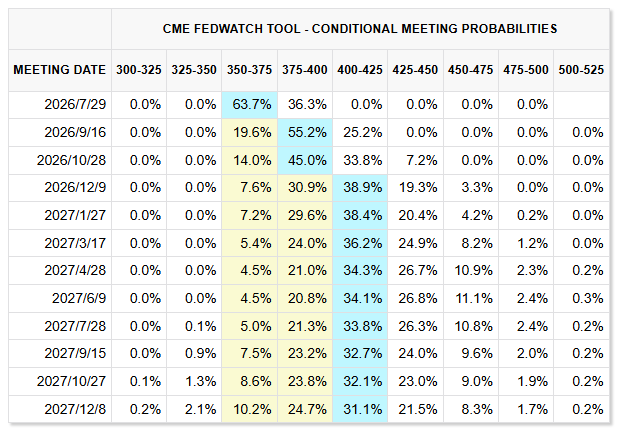
However, some Wall Street analysts pointed out that the rate hike may arrive much earlier than expected.
Neil Dutta, chief economist at Renaissance Macro Research, believes that the market may experience an unexpected rate hike at this week's Federal Reserve meeting. He said that acting now will allow the Federal Reserve to avoid falling into passivity in the coming months.
Joseph Lavorgna, a former Trump administration treasury official and current US chief economist at SMBC Nikko Securities, also pointed out that this month's interest rate hike may be less expensive than the political cost of raising interest rates closer to the November midterm elections. If interest rate hikes are postponed until September or even October for the first time, “What would that look like? Why don't you act now.”
Policy uncertainty is triggering a rare “double-sided bet” in the financial system. Pradeep Bhatia, CEO of Derivative Path Inc., said, “About one-third of the banks we work with are preparing for further interest rate hikes, while the rest are hedging the risk of interest rate cuts. This fragmentation shows that the market is no longer trying to predict the Fed's actions, but is beginning to prepare for both outcomes.”
Additionally, the Bank of England will announce interest rate decisions, meeting minutes, and monetary policy reports this Thursday. Since the June inflation data fell short of market expectations, the market generally predicts that the Bank of England will keep the benchmark interest rate unchanged this week.
The Bank of Japan will announce interest rate decisions and economic outlook reports this Friday. Markets generally expect the Bank of Japan to stay on hold this week, and policymakers tend to evaluate the impact of the last rate hike first. However, as the exchange rate of yen against the US dollar falls to its lowest level in nearly 40 years, analysts expect the Bank of Japan to release stronger hawkish signals.
The situation in the Middle East is now showing signs of easing, oil prices have dropped sharply from the 100 yuan mark
At the beginning of the Asia-Pacific session on Monday, the three major US stock index futures, precious metals markets, and cryptocurrency markets rose across the board, while international oil prices dived sharply. According to the news, signs of cooling tension in the Middle East have boosted market risk appetite. Iranian sources said that as long as the US stops military attacks, Iran will also stop military operations, but Iran is still “skeptical” about the intentions of the US side.
Earlier, there were reports that US President Trump ordered the US military on the 24th not to launch attacks on Iran that day, thus breaking the previous situation where the US military launched air strikes against Iraq for 13 consecutive days. Trump told the media at the White House on the afternoon of the 24th that the US and Iran are still in dialogue, adding that Iran is “serious this time.” At the same time, he threatened that the US side can also continue its military attacks on Iran. “If necessary, it can be raised to a higher level. We are ready and ready to act”.
Meanwhile, the latest news came from the US-Iran negotiations. On July 26, local time, US Permanent Representative to the United Nations Michael Waltz said that in order to leave more room for diplomatic negotiations, US President Trump has suspended military attacks on Iran. Iranian Foreign Ministry spokesman Bagae also said that the exchange of information between Iran and the US is continuing, and the mediators are also continuing to carry out related work.
Bagae said that the memorandum of understanding between Iran and the US is not a lengthy and complicated document, but rather a short memorandum of understanding containing only 14 clauses. The international community originally expected the US to fulfill its promises “at least this time,” but America's actions flagrantly and seriously violated many elements of the Memorandum of Understanding, causing diplomatic efforts to be “turned back on for the third time.”
As of press release, WTI crude oil futures prices plummeted 4.56% to $85.24 per barrel; Brent crude futures prices plummeted 4% to $88.01 per barrel.
