
- PRICING
- LIVE QUOTES
- LEARN
- HELP


EN
Public Storage (PSA) Stock Still Looks Cheap Despite Stabilizing Occupancy
Public Storage stock has delivered a 29.3% return over the past three years, and the latest Discounted Cash Flow (DCF) intrinsic value estimate now points to the shares trading at a 23.1% discount, while broader valuation checks present a more mixed picture.
- Over the last three years, Public Storage has returned 29.3%, which puts current investors in the position of weighing further upside against the gains already on the table.
- Recent news has highlighted stabilizing occupancy rates and integration of acquisitions as potential supports for future cash flows, while any setback in those occupancy trends or redevelopment returns could pressure the stock's valuation.
- On Simply Wall St's broader checks, Public Storage screens as attractive on some metrics but not others. The stock scores 4 out of 6 on valuation, which points to a mixed picture rather than a clear bargain or clear overvaluation.
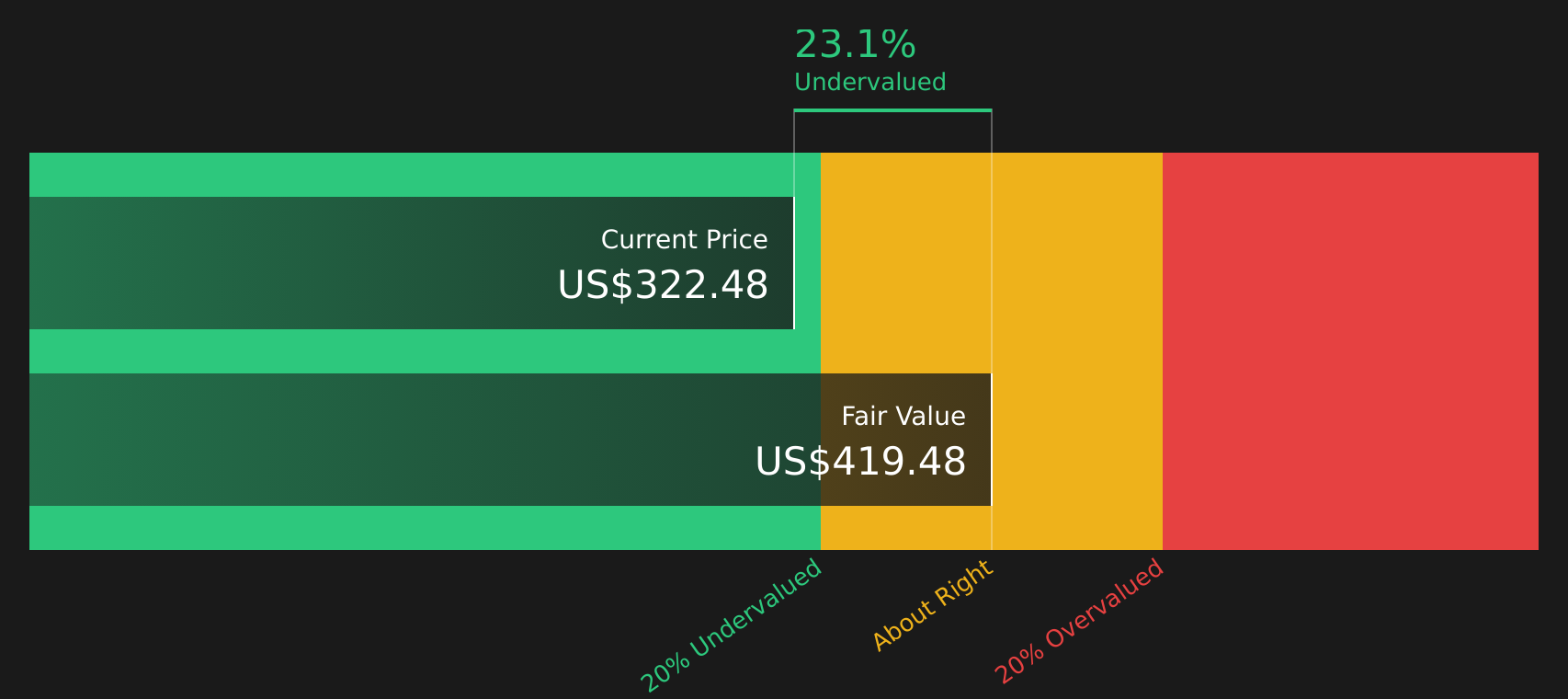
The issue now is whether that apparent 23.1% discount to intrinsic value offers a genuine margin of safety for Public Storage at today's price of US$322.48.
Is Public Storage Still Cheap on Cash Flow?
The Discounted Cash Flow (DCF) model here uses adjusted funds from operations to estimate what Public Storage might be worth based on its cash generation. On this view, the company is producing last twelve month free cash flow of about $2.8b, with the model assuming broadly growing cash flows rather than sharp swings.
Those projections translate into an estimated intrinsic value of about $419 per share, compared with the current share price of $322.48. This comparison points to Public Storage stock trading at roughly a 23.1% discount. Because recent news has focused on stabilizing occupancy rates and integration of acquisitions, the market may be slower to fully reflect the cash flows implied in this DCF outcome.
On balance, the DCF workup suggests Public Storage currently screens as undervalued relative to its estimated intrinsic value.
Our Discounted Cash Flow (DCF) analysis suggests Public Storage is undervalued by 23.1%. Track this in your watchlist or portfolio, or discover 49 more high quality undervalued stocks.
Does Public Storage Look Fairly Valued on Earnings?
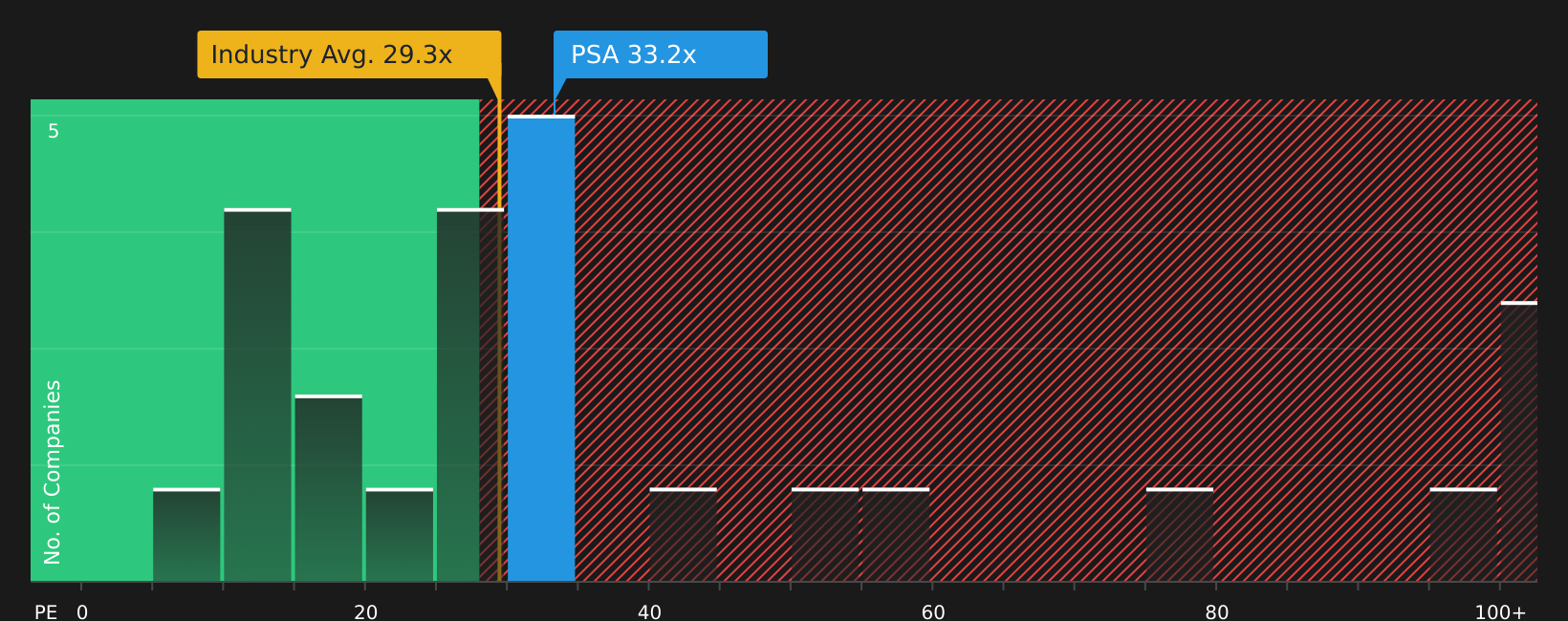
The P/E ratio is a useful yardstick for Public Storage because earnings remain a key driver of returns for a mature real estate investment trust. Public Storage currently trades on a P/E of about 33.2x, compared with an industry average of roughly 16.2x for specialized REITs and a peer average near 54.4x.
According to Simply Wall St's model, a P/E of about 34.0x appears reasonable for Public Storage once factors such as size, business mix, profitability and risk are taken into account. The current multiple sits very close to that fair ratio, which suggests the stock is not clearly cheap or expensive on earnings, even though it screens as richer than the broader REIT industry.
Overall, Public Storage appears roughly fairly valued on its P/E multiple relative to the earnings profile implied by the fair ratio.
See what the numbers say about this price — find out in our valuation breakdown.
The Public Storage Narrative: What Would Justify Today's Price?
Simply Wall St Narratives for Public Storage pick up where the valuation puzzle leaves off. They spell out which paths for Public Storage's growth, margins and earnings would line up with the stock being worth materially more or less than today's price, and each one sets out the assumptions that sit behind its view of fair value so you can later compare those with the company’s actual results on the Community page.
If you have a clear, number driven view on whether Public Storage's stabilizing occupancy rates and recent acquisition integration justify today's price, share a Narrative in the Simply Wall St community to put your case on record. Add your voice and track how your thesis holds up as Public Storage's results and market sentiment evolve.
Do you think there's more to the story for Public Storage? Head over to our Community to see what others are saying!
The Bottom Line
For Public Storage, the Discounted Cash Flow (DCF) work points to intrinsic value above the current share price, while the earnings multiple suggests the stock is priced roughly in line with its peer adjusted profile. Taken together with the mixed broader checks, this leaves the valuation case neither a clear bargain nor a clear stretch. From here, the key question is whether occupancy trends and acquisition integration continue to support the cash flows implied in the DCF work, or whether any disappointment in these areas shows that the current discount reflects the market’s assessment of execution risk.
This article by Simply Wall St is general in nature. We provide commentary based on historical data and analyst forecasts only using an unbiased methodology and our articles are not intended to be financial advice. It does not constitute a recommendation to buy or sell any stock, and does not take account of your objectives, or your financial situation. We aim to bring you long-term focused analysis driven by fundamental data. Note that our analysis may not factor in the latest price-sensitive company announcements or qualitative material. Simply Wall St has no position in any stocks mentioned.
Have feedback on this article? Concerned about the content? Get in touch with us directly. Alternatively, email editorial-team@simplywallst.com