
- PRICING
- LIVE QUOTES
- LEARN
- HELP


EN
This Group of Stocks Is Surging Due to the Surge in Oil Prices. Should You Invest?
Key Points
The spreads between crude oil prices and prices of refined petroleum products are at a record high.
Even if crude prices come back down, the shortage of refining capacity will keep refiners' margins elevated.
The energy industry, broadly speaking, has benefited from the higher oil prices this year resulting from Iran's effective closure of the Strait of Hormuz.
Yet one energy subsector has significantly outperformed both the energy sector and the broader market.
Missed Nvidia in 2009? This Rare Signal Is Flashing Again. In 2009, a "Double Down" signal flashed for a little-known chipmaker called Nvidia. For the first time in years, that same "Total Conviction" signal is flashing for a company 1/100th the size of Nvidia. Continue »
I'm talking about refiners. As measured by the VanEck Oil Refiners ETF (NYSEMKT: CRAK), refiner stocks are up about 24% since the start of the U.S.-Iran war. That's much better than the overall energy sector, as measured by the State Street Energy Select Sector ETF, up 9% over that period, and the S&P 500 index, up about 7.5%.
Digging down to individual companies, some of the biggest refiners have seen much larger gains.
Marathon Petroleum (NYSE: MPC) is up 59% since the war began, Valero Energy (NYSE: VLO) has climbed 52%, and Phillips 66 (NYSE: PSX) is up 36%.
So, what's going on that has driven refiner stocks so much higher than other energy stocks in recent months?
Basically, it's all about crack spreads. Those reflect the difference between the price of crude oil that refiners buy on global markets and the price they can charge for the refined products they extract from it, such as gasoline, diesel, or heating oil. That difference is also essentially the refiner's profit margin.
The most common industry benchmark is the 3-2-1 crack spread, the spread obtained by converting three barrels of crude oil into two barrels of gasoline and one barrel of a distillate, such as diesel or heating oil.
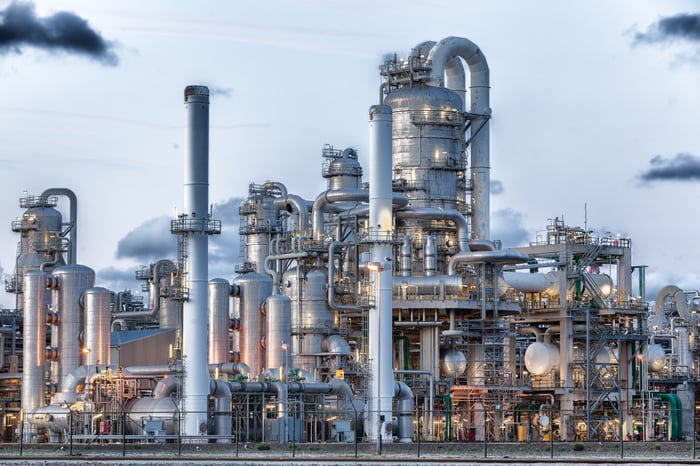
Image source: Getty Images.
So while many people believe the price of gasoline and other products moves exactly in tandem with the price of crude, in fact, there's a difference because of the refining process. When there's a shortage of refining capacity, the price of products like gasoline and jet fuel will rise and deliver bigger profit margins to refiners.
That's the case today.
A global refining capacity shortage
Due to wars in Ukraine and the Persian Gulf and the resulting destruction of refining infrastructure, as well as pandemic-era closures and aging infrastructure, global refining utilization was about 78 million barrels a day during the second quarter. That's 5 million barrels below the same period a year ago.
That's created a bottleneck that's driven the 3-2-1 crack spread for U.S. refiners to about $64, a new high.
Even if the two conflicts end tomorrow, it will take much longer to get refining capacity back where it needs to be to meet global demand for petroleum products.
That has generated considerable optimism about refining stocks. This week, Goldman Sachs raised its price target for Valero from $286 to $357, suggesting a 14% upside from the current price.
While I wouldn't put a lot of money into oil companies, as the price of oil remains highly volatile due to the twists and turns of the Persian Gulf conflict, I would invest in refiners. The global refining shortage driving their margins higher will last a lot longer.
Matthew Benjamin has positions in Select Sector SPDR Trust-State Street Energy Select Sector SPDR ETF. The Motley Fool has positions in and recommends Goldman Sachs Group. The Motley Fool recommends Phillips 66. The Motley Fool has a disclosure policy.