
- PRICING
- LIVE QUOTES
- LEARN
- HELP


EN
Does Stanley Black & Decker’s Higher Dividend Signal Strategic Confidence In Its Restructuring Path For SWK?
- In July 2026, Stanley Black & Decker’s Board approved a US$0.01 increase in its quarterly cash dividend to US$0.84 per share, payable on September 22, 2026, to shareholders of record as of September 8, 2026.
- This incremental dividend raise, announced alongside attention on upcoming quarterly earnings expectations, highlights management’s willingness to return more cash to shareholders even as revenue forecasts remain slightly softer.
- Next, we’ll examine how this dividend increase may influence Stanley Black & Decker’s cost-cut and margin-improvement investment narrative.
This technology could replace computers: discover 26 stocks that are working to make quantum computing a reality.
Stanley Black & Decker Investment Narrative Recap
To own Stanley Black & Decker, you need to believe its cost-cut and margin-improvement efforts can offset soft DIY and Outdoor demand and pricing pressure from tariffs and big-box retailers. The US$0.01 quarterly dividend increase is a modest signal and does not materially change the near term earnings catalyst or the key risk of sluggish end-market volumes and constrained pricing power.
The most relevant recent announcement alongside the dividend move is the upcoming Q2 2026 earnings release, where analysts expect year-over-year EPS growth on slightly lower revenue. How management frames margins, tariff impacts and demand trends in that update will likely matter far more for the cost-out narrative than this incremental dividend raise.
Yet behind the higher dividend, investors should be aware of how ongoing tariff costs and price sensitive customers could still challenge...
Read the full narrative on Stanley Black & Decker (it's free!)
Stanley Black & Decker's narrative projects $16.4 billion revenue and $1.1 billion earnings by 2029. This requires 2.5% yearly revenue growth and a roughly $728.9 million earnings increase from $371.1 million today.
Uncover how Stanley Black & Decker's forecasts yield a $92.65 fair value, a 6% upside to its current price.
Exploring Other Perspectives
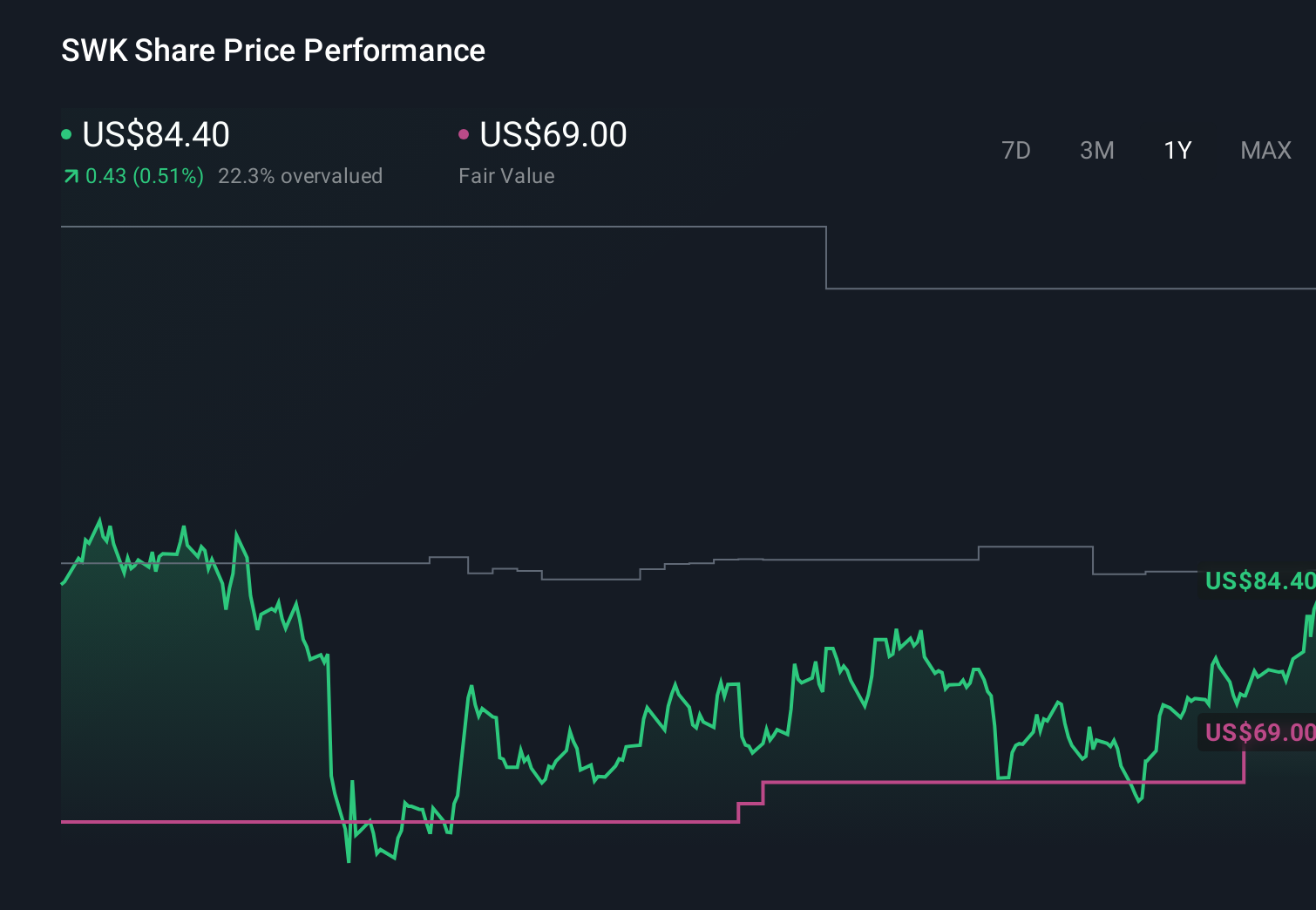
Some of the most optimistic analysts were already assuming earnings could reach about US$1.2 billion by 2029, which contrasts sharply with concerns about tariff driven margin pressure, reminding you that expectations diverge widely and could shift again after this dividend news.
Explore 4 other fair value estimates on Stanley Black & Decker - why the stock might be worth 6% less than the current price!
Form Your Own Verdict
Don't just follow the ticker - dig into the data and build a conviction that's truly your own.
- A great starting point for your Stanley Black & Decker research is our analysis highlighting 2 key rewards and 3 important warning signs that could impact your investment decision.
- Our free Stanley Black & Decker research report provides a comprehensive fundamental analysis summarized in a single visual - the Snowflake - making it easy to evaluate Stanley Black & Decker's overall financial health at a glance.
Seeking Other Investments?
Don't miss your shot at the next 10-bagger. Our latest stock picks just dropped:
- Outshine the giants: these 16 early-stage AI stocks could fund your retirement.
- AI is about to change healthcare. These 39 stocks are working on everything from early diagnostics to drug discovery. The best part - they are all under $10b in market cap - there's still time to get in early.
- Invest in the nuclear renaissance through our list of 90 elite nuclear energy infrastructure plays powering the global AI revolution.
This article by Simply Wall St is general in nature. We provide commentary based on historical data and analyst forecasts only using an unbiased methodology and our articles are not intended to be financial advice. It does not constitute a recommendation to buy or sell any stock, and does not take account of your objectives, or your financial situation. We aim to bring you long-term focused analysis driven by fundamental data. Note that our analysis may not factor in the latest price-sensitive company announcements or qualitative material. Simply Wall St has no position in any stocks mentioned.
Have feedback on this article? Concerned about the content? Get in touch with us directly. Alternatively, email editorial-team@simplywallst.com