
- PRICING
- LIVE QUOTES
- LEARN
- HELP


EN
NXP Stock And 2 Global Tech Names Facing New US Policy Pressure
Rising US tariffs, tighter rules on foreign tech, and pressure on countries to buy American are reshaping the risk profile for global tech and payments stocks. Some companies could see their opportunities squeezed as access to the US market, key supply chains, and cross border customers comes under stress. Others may find new openings as demand shifts. This article focuses on the risk side of that equation. It unpacks how the latest US policy shifts may work against three specific stocks exposed to these tensions, and what that might mean for investors weighing whether to stay cautious or step in slowly.
NXP Semiconductors (NXPI)
Overview: NXP Semiconductors designs and sells chips that sit inside cars, industrial equipment, connected devices and phones, providing processing power, wireless connectivity, security and sensing for everything from auto radar to factory automation and mobile payments. Its portfolio spans microcontrollers, application and communication processors, wireless SoCs, radio frequency products and security controllers sold globally to automakers, industrial customers and electronics manufacturers.
Operations: NXP Semiconductors generates about US$12.6b in revenue, entirely from its High Performance Mixed Signal segment.
Market Cap: US$70.4b
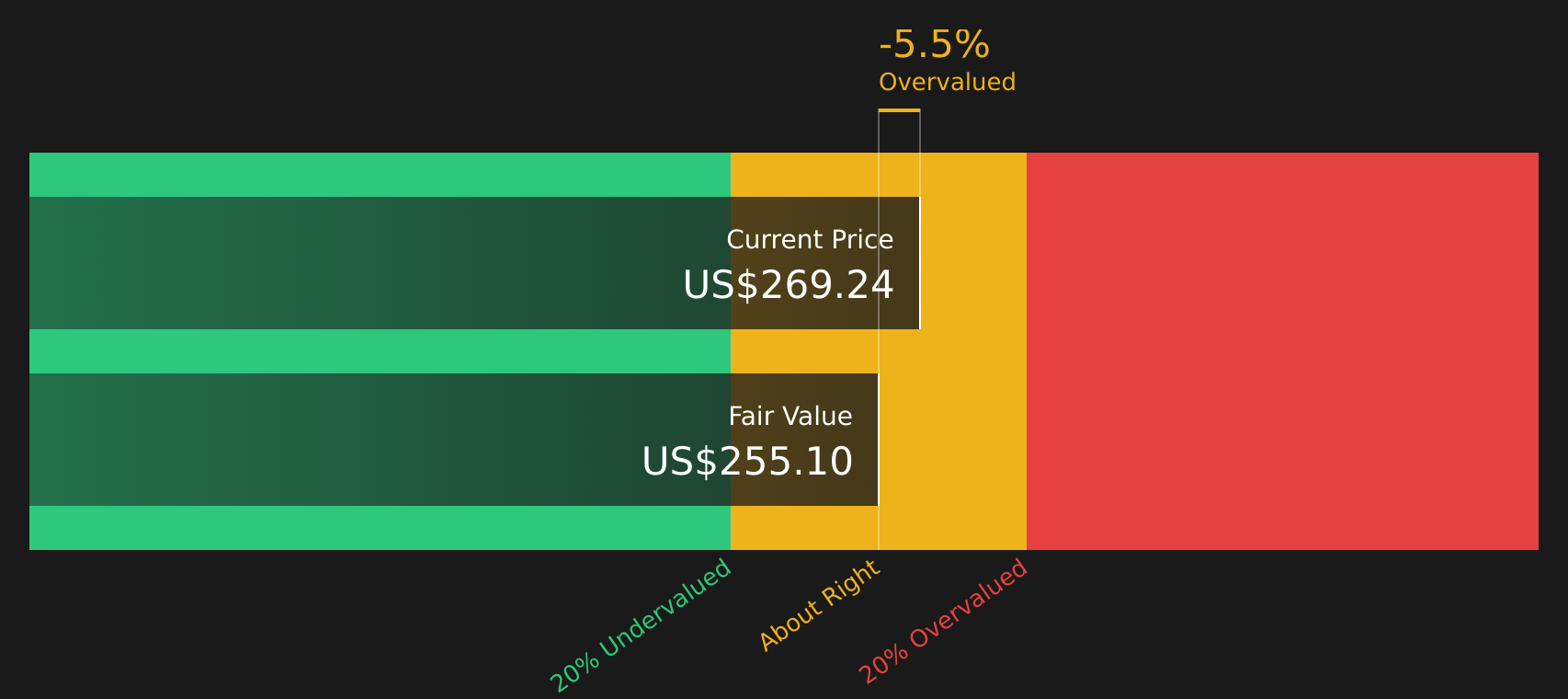
Investors may find aspects of NXP Semiconductors compelling, but there are also reasons to be cautious. The company is tightly linked to auto and industrial chips, which are among the areas most exposed if US tariffs and tech restrictions start to affect customers in China and Europe more significantly, even as management currently describes the direct impact as “immaterial.” Earnings and margins appear strong based on recent reporting, yet the stock trades on a P/E that sits above NXP’s own estimated cash flow value, while a sizeable debt load can make return metrics look more flattering. Combined with intense competition in China and ongoing acquisition spending, the possibility that a policy shock or slower auto recovery could affect both expectations and valuation remains an important risk for investors to consider.
NXP Semiconductors’ rich P/E relative to its own cash flow estimates, combined with its debt load and policy risk, raises a simple question: is the story stronger than the balance sheet? Read the NXP Semiconductors financial health report
Adyen (ENXTAM:ADYEN)
Overview: Adyen is a Dutch payments company that runs a single global platform helping large merchants accept cards and digital wallets online, in stores, and inside partner platforms, while also offering add ons like fraud prevention, tokenization, and embedded financial products such as accounts, capital, and issuing.
Operations: Adyen generates about €2.38b in revenue, almost entirely from Payment Services, with activity spread across North America, EMEA, the Netherlands, Asia Pacific, and Latin America.
Market Cap: €25.1b
Adyen attracts attention because it combines a high margin payments engine, with net revenue of €2.36b and EBITDA of €1.25b in 2025, and a push into merchant tools like loyalty, billing, and embedded finance. Yet it still trades on a premium multiple and has underperformed the Dutch diversified financials sector over the past year. At the same time, US tariffs have already hurt a handful of Asia based merchants selling into America, management now faces a CFO transition, and ambitious product bets in promotions and AI commerce need to turn into real monetisation rather than just a broader story. For investors, the question is whether the quality of Adyen’s platform is enough to offset policy headwinds and execution risk at this price point.
Adyen’s premium pricing and CFO handover could be masking where pressure really sits. Read the analysis report for Adyen for details on how policy risk, product bets and merchant exposure might intersect next.

Tencent Holdings (SEHK:700)
Overview: Tencent Holdings is a Chinese technology group that runs the Weixin social and communications ecosystem, develops online games and digital content, and provides fintech, cloud and enterprise software services across sectors such as finance, retail, education and healthcare in China and abroad.
Operations: Tencent Holdings generates revenue mainly from Value Added Services at CN¥373.3b, Fintech and Business Services at CN¥234.4b, Marketing Services at CN¥151.3b, and Other activities at CN¥9.2b.
Market Cap: HK$3.996t
Tencent Holdings may appear to have a relatively low P/E compared with the Asian Interactive Media and Services industry and has reported earnings growth of 17.6% in the past year. However, the investment case involves several complications. The stock has lagged the Hong Kong market and faces a significant geopolitical overhang, with US policy hardening toward Chinese technology and AI platforms. It is already on a US military companies blacklist, while sanctions risk affects its cross border payments and cloud ambitions. In addition, US tariffs and efforts by other countries to retain foreign users could influence how much value Tencent can derive from assets such as TenPay Global, TenPayGo, and overseas cloud arrangements. Investors considering whether the apparent valuation difference adequately reflects these policy risks may wish to examine the situation in more detail.
Tencent Holdings’ valuation gap to peers may look tempting, but US blacklists and sanctions risk could be masking where the real pressure sits. Read the analysis report for Tencent Holdings

Take Control of Your Investment Journey
If Adyen or any of these companies are making you feel more cautious, register for FREE with Simply Wall St and add your companies to a Watchlist to monitor the share price against the fair value and track any new developments as they happen. Once you've made your move, manage your holdings with our Portfolio Command Center that filters out the noise to deliver only the most critical, actionable updates. Throughout your journey, our Community allows you to filter the best ideas from thousands of investor perspectives. By uncovering hidden catalysts and risks early, you'll accelerate your decision-making and stay one step ahead of the market.
Seeking Fresh Alternatives Before Others Notice?
Fresh ideas move fast, and the stocks with real breakout potential rarely stay under the radar for long. Scan these focused shortlists before momentum flies away and consider your options promptly.
- Spot potential turnarounds and early momentum shifts by running through a curated set of 20 high quality undiscovered gems that many investors have not fully caught yet.
- Focus on companies with strong cash backing by checking the list of solid balance sheet and fundamentals (48 results) and see which stocks might hold up when others start dropping.
- Explore structural themes in automation and efficiency by scanning the hand picked 34 robotics and automation stocks, which highlight companies involved in these areas.
This article by Simply Wall St is general in nature. We provide commentary based on historical data and analyst forecasts only using an unbiased methodology and our articles are not intended to be financial advice. It does not constitute a recommendation to buy or sell any stock, and does not take account of your objectives, or your financial situation. We aim to bring you long-term focused analysis driven by fundamental data. Note that our analysis may not factor in the latest price-sensitive company announcements or qualitative material. Simply Wall St has no position in any stocks mentioned.
Have feedback on this article? Concerned about the content? Get in touch with us directly. Alternatively, email editorial-team@simplywallst.com