
- PRICING
- LIVE QUOTES
- LEARN
- HELP


EN
Autodesk (ADSK) Stock Looks Below Fair Value As Shares Fell 36%
Autodesk’s share price has declined 36% over the past five years, yet the intrinsic value estimate from a Discounted Cash Flow (DCF) model currently sits well above the market price. This raises the question of whether the stock is being priced too pessimistically after a long stretch of weak returns.
- Over the last 5 years, Autodesk has delivered a share price decline of 36%. This means long term holders have seen meaningful value erode despite the company remaining a key player in design and 3D software.
- Progress around OpenUSD and its role in 3D data interoperability for agentic AI workflows can support confidence in Autodesk’s long term cash generation. Any slowdown in adoption of these technologies may weigh on how much investors are willing to pay for that future growth.
- Autodesk screens as attractive on the broader checks, with the valuation framework indicating the stock looks cheap in 5 of 6 tests, as shown by its value score of 5.
The issue now is whether the current discount to the DCF based intrinsic value offers enough compensation for the risks that have already dragged Autodesk’s share price down over the past few years.
Find out why Autodesk's -31.8% return over the last year is lagging behind its peers.
Is Autodesk Still Cheap on Cash Flow?
The Discounted Cash Flow (DCF) approach values Autodesk by projecting its future cash flows and discounting them back to today. On the latest figures, Autodesk generated roughly $2.7b in free cash flow over the last twelve months, and the model applies a growing cash flow profile from this base. This feeds into a 2 Stage Free Cash Flow to Equity framework that aims to capture an earlier growth phase followed by a steadier period.
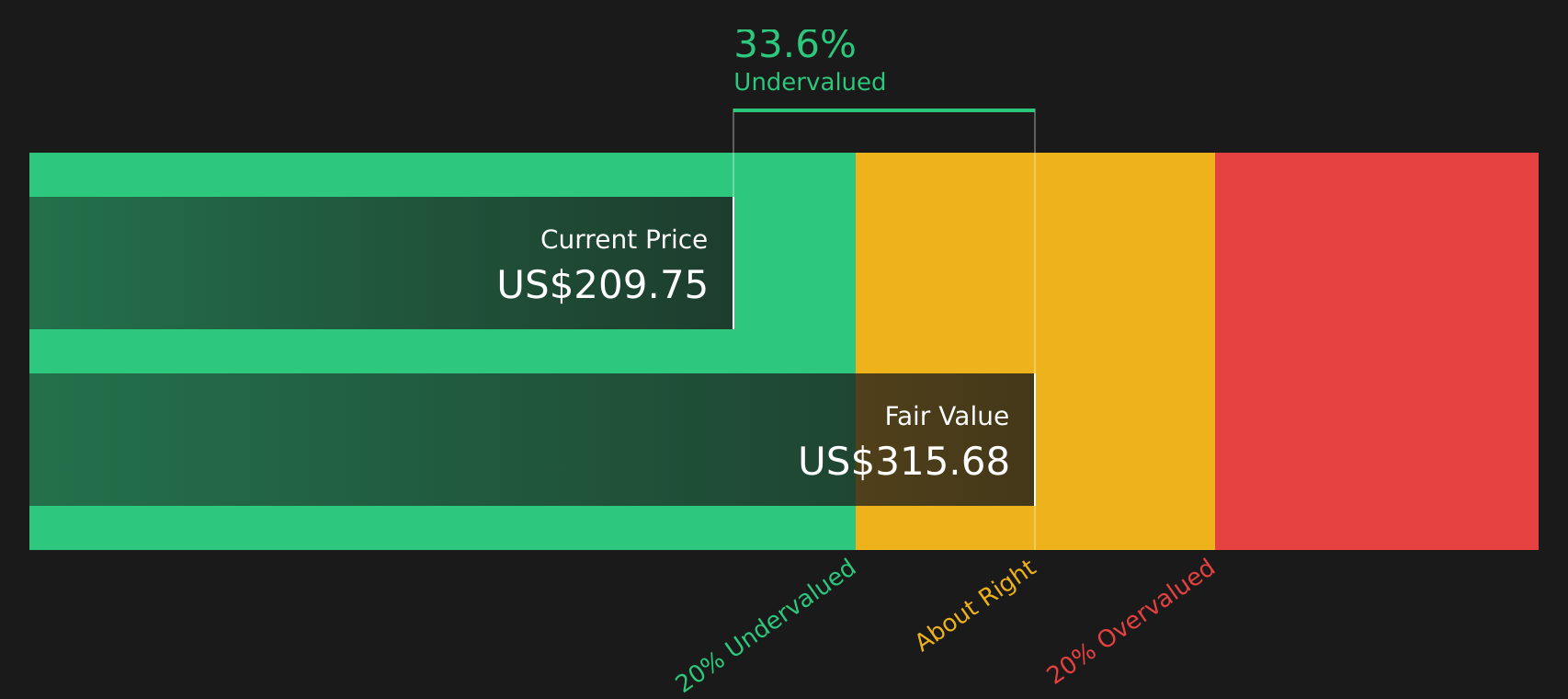
On that basis, the DCF points to an estimated intrinsic value of about $315 per share, implying the stock is 34.9% undervalued versus the current market price. Because the Alliance for OpenUSD news highlights Autodesk’s role in 3D data interoperability and agentic AI workflows, the market’s discount relative to the cash flow valuation suggests investors are still cautious despite this positioning.
Overall, the Discounted Cash Flow model indicates Autodesk stock currently looks undervalued relative to the cash it is projected to generate.
Our Discounted Cash Flow (DCF) analysis suggests Autodesk is undervalued by 34.9%. Track this in your watchlist or portfolio, or discover 38 more high quality undervalued stocks.
Is Autodesk Fairly Priced on Earnings?
The P/E ratio is a useful cross-check for Autodesk because earnings are a key focus for many software investors. Autodesk trades on a P/E of about 29.6x, which is above the broader software industry average of roughly 27.0x but below the peer group average of around 46.9x.
The tailored fair P/E for Autodesk is estimated at 30.5x, only slightly above the current multiple, so the stock does not screen as materially cheap or expensive on this measure. The modest premium to the industry average suggests investors are willing to pay a bit more for Autodesk than for the typical software company, but not as much as for some higher multiple peers.
On the P/E multiple, Autodesk stock appears to be priced roughly in line with what this framework suggests is fair.

See what the numbers say about this price — find out in our valuation breakdown.
The Autodesk Narrative: What Would Justify Today's Price?
Simply Wall St Narratives pick up where the Autodesk valuation puzzle leaves off by spelling out which paths for Autodesk's revenue, margins and earnings would need to occur for the stock to be worth significantly more or less than today's price on the Community page. Instead of stopping at a single output from a ratio or model, they describe the future that figure relies on so you can watch how the real world lines up over time.
One of the top community narratives on Autodesk: 49% undervalued
"Autodesk's proprietary 2D and 3D AI models trained on geometry rich, real world project data, combined with an agentic AI layer that can be priced through subscription, consumption and outcome based models, create multiple monetization paths that can support revenue and earnings over time..."
Read one of the top narratives on Autodesk
Do you think there's more to the story for Autodesk? Head over to our Community to see what others are saying!
The Bottom Line
Autodesk looks undervalued on the Discounted Cash Flow (DCF) view, with the intrinsic value estimate sitting well above the current share price, while the P/E cross check suggests the stock is priced at about the right level relative to earnings. Taken together, the high value score hints that the broader checks lean supportive, even though the market is not treating Autodesk as a clear bargain on multiples alone. The real split between bulls and bears is whether Autodesk can translate its position in 3D data interoperability and agentic AI workflows into durable cash generation that justifies the intrinsic value estimate rather than a value trap.
This article by Simply Wall St is general in nature. We provide commentary based on historical data and analyst forecasts only using an unbiased methodology and our articles are not intended to be financial advice. It does not constitute a recommendation to buy or sell any stock, and does not take account of your objectives, or your financial situation. We aim to bring you long-term focused analysis driven by fundamental data. Note that our analysis may not factor in the latest price-sensitive company announcements or qualitative material. Simply Wall St has no position in any stocks mentioned.
Have feedback on this article? Concerned about the content? Get in touch with us directly. Alternatively, email editorial-team@simplywallst.com