
- PRICING
- LIVE QUOTES
- LEARN
- HELP


EN
Ashland (ASH) Stock May Be 27% Undervalued On Cash Flow Strength
Ashland stock has delivered a 35.1% return over the past year, yet there is a clear split between valuation tools, with a Discounted Cash Flow (DCF) intrinsic value estimate suggesting the shares trade below fair value while market based multiples point to a richer price.
- Over the past 12 months, Ashland is up 35.1%. This puts recent performance firmly in focus when judging whether today’s US$66.56 share price still offers value.
- Expectations around Ashland’s ability to convert revenue into steady cash flows can support the intrinsic value case. By contrast, any pressure on margins or higher capital needs may weigh on what investors are willing to pay.
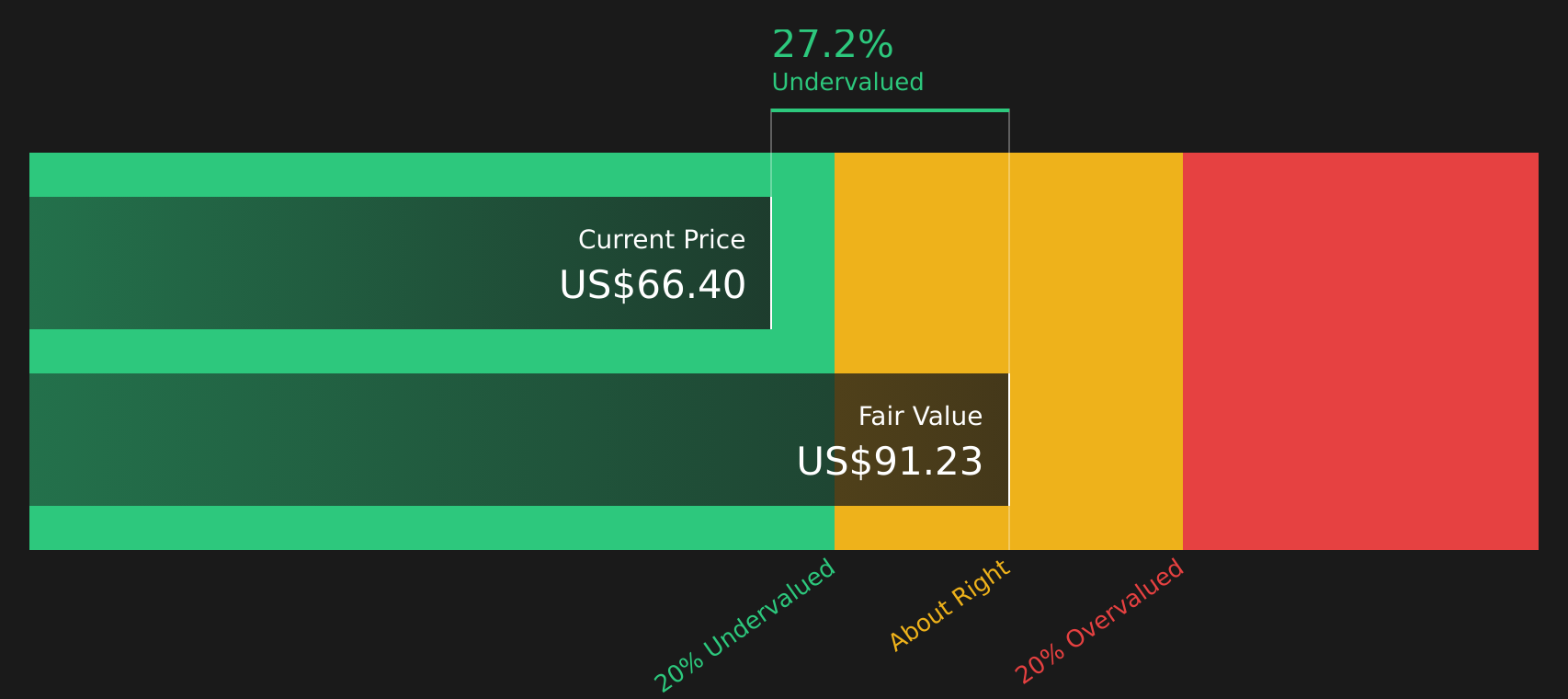
- Ashland screens as undervalued on the Discounted Cash Flow (DCF) estimate by about 27.2%. However, with only 2 of 6 valuation checks looking attractively priced, the broader picture leans closer to expensive than to a clear bargain.
The issue now is whether Ashland’s recent share price strength already reflects most of the intrinsic value upside that the DCF model indicates, or if the market’s caution on the broader checks is overstated.
Is Ashland a Bargain on Cash Flow?
The Discounted Cash Flow (DCF) model values Ashland based on the cash it is expected to generate for shareholders over time. For Ashland, the latest twelve month free cash flow stands at about $166.5 million, with the model assuming a growing but measured cash flow profile rather than rapid expansion or sharp decline.
Feeding those projections into a 2 Stage Free Cash Flow to Equity approach produces an estimated intrinsic value of roughly $91.49 per share. Compared with the current $66.56 share price, the model implies Ashland trades at about a 27.2% discount to this intrinsic estimate, indicating that the market price may not fully reflect the company’s projected cash generation.
On this Discounted Cash Flow view, Ashland stock currently screens as undervalued.
Our Discounted Cash Flow (DCF) analysis suggests Ashland is undervalued by 27.2%. Track this in your watchlist or portfolio, or discover 38 more high quality undervalued stocks.
Has Ashland Run Too Far on Sales?
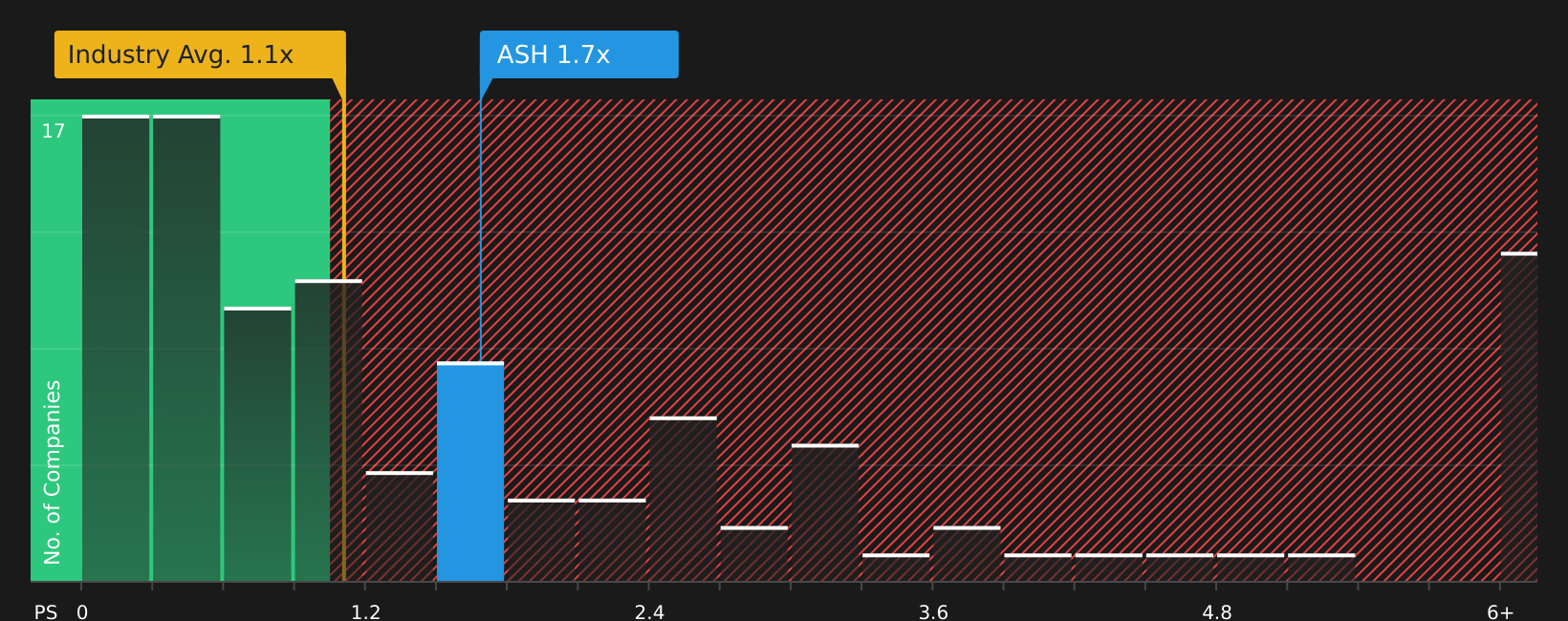
P/S is a useful way to look at Ashland because it ties the current share price directly to the revenue investors are paying for. Ashland currently trades on a P/S of about 1.7x, compared with a Chemicals industry average of roughly 1.2x and a peer group average near 1.3x, so the stock changes hands at a higher revenue multiple than both benchmarks.
The fair P/S ratio implied by the blended model is about 1.4x, which sits below Ashland’s current 1.7x level. That gap suggests investors are paying a premium to the revenue profile that the model would usually support, even after considering factors such as size, margins and risk.
On this P/S measure, Ashland stock currently screens as comparatively expensive relative to its estimated fair multiple and to the wider Chemicals peer group.
See what the numbers say about this price — find out in our valuation breakdown.
The Ashland Narrative: What Would Justify Today's Price?
Simply Wall St Narratives for Ashland pick up where this valuation split leaves off by spelling out which paths for Ashland’s growth, margins and earnings would need to play out for the stock to be worth materially more or materially less than today’s price. Each narrative ties its number to a clear view of how Ashland’s growth, profitability and risks might evolve, giving you a reference point to revisit as new information comes through on the Community page.
Community views on Ashland sit on very different tracks, with one side seeing the stock as roughly fairly valued and the other flagging it as 30% overvalued.
Bull case: roughly fairly valued
"With 85% of the portfolio tied to noncyclical, resilient consumer end-markets (pharma, personal care), Ashland's more focused business mix enhances revenue stability and pricing power…"
Read the full Bull Case to see why Ashland could be undervalued
Bear case: 30% overvalued
"Intensifying global environmental regulations, along with increasing sustainability and green chemistry compliance costs, are expected to constrain Ashland's product offerings and raise its cost base…"
Read the full Bear Case to see why Ashland could be overvalued
Do you think there's more to the story for Ashland? Head over to our Community to see what others are saying!
The Bottom Line
Ashland sits at an interesting crossroads, with the Discounted Cash Flow (DCF) intrinsic value estimate pointing to undervaluation while the P/S multiple paints the stock as overvalued versus peers. The gap comes down to what you prioritise: long term cash generation and funding needs, or current market expectations for growth and where comparable stocks are priced today. With broader valuation checks coming through as weak, the DCF signal alone is not enough to settle the debate. The real swing factor from here is whether Ashland can deliver the cash flow and margin profile that would turn today’s mixed valuation picture into clear value rather than a value trap.
This article by Simply Wall St is general in nature. We provide commentary based on historical data and analyst forecasts only using an unbiased methodology and our articles are not intended to be financial advice. It does not constitute a recommendation to buy or sell any stock, and does not take account of your objectives, or your financial situation. We aim to bring you long-term focused analysis driven by fundamental data. Note that our analysis may not factor in the latest price-sensitive company announcements or qualitative material. Simply Wall St has no position in any stocks mentioned.
Have feedback on this article? Concerned about the content? Get in touch with us directly. Alternatively, email editorial-team@simplywallst.com