- PRICING
- LIVE QUOTES
- LEARN
- HELP


EN
Consumer resilience exceeds expectations! Retail sales in the UK unexpectedly increased by 1% in June, and the “triple benefit” cannot hide the fragile recovery
The Zhitong Finance App learned that in the midst of the double headwinds of the ongoing US-Iran conflict and the Trump administration's new round of tariffs, British consumers used their wallets to cast a vote of confidence. According to data released by the UK Office for National Statistics (ONS) on Friday, retail sales unexpectedly increased by 1.0% month-on-month in June, far exceeding economists' expectations of a 0.3% decline; the year-on-year increase was 4.2%, almost double the 2.3% increase expected by the market. This is the fifth time since this year that retail data has surpassed expectations. Combined with the GfK Consumer Confidence Index, the biggest monthly jump in the year, the UK economy is showing a rare phenomenon of “political and economic resonance.” Core retail sales in the UK increased 5.4% year on year and 1.1% respectively in June, both far better than expected.
“Sunshine, Soccer, and the New Prime Minister”: The triple engine of consumer recovery
The higher-than-expected performance of retail data for June is the result of the triple favorable resonance of weather, competition, and politics.
Weather bonus: June 2026 is the second-warmest June in the UK since records began in 1994. ONS senior statistician Hannah Finselbach said that demand for “outdoor goods, air conditioning, and clothing” was strong during the month, and online sales performance of sporting goods was also quite good. Clothing store sales increased 1.9% month-on-month, the biggest monthly increase since September 2025.
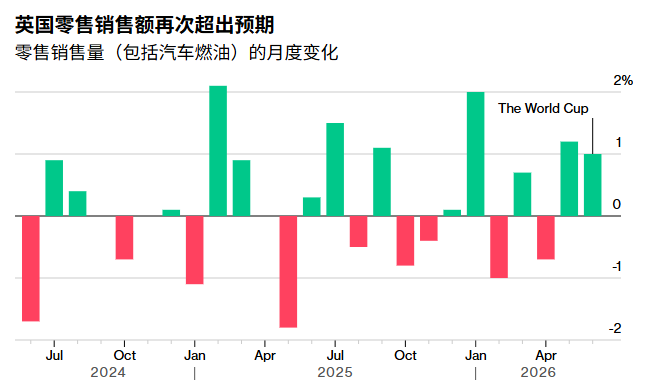
Tournament effect: England's participation in the World Cup has greatly boosted consumer sentiment. According to the data, sales of British supermarkets increased by 4.4% in the four weeks ending July 11. On the day of the England quarter-finals, the share of FMCG online sales reached the highest level in the year. Consumers bought the equivalent of 314 million pints of lager. BRC CEO Helen Dickinson stated, “England's promotion in the World Cup knockout phase brought a national 'feel-good' factor”.
“Burnham effect”: The GfK consumer confidence index jumped 6 points to -17 in July, the biggest monthly increase since November 2023. The study was conducted before Burnham officially entered Downing Street. The interviewees responded more to the expectations of the new prime minister than to the announced policies. “After the summer heatwave, July brought a wave of optimism,” said Neil Bellamy, director of consumer insight at GfK.
Consumption structure: selective consumption dominates, online channels become winners
Despite strong overall growth, consumers have maintained the characteristics of “selective consumption.” The strongest growth areas are concentrated on products with clear buying motivations — refrigeration products, food and beverages, and sporting goods. Non-food sales increased by 1.2%, exceeding the 12-month average increase of 0.6%. The growth rate of Barclays credit card spending hit an 11-month high.
The hot weather has curtailed physical store traffic to a certain extent, but strong online sales have made up for it. The share of online sales reached its highest level since 2026. BRC stated, “Although physical store sales were blocked due to high temperatures, the proportion of online sales reached a new high in 2026, thanks to well-timed promotions.”
Headwinds Unresolved: Tariffs, Oil Prices, and Fiscal Concerns
However, there are many concerns behind this impressive data. The ONS data collection period was before July and did not fully reflect recent multiple shocks.
Trade tariffs: The Trump administration announced new tariffs of 10% to 12% on 60 trading partners, further dampening investor sentiment after the temporary 10% global tariff expired. As one of the key trading partners, the UK will face significant cost pressure for export-oriented companies.
Energy prices: After the US-Iran cease-fire agreement broke down, reports of attacks on Saudi ships drove Brent crude oil to close to $100. The UK relies on imports for almost all of its energy, and soaring oil prices will directly push up household energy bills. Burnham has announced the abolition of value-added tax on residents' electricity bills starting in October. It is estimated that each household will save about £45 per year, but the energy industry warned that the upper limit of energy prices may be raised in October, and the effects of the tax cuts may be partially offset.
Fiscal concerns: The pound failed to rise due to a boost in retail data. It traded around 1.3300, with a cumulative decline of about 1% this week. Investors are increasingly worried that Burnham's spending plan could jeopardize the UK's financial stability. ING analysts warned that “the pound's rebound was more driven by positions and arbitrage, rather than continued improvement in fundamentals.”
The fragility of recovery: BRC's warning
BRC CEO Dickinson's comments provide a sobering footnote to this optimistic data: “Consumer confidence has improved for the third month in a row, largely due to a rise in sentiment among baby boomers.” “But we shouldn't mistake it for a recovery: only about 1 in 10 people expect the economy to improve in the future”. She warned that “confidence is still weak, and the cost of living pressure continues to weigh heavily on many families.”
GFK's Bellamy also pointed out that “if the Burnham effect is to continue and boost consumer confidence, the new government needs to continue to deliver on its promises in terms of deep cost of living challenges and continued low economic growth.”
The UK's GDP increased 0.1% month-on-month in May, reversing the April decline, but industrial output fell 0.5% and the construction industry fell 0.8%, and only the service sector supported growth. Deutsche Bank expects the UK to lead the G7 in growth in the second quarter, but the basis for recovery is weak and unevenly distributed.
Inflation and employment: Inflation is generally cooling down, but the “core” is stubborn, and wages are cooling to ease hawkish pressure
The CPI fell to 2.6% year on year in June, the lowest since March 2025, mainly driven by falling commodity, food and transportation prices. However, the core CPI still reached 2.6% year over year, higher than market expectations of 2.5%; the core price rose 0.3% month-on-month, and the annualized conversion rate was much higher than the moderate figure shown by the year-on-year data.
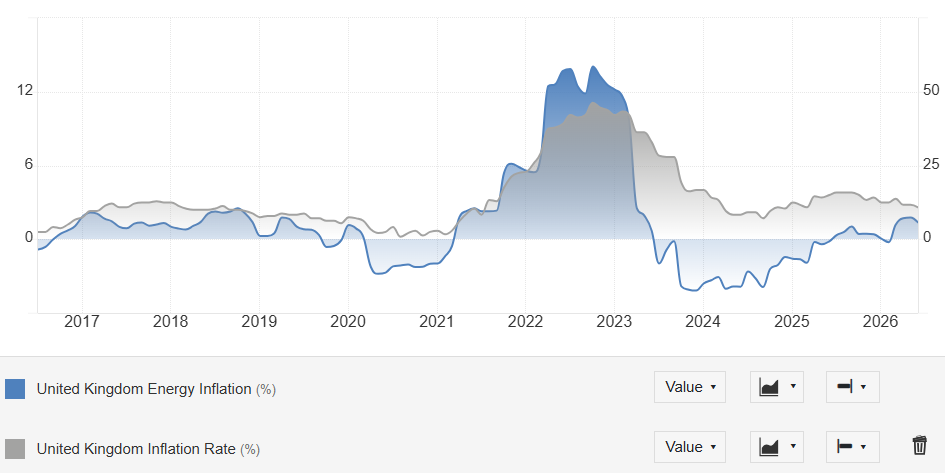
What makes central banks even more wary is the structural stickiness of service inflation. Restaurant and hotel prices rose 1.0% month-on-month, entertainment and culture rose 0.5%, and service inflation fell only from 3.7% to 3.6%, higher than market expectations of 3.5%. As long as service inflation remains above 3.5%, it is difficult to confirm the credibility of core inflation continuing to converge towards the 2% target.
Forward-looking risks should also not be ignored. The upper energy price cap for British residents was raised by 13% on July 1, and typical household annual bills rose to £1,862; Brent crude oil has surpassed $100 per barrel, and the Middle East conflict continues to drive up supply risk premiums. The Bank of England expects inflation to pick up again in the second half of the year. The CPI was slightly below 3% in the third quarter and slightly above 3.25% in the fourth quarter.
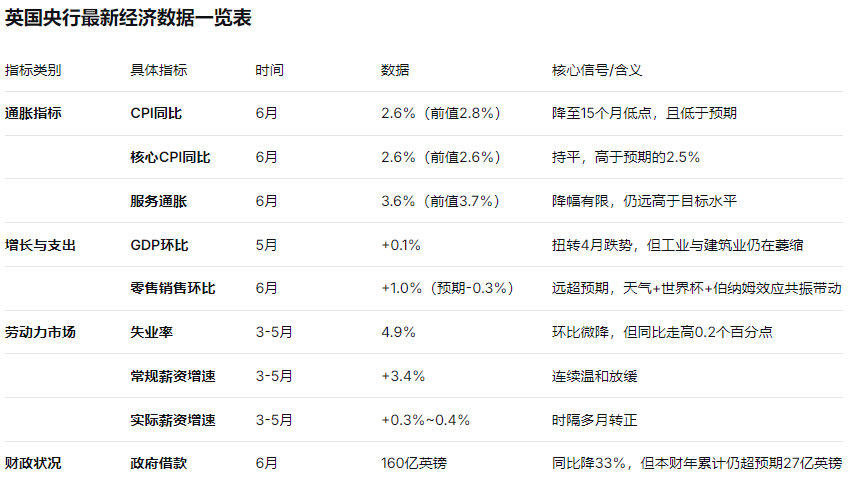
On the payroll side, regular salary increased 3.4% year-on-year in March-May, with bonus salary increased 4.3%. Based on CPI estimates, the actual growth rate of regular wages is 0.4%, and the total salary is 1.3% — after a period of many months, UK residents' wages outperformed inflation. However, wage growth has continued to slow moderately, and wage inflationary pressure continues to cool down.
On the employment side, the unemployment rate was 4.9%, a slight decrease from month to month but higher year on year. Employment in enterprises continued to shrink. In April-June, 712,000 jobs were vacant, a decrease of 7,000 from the first quarter; the number of salaried employees decreased by 90,000 over the same period last year. The youth unemployment rate rose to 14.8%, the highest level since 2014. Bank France and Pakistan pointed out that the double signal of a tight labor market and a slowdown in wage inflation gave the central bank sufficient reason to wait and see.
The July standstill is a foregone conclusion, but differences still exist
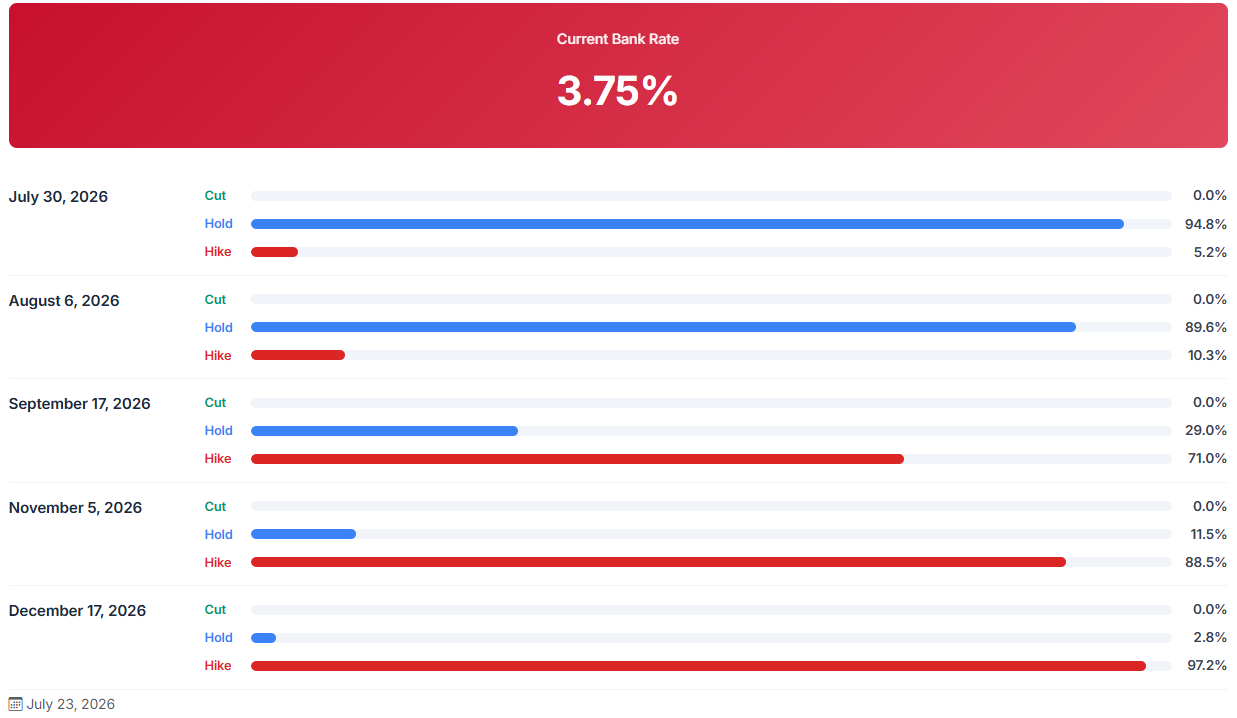
On the eve of the Bank of England's interest rate meeting on July 30, a series of macroeconomic data was intensively released, outlining a complicated picture of “moderate cooling of inflation, weak fragmentation of growth, and hot and cold employment.” The market generally predicts that the central bank will keep the benchmark interest rate of 3.75% unchanged next week, but the balance surrounding interest rate hikes and interest rate cuts during the year is still undecided.
For the July 30 meeting, the market generally expected to remain unchanged at 3.75%. At the June meeting, interest rates were maintained by a 7-2 vote, and two members advocated raising interest rates to 4%. Vice President Briden, as a representative of the dovish faction, has clearly downplayed the risk of inflation spreading to wages and corporate pricing practices. Financial market pricing indicates that interest rate hikes of 25 basis points may still occur 1 to 2 times before the end of 2026.