
- PRICING
- LIVE QUOTES
- LEARN
- HELP


EN
New Stock Outlook | Baoji Yuan and IPO: Relying on Baoji Pills to stabilize Hong Kong's market share at the top, but they are stuck in the local market and production capacity is idle
With “Proprietary Chinese Medicine+Traditional Chinese Medicine Clinic” as a dual driver, it owns Hong Kong's century-old brand proprietary Chinese medicine products “Baoji Pills and Tenki Pills”, and has steadily increased its performance, and sprinted to the Hong Kong Stock Exchange.
The Zhitong Finance App learned that Baoji Yuan recently submitted a listing application to the main board of the Hong Kong Stock Exchange, and Huafu Construction Enterprise Finance is the sole sponsor. The company is a leading proprietary Chinese medicine group in Hong Kong. According to Frost & Sullivan, the company ranked first in the Hong Kong proprietary Chinese medicine market with a market share of 9.2%, ranking second in the Hong Kong concentrated Chinese medicine granule market, with a market share of 25.2%.
The company's performance was steady. From fiscal year 2024 to fiscal year 2026, the company's revenue was HK$339 million, HK$361 million and HK$464 million respectively, with a compound growth rate of 17%, and net profit of shareholders of HK$59 million, HK$43 million and HK$71 million, a compound growth rate of 9.7%. Furthermore, operating cash flow was relatively healthy. Net inflows for the above periods were HK$15 million, HK$73 million and HK$50 million, respectively. As of May 2026, cash and equivalents were HK$53 million.
Baoji Yuanhe is a wholly-owned subsidiary of the Hong Kong stock listed company Jianbei Miao Miao (02161). The spin-off listing is to attract more investors to optimize the shareholding structure of Baoji Yuanhe, and on the other hand, to obtain development capital and independent financing platforms, or accelerate business globalization.
Core business is growing steadily, but capacity utilization is low
The Zhitong Finance App learned that Baojiyuan dates back to 1998. It was initially a pharmaceutical company, Jacson Pharmaceuticals, and gradually expanded to cover various fields such as brand health care business. In 2021, Jacoson Pharmaceuticals split the health care business and listed on the Hong Kong stock market under the name JianbeMiao Miao. In 2023, Jacobson Pharmaceuticals and Jianbeimei Miao completed the reverse operation of shares. Jianbeimei Miao became the company's wholly-owned shareholder. In 2025, it acquired Tianxitang and Jianfudang TCM Group to expand the TCM clinic service business. Currently, the business includes branded proprietary Chinese medicine products and traditional Chinese medicine clinic services.
TCM Clinic Services was acquired and listed in 2025, with a low revenue contribution of 8.6%. The core revenue source was branded proprietary Chinese medicine products. The business performance was steady. The revenue for the 2024-2026 fiscal year increased from 340 million yuan to 424 million yuan, a compound growth rate of 11.67%.
The brand has a rich portfolio of proprietary Chinese medicine products. As of March 31, 2026, it has more than 100 combinations. The core products include Baoji Pills, Tianxitang Tenki Pills, Shiling Oil, Flying Eagle Huoluo Oil, and Pain Relief Ba Huoluo Oil. Among them, Baoji Pills has a history of 130 years, and Tenkido Tenki Pills has a history of 120 years, making them the company's top two major products. In 2026, the company's top six products contributed 45.1% to business revenue, of which Baosai pills contributed 36.3%.
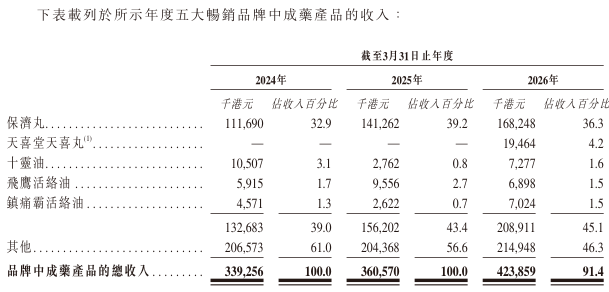
Data source: Company hearing materials
Furthermore, through the acquisition of traditional Chinese medicine clinics, Baoji Yuanhe created a vertically integrated traditional Chinese medicine platform connecting products, traditional Chinese medicine practitioners and patients. As of March 2025, it operated 40 clinics strategically located in densely populated residential areas, with 51 registered TCM physicians providing professional diagnosis services. Although the business has just been launched, as of June 2026, the company has become the fifth largest private TCM chain in Hong Kong in terms of number of clinics. The largest private orthopedic specialist TCM clinic chain is expected to increase significantly in 2026.
The company's market is concentrated in Hong Kong, with a small number of markets in mainland China, Singapore and Macau. The revenue contributions of these regions in the 2026 fiscal year were 86%, 3%, 5.1% and 2.5%, respectively. The company sells products through direct sales and distribution models. Among them, the direct sales model accounts for the majority and relies on traditional Chinese medicine practitioners. Physicians account for 41.5% of sales in the 2026 fiscal year. Overall, however, its customer concentration was low. The top five customers contributed 24.3%, 22.8%, and 35.2% of revenue for the first half of the 2024-2026 fiscal year, respectively.
In terms of production capacity supply, Baoji Yuan and two GMP certified manufacturing facilities in Hong Kong are mainly used to produce Baoji Pills, Flying Eagle Active Oil, and Tianxido Tianxi Pills and Medicinal Oil produced from June 2026. They maintained a utilization rate of 61% to 75% during the track record period, which is relatively low. The company is also expanding the brand supply of its own brand of concentrated Chinese medicine granular products and other proprietary Chinese medicine products through third-party manufacturing. With the development of the global market, especially the accelerated release of the Singaporean market, capacity utilization is expected to improve and drive continued growth in performance.
A number of products are leading in Hong Kong, and abundant cash flow is driving the expansion of two major businesses
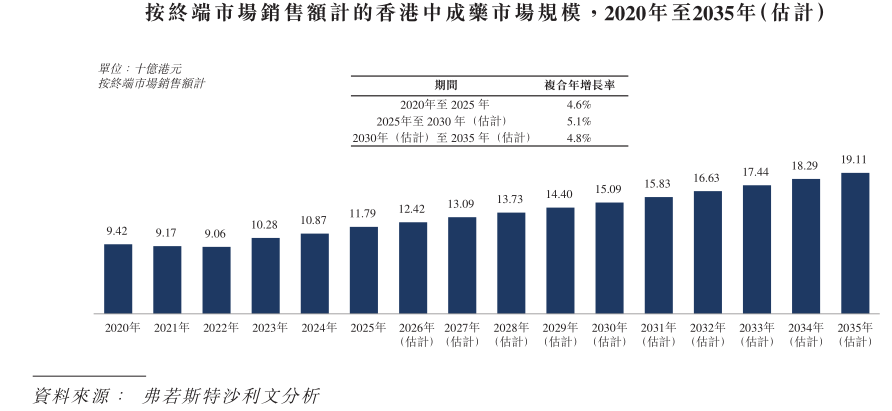
From an industry perspective, the Boji dollar and core revenue are growing steadily in Hong Kong. According to Frost & Sullivan, the market size in 2025 was HK$11.79 billion, and the compound growth rate in 2020-2025 was 4.6%. It is expected to reach HK$15.09 billion by 2030, a compound growth rate of 5.1%. Meanwhile, Hong Kong's proprietary Chinese medicine market is fiercely competitive, with the top five participants contributing 31.9% in 2025.
Baoji Yuanhe is the leading Chinese medicine leader in Hong Kong. In terms of terminal market sales, the company also ranks first in the industry with a market share of 9.2%, and is also in a leading position in market segments, such as the concentrated Chinese medicine granule market, which ranks second with a market share of 25.2%; in the gastroenterology proprietary Chinese medicine market, it also ranks first with a market share of 11.8%.
It is worth mentioning that TCM clinic services are a new business laid out by the company in 2025. According to Frost & Sullivan, the industry size in 2025 was HK$6.37 billion, and the compound growth rate was 1.6% in 2020-2025, but the market size is expected to reach 8.08 billion yuan by 2030, and the compound growth rate will increase to 4.9%. With 40 clinics, the company is the fifth largest private chain of traditional Chinese medicine clinics in Hong Kong. It has a certain scale advantage, and the number of the top five is not much different.
Baoji Yuan and have healthy finance to develop two major business markets. On the one hand, cash flow is relatively stable, and operating cash flow continues to be net; on the other hand, there are basically no interest-bearing debts, and the finances are relatively healthy.
In the 2024-2026 fiscal year, the company's profitability was relatively stable, with gross margins of 49.6%, 46.9% and 48.2% respectively. The gross margin of proprietary Chinese medicines increased year by year, but the gross margin for the new business TCM clinic services was low, only 17%. The net profit margin was mainly affected by core sales expenses, with a net profit margin of 17.4% for the 2026 fiscal year. The good profit record also enabled the company to maintain a net operating cash flow inflow of HK$50 million each year.
However, the company has almost no interest-bearing debt. As of May 2026, the company had a cash equivalent of HK$53 million. However, it should be noted that the company's trade and other payables were large, especially payments to intermediary holding companies and similar subsidiaries, resulting in negative current liabilities all year round. The company relies heavily on Hong Kong for revenue, and this listing is expected to boost cash flow and open up markets in mainland China and other regions.
Overall, the Baoji yuan and performance are growing steadily, and profitability fluctuates slightly, but operating cash flow continues to flow in net, and the finances are relatively healthy. The company's core products have a history of 100 years, and some of its businesses are in a leading position in the industry. The competitive advantage is obvious, while the core Hong Kong market continues to grow, driving the company's revenue growth. The company still has room to improve its production capacity utilization, and is actively deploying the global market, which is expected to create new growth points.
However, the company still has major risk points, including high revenue and dependence on the Hong Kong region, the global layout may fall short of expectations, and the risk that trade and other payables are too high, which should be viewed with caution.