
- PRICING
- LIVE QUOTES
- LEARN
- HELP


EN
The Black Sea and the Red Sea are doubly anxious! US oil was frantically “snapped up” by Asian and European buyers, and WTI premiums skyrocketed
The Zhitong Finance App notes that the rise in demand for US crude oil in Asia and Europe is one of the first signs that market concerns about the sufficiency of oil supply are increasing at a time when geopolitical hot spots are frequent.
The Iran-backed Houthis attacked two Saudi oil tankers in the Red Sea, adding a new element of fluctuation to the Iran conflict and pushing the international benchmark oil price to break through the $100 mark per barrel. Meanwhile, after Ukrainian drones attacked shipping in the Black Sea, Kazakhstan cut oil production, prompting buyers to turn to similar crude oil grades, including supplies from the Permian Basin.
At the US domestic level, the situation is also serious: if US crude oil exports fully return to a rapid growth trend, it will eventually push up fuel costs for consumers and increase inflationary pressure on the eve of the US midterm elections.
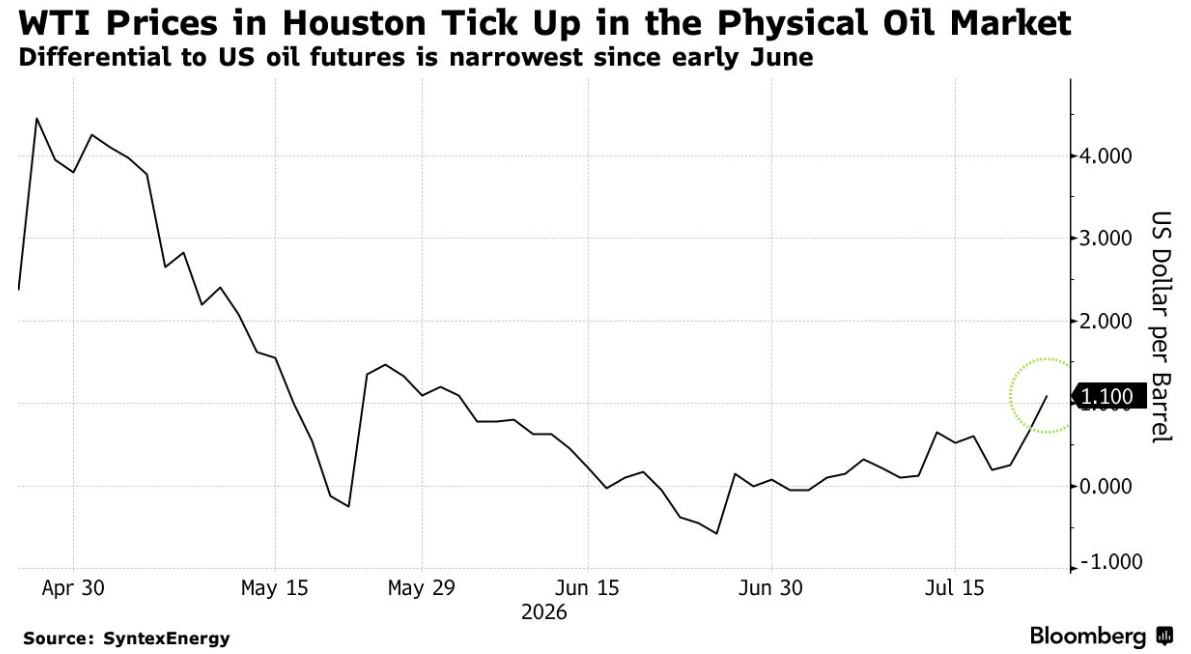
According to traders, on Thursday, the September shipment of WTI crude oil delivered along the US Gulf coast had a premium of about 5 US dollars per barrel over the global benchmark oil price. The day before, the difference was still $2.
Some Asian buyers are taking unconventional steps to buy temporary stock containers that will be loaded into the ship for several weeks. Other buyers are hoping that oil tankers can try to cross dangerous areas around the Strait of Hormuz and the Red Sea by turning off the Automatic Ship Identification System (AIS) transponders.
ExxonMobil and oil trader Petroineos have withdrawn premium offers of $6.75 and $6.55 per barrel for WTI Midland crude oil in the European market, respectively, which is a typical sign of increased price fluctuations.
Since the US and Israel triggered the Iran conflict in late February, demand for US crude oil has been strong due to its remoteness from the war zone. According to Kpler Ltd data, US oil exports soared to a record high of 5.66 million barrels per day in May, highlighting its role as the “supplier of last resort.”
Recently, with the brief reopening of the Strait of Hormuz, oil tankers trapped in the Persian Gulf were able to sail to Europe and Asia, and the volume of such outbound goods declined somewhat.
Sparta Commodities pointed out that as a traditional supplier to refiners in the Mediterranean and North-West Europe, Kazakhstan's production reduction measures have made WTI more competitive in these regions. However, the supply interruption is likely to be temporary, which means that demand for U.S. crude oil will be fueled or difficult to sustain.
U.S. crude oil inventories are continuing to shrink as demand picks up. U.S. commercial crude oil inventories have reached an eight-year low, and their emergency reserves have fallen to their lowest level since 1983.