
- PRICING
- LIVE QUOTES
- LEARN
- HELP


EN
Moody's (MCO) Stock Looks Overvalued With Little Margin Of Safety
Moody's stock is coming off a mixed stretch, with the share price down over the past year but still up 37.7% over three years, and the current Excess Returns intrinsic value estimate and market multiples both pointing to the shares trading at a premium rather than looking cheap.
- Moody's has returned 37.7% over the last three years, which suggests longer term holders have still come out ahead despite recent weakness.
- Expectations for the resilience of Moody's fee based credit and analytics businesses can support a full valuation, while any slowdown in issuance or data demand may weigh on the cash flows that underpin today's price.
- Moody's scores just 1 out of 6 on the valuation checks, which leans more toward the stock being expensive than a clear bargain on these broader measures.
The issue now is whether Moody's current valuation leaves enough margin of safety for new capital going into the stock.
Find out why Moody's -7.2% return over the last year is lagging behind its peers.
Does Moody's Look Pricey on Excess Returns?
The Excess Returns model evaluates how much value Moody's creates over and above the cost of its equity capital. For Moody's, the inputs indicate a business that is earning significantly more on its equity base than the model treats as required.
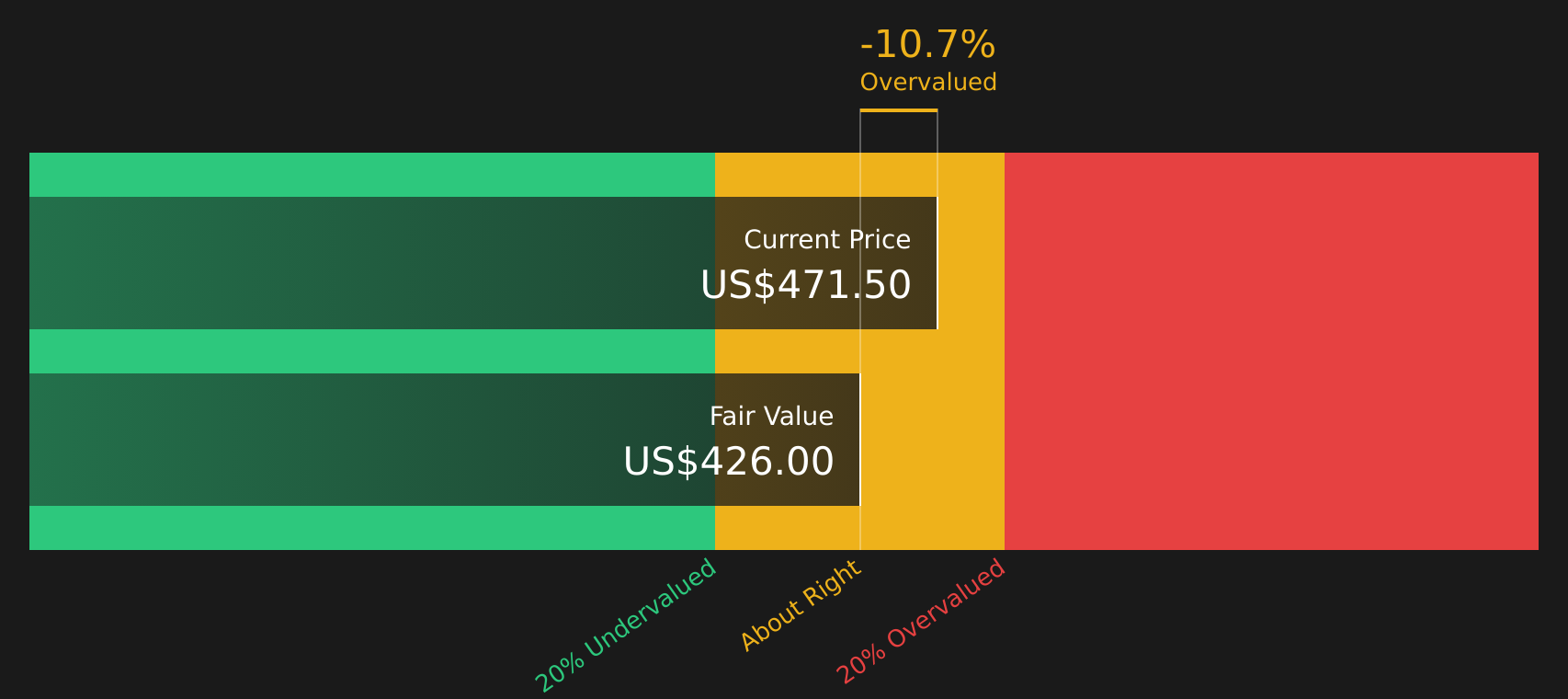
Book value is set at $17.38 per share, with a stable book value estimate of $22.91 per share. Stable EPS is $19.71 per share, sourced from weighted future Return on Equity estimates from 7 analysts. Against a cost of equity of $1.82 per share, that implies an excess return of $17.89 per share and an average Return on Equity of 86.01%. Those excess returns feed into an intrinsic value estimate of $429 per share.
With Moody's currently trading about 10.0% above that Excess Returns estimate, the model suggests the stock is pricing in a premium to its projected value creation on equity.
On this Excess Returns view, Moody's stock currently screens as overvalued relative to its estimated intrinsic value.
Our Excess Returns analysis suggests Moody's may be overvalued by 10.0%. Discover 38 high quality undervalued stocks or create your own screener to find better value opportunities.
Is Moody's Getting Expensive on Earnings?
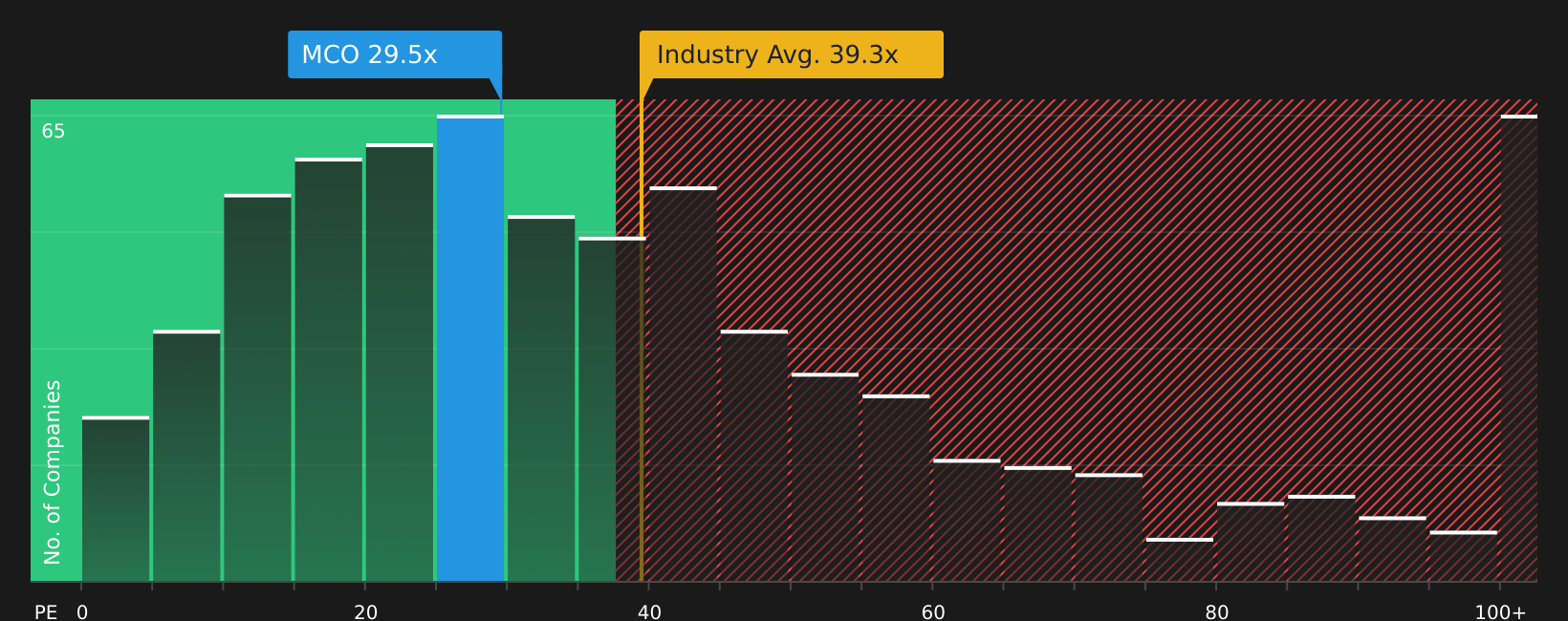
The P/E ratio is a useful starting point for Moody's because earnings are a key driver of value for a fee based, asset light business. Moody's currently trades on a P/E of 29.5x, compared with a Capital Markets industry average of 39.0x and a peer group average of 23.8x, so the stock sits between the broader sector and closer listed peers.
The modelled fair P/E ratio for Moody's is 17.7x, which reflects what investors might typically pay given its margins, scale and risk profile. Set against the current 29.5x, that fair ratio indicates the market is assigning a sizeable premium to Moody's earnings relative to this framework and to peer valuations.
On the P/E multiple alone, Moody's stock appears overvalued, with the current price indicating a higher earnings premium than the model and peers suggest.
See what the numbers say about this price — find out in our valuation breakdown.
The Moody's Narrative: What Would Justify Today's Price?
Simply Wall St Narratives for Moody's pick up where the valuation checks leave off by spelling out what combinations of future growth, margins and earnings would need to play out for the stock to be worth materially more or less than it is today. Instead of stopping at a single output from a ratio or model, they outline the future those numbers rely on so you can watch how Moody's actual progress lines up with that path on the Community page.
The community is split on Moody's, with one camp seeing a core piece of global market infrastructure and the other arguing the stock price already reflects that story.
Bull case: roughly fairly valued
"Over the past decade, management has steadily built Moody’s Analytics (MA) into a major recurring-revenue software and data business…"
Read the full Bull Case to see why Moody's could be undervalued
Bear case: 170% overvalued
"Moody''s Corporation is a regulatory-moated oligopoly wrapped in a compounding software business…"
Read the full Bear Case to see why Moody's could be overvalued
Do you think there's more to the story for Moody's? Head over to our Community to see what others are saying!
The Bottom Line
For Moody's, both the intrinsic value estimate from the Excess Returns model and the P/E based market multiple view point to the stock as overvalued rather than obviously mispriced. The broader valuation checks lean in the same direction, so the burden of proof now sits with the company to deliver enough durable earnings power to justify a premium entry point.
The crux for investors is whether Moody's fee based credit and analytics businesses can sustain the level of profitability and demand implied in today's valuation, or whether any cooling in issuance and data spending would force the market to reassess the multiple being paid for the stock.
This article by Simply Wall St is general in nature. We provide commentary based on historical data and analyst forecasts only using an unbiased methodology and our articles are not intended to be financial advice. It does not constitute a recommendation to buy or sell any stock, and does not take account of your objectives, or your financial situation. We aim to bring you long-term focused analysis driven by fundamental data. Note that our analysis may not factor in the latest price-sensitive company announcements or qualitative material. Simply Wall St has no position in any stocks mentioned.
Have feedback on this article? Concerned about the content? Get in touch with us directly. Alternatively, email editorial-team@simplywallst.com