
- PRICING
- LIVE QUOTES
- LEARN
- HELP


EN
UPS (UPS) Stock Looks Reasonable As Shares Stay Down 28%
United Parcel Service has climbed 18.9% over the past year but is still down 27.9% over three years, while valuation checks and an intrinsic value estimate based on a Discounted Cash Flow (DCF) approach both point to the stock trading below what its cash flows may justify. That sets up a clear tension between a recovering share price and indicators that still suggest potential undervaluation.
- The share price decline of 27.9% over three years means long-term holders are still under water, even after the recent rebound.
- USPS scrutiny of a large air cargo contract and rising competition from Amazon Shipping can weigh on confidence, while any improvement in parcel pricing or contract visibility may support how investors value future cash flows.
- United Parcel Service screens as undervalued on both the DCF intrinsic value estimate and earnings multiples, yet a mixed set of broader checks, with the stock scoring 4 out of 6 on value, suggests a discount that investors still need to scrutinize.
The issue now is whether the current US$114.10 share price already reflects the contract and competitive risks around United Parcel Service, or if the implied discount to intrinsic value still offers room for further upside.
Find out why United Parcel Service's 18.9% return over the last year is lagging behind its peers.
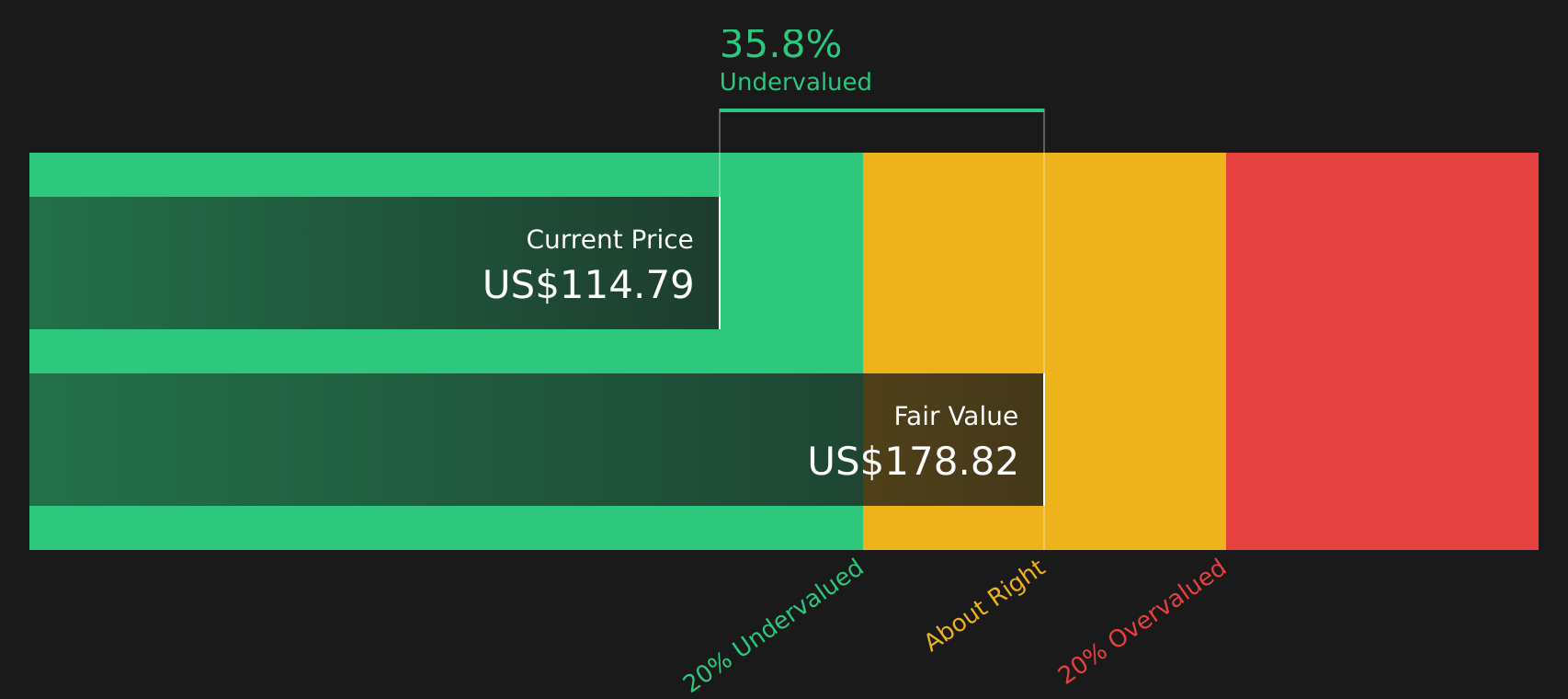
Is United Parcel Service a Bargain on Cash Flow?
The Discounted Cash Flow (DCF) model values United Parcel Service by projecting the cash it could return to shareholders and discounting it back to today. United Parcel Service is modeled with a 2 Stage Free Cash Flow to Equity approach, starting from latest twelve month free cash flow of about $4.0b and using assumptions that point to growing cash flows over time before they level out.
On these inputs, the DCF model arrives at an estimated intrinsic value of $178.76 per share, compared with the current $114.10 share price, implying the stock screens as 36.2% undervalued. Scrutiny of the large USPS air cargo contract helps explain why the market is hesitant, even though the cash flow projections support a higher value for United Parcel Service stock.
Overall, the DCF workup suggests United Parcel Service appears undervalued relative to what its projected cash flows may justify.
Our Discounted Cash Flow (DCF) analysis suggests United Parcel Service is undervalued by 36.2%. Track this in your watchlist or portfolio, or discover 40 more high quality undervalued stocks.
Is United Parcel Service a Bargain on Earnings?
P/E is a useful yardstick for United Parcel Service because earnings remain a core focus for many investors in mature logistics businesses. On this measure, United Parcel Service trades at about 18.5x earnings, which is above the logistics industry average of roughly 15.4x but below the peer group average of about 24.6x.
When compared with a Fair P/E Ratio of 25.5x, which reflects what investors might typically pay for United Parcel Service given its business profile and risks, the current 18.5x multiple sits at a discount to this figure. That gap suggests the stock is priced more conservatively than both this tailored benchmark and many peers in the sector, even with ongoing questions around USPS contract scrutiny and competition from Amazon Shipping.
Taken together, the P/E comparison indicates United Parcel Service stock appears undervalued on this earnings multiple.

See what the numbers say about this price — find out in our valuation breakdown.
The United Parcel Service Narrative: What Would Justify Today's Price?
Simply Wall St Narratives for United Parcel Service pick up from the valuation gap and spell out what would need to be true about United Parcel Service's future growth, margins and earnings for the stock to be worth materially more or less than today's price. They sit on the company's Community page, and each one links its number to a clear view of how growth, profitability and risks might evolve, giving you something concrete to revisit as new information comes through.
Community views on United Parcel Service sit far apart, with one camp focused on transformation upside and another on execution and cost risks.
Bull case: 15% undervalued
"The company's expanding healthcare logistics business, including cold chain, pharma, and SMB healthcare, has an $82 billion addressable market. With the pending Andlauer acquisition, best-in-class service levels, and differentiated tech capabilities, UPS is poised to accelerate high-margin, recurring revenue streams that can support long-term earnings stability and growth…"
Read the full Bull Case to see why United Parcel Service could be undervalued
Bear case: 20% overvalued
"These pressures, combined with declining revenue and earnings per share across recent quarters, suggest that profitability will continue to struggle…"
Read the full Bear Case to see why United Parcel Service could be overvalued
Do you think there's more to the story for United Parcel Service? Head over to our Community to see what others are saying!
The Bottom Line
For United Parcel Service, both the Discounted Cash Flow (DCF) intrinsic value estimate and the earnings multiple view indicate that the stock appears undervalued, even if the broader checks are only mixed rather than strongly supportive. This suggests that the market is still pricing in a significant degree of caution around contract scrutiny and competition, despite what the valuation work indicates.
The key question from here is whether United Parcel Service can maintain the cash flows and earnings that support those models, or whether contract and execution risks remain persistent enough that the current discount reflects ongoing uncertainty rather than a clear opportunity.
This article by Simply Wall St is general in nature. We provide commentary based on historical data and analyst forecasts only using an unbiased methodology and our articles are not intended to be financial advice. It does not constitute a recommendation to buy or sell any stock, and does not take account of your objectives, or your financial situation. We aim to bring you long-term focused analysis driven by fundamental data. Note that our analysis may not factor in the latest price-sensitive company announcements or qualitative material. Simply Wall St has no position in any stocks mentioned.
Have feedback on this article? Concerned about the content? Get in touch with us directly. Alternatively, email editorial-team@simplywallst.com