
- PRICING
- LIVE QUOTES
- LEARN
- HELP


EN
Lennar (LEN) Stock Looks Below Fair Value While Broader Checks Stay Weak
Lennar stock has had a weak run over the past year, yet traditional valuation multiples still screen the shares as undervalued, while a broader set of checks paints a less clear picture. That gap between recent share price performance and what the valuation tools are signaling is what investors are trying to make sense of.
- Over the last 12 months, Lennar has declined 26.2%, which puts recent returns firmly in negative territory even before looking at fundamentals.
- For a large homebuilder, the key upside driver for valuation can be how consistently it converts its order book into cash flow. The main risk is that any sustained pressure on housing demand or construction costs may weigh on profitability.
- Lennar screens as undervalued on some earnings based measures, yet it only passes 2 of 6 broader valuation checks. This suggests the stock does not come across as a clear bargain when viewed in the round, according to 2.
The issue now is whether Lennar's current share price already reflects these mixed signals, or if the market is still pricing the stock too cautiously.
Find out why Lennar's -26.2% return over the last year is lagging behind its peers.
Does Lennar Look Undervalued on Earnings?
The P/E ratio is a common way to compare what you are paying for each dollar of Lennar's earnings against similar companies. Lennar currently trades on a P/E of about 12.4x, which is very close to the peer average of 12.3x and slightly below the wider Consumer Durables sector average of 13.1x. On the surface, that puts the stock roughly in line with direct peers and at a modest discount to the broader industry.
A more tailored model that looks at Lennar's growth profile, profitability, size and risk suggests a higher fair P/E of 21.9x. Set against the current 12.4x multiple, this indicates the stock is pricing in a lower valuation than that framework would suggest, even though headline comparisons to peers do not look extreme.
Overall, Lennar stock appears undervalued on a P/E basis relative to the multiple implied by this fair value framework.
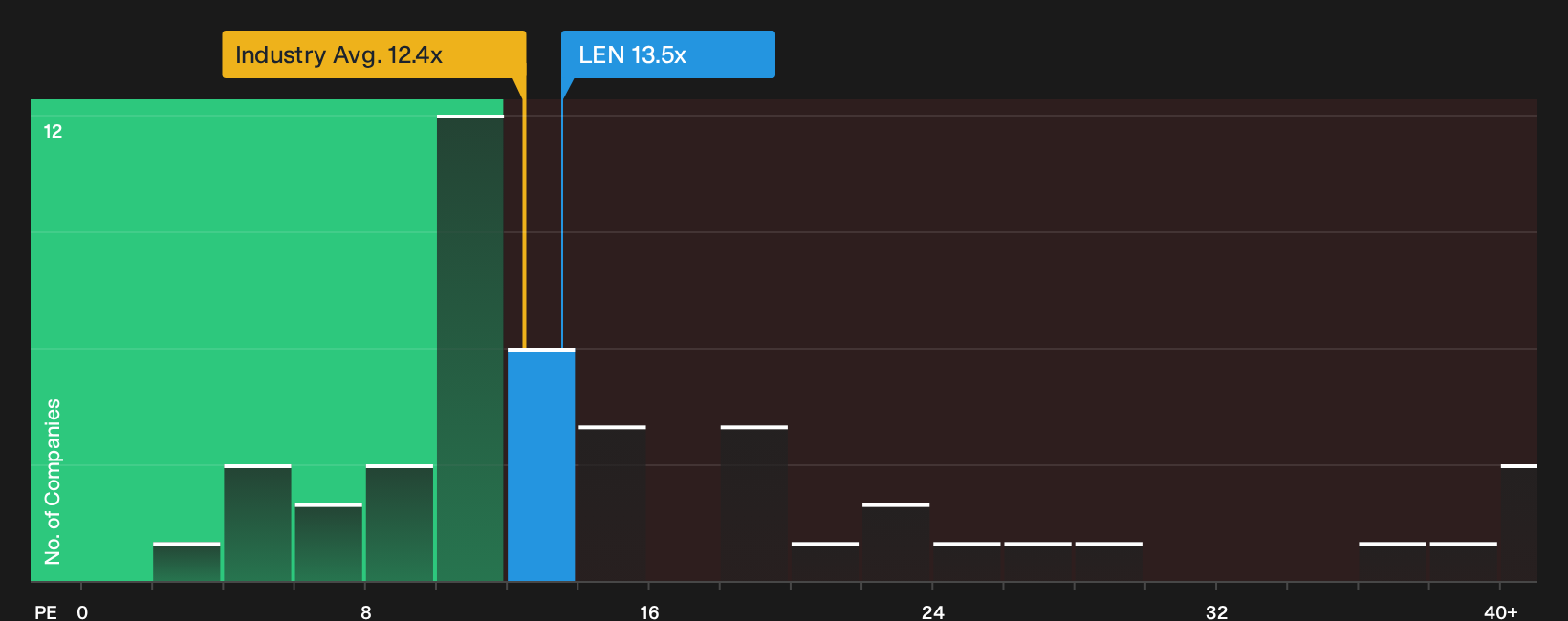
See what the numbers say about this price — find out in our valuation breakdown.
The Lennar Narrative: What Would Justify Today's Price?
Simply Wall St Narratives for Lennar pick up where this valuation puzzle leaves off by spelling out what would need to happen to Lennar's future growth, margins and earnings for the stock to be worth materially more or less than it is today, and they sit on the Community page. Each Narrative treats fair value as a thesis about how Lennar's business might develop over time, which you can then track and reassess as new information comes through.
The community is sharply split on Lennar, with one camp focused on the upside from its asset light shift and another worried about land banking costs and thinner margins.
Bull case: 7% undervalued
"Lennar's transition to an asset-light, land-light model with just-in-time delivery is expected to generate more predictable volume and growth, reducing the asset base and risk profile while improving cash flow, and enhancing future revenue and net margin potential…"
Read the full Bull Case to see why Lennar could be undervalued
Bear case: 11% overvalued
"Lennar is facing a challenging macroeconomic environment with persistently high mortgage interest rates, leading to a decline in actionable demand in the housing market…"
Read the full Bear Case to see why Lennar could be overvalued
Do you think there's more to the story for Lennar? Head over to our Community to see what others are saying!
The Bottom Line
Lennar screens as undervalued on earnings-based multiples, yet the broader set of valuation checks is weak, so the picture is not a straightforward bargain. The key debate is whether that discount reflects temporary caution or a more lasting concern about how margins and cash generation hold up against housing demand and cost pressures. For now, the central question for Lennar stock is whether its shift toward an asset-light model can sustain attractive returns without eroding profitability, or whether the current discount reflects the market’s assessment of execution and demand risks.
This article by Simply Wall St is general in nature. We provide commentary based on historical data and analyst forecasts only using an unbiased methodology and our articles are not intended to be financial advice. It does not constitute a recommendation to buy or sell any stock, and does not take account of your objectives, or your financial situation. We aim to bring you long-term focused analysis driven by fundamental data. Note that our analysis may not factor in the latest price-sensitive company announcements or qualitative material. Simply Wall St has no position in any stocks mentioned.
Have feedback on this article? Concerned about the content? Get in touch with us directly. Alternatively, email editorial-team@simplywallst.com