
- PRICING
- LIVE QUOTES
- LEARN
- HELP


EN
Honeywell Stock Leads These 3 Tariff Exposed Supply Chain Picks
Tariff headlines are no longer short term noise; they are reshaping how companies run global supply chains and manage cash. For investors, that creates clear potential winners and losers. Some stocks stand to benefit as demand grows for tools that add flexibility, such as Foreign Trade Zones and real time supply chain analytics. Others could face margin and cash flow pressure if they stay tied to rigid import and manufacturing setups. This article walks through three stocks exposed to the recent tariff volatility news: one potentially positioned on the right side of these changes and two that may be more vulnerable.
Honeywell International (HON)
Overview: Honeywell International is a global industrial technology company that supplies automation hardware, software, and analytics for factories, logistics centers, refineries, and commercial buildings, alongside energy and sustainability solutions for sectors such as refining, petrochemicals, gas, LNG, and low carbon fuels.
Operations: Honeywell generates most of its revenue from Aerospace Technologies at US$17.7b, followed by Industrial Automation at US$9.2b and Building Automation at US$7.6b, with smaller contributions from segment adjustments and corporate items.
Market Cap: US$72.8b
Honeywell International gives you direct exposure to the tools companies are using to cope with tariff volatility and supply chain stress, from automation and sensing gear in factories to software that models real time logistics and energy use. Management has highlighted a mature local for local footprint and a detailed tariff response playbook, yet earnings and revenue are forecast to decline and recent profit margins have come under pressure. This combines with high debt and a US$1.5b loss to create downside risk. Together with governance changes and mixed sentiment ahead of post spin earnings, this leaves a stock where the tariff driven opportunity is clear, but the balance between cash flow, valuation and execution is not straightforward.
Honeywell International is at the center of tariff volatility, but the real story may be how its balance sheet and cash flows cope with that pressure. For more detail, see the Honeywell International financial health report
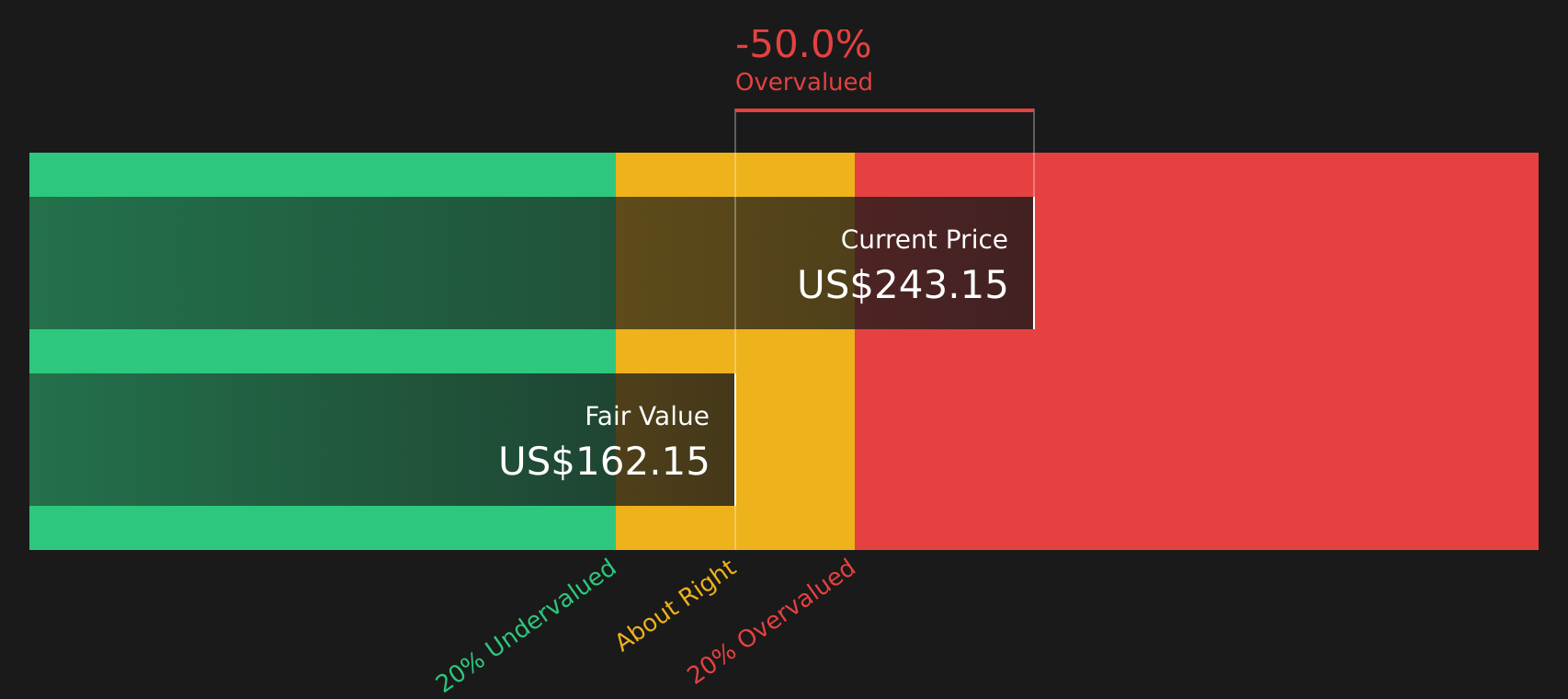
Whirlpool (WHR)
Overview: Whirlpool is a long established home appliance manufacturer that sells refrigerators, laundry machines, cooking appliances, dishwashers and small appliances under brands such as Whirlpool, Maytag and KitchenAid to retailers, builders, other manufacturers and directly to consumers around the world.
Operations: Whirlpool reports US$10.1b from segment adjustments tied to its core appliance activities, alongside Major Domestic Appliances Latin America at US$4.6b, Small Domestic Appliances Global at US$1.1b and smaller contributions from Other and Eliminations.
Market Cap: US$2.4b
Whirlpool attracts attention because the stock screens as cheap against cash flow estimates and earnings forecasts that point to faster profit growth than revenue. However, the business is wrestling with tariff exposure, a complex global supply chain and thin margins around 1.1%. Management promotes its strong U.S. manufacturing base as a relative advantage under new trade rules, but external borrowing is heavy, interest costs are not comfortably covered and shareholders have been diluted while the dividend has been reset lower. With analysts cutting price targets and warning of weaker near term earnings, the key question is whether Whirlpool’s restructuring and product upgrades can offset tariff pressure and intense Asian competition before balance sheet risks bite harder.
Whirlpool’s thin margins, heavy borrowing and tariff exposure suggest the story may be less about a cheap stock and more about fragile cash flows under pressure. Get the full context in the Whirlpool financial health report

Stanley Black & Decker (SWK)
Overview: Stanley Black & Decker is a global tools and industrial products company that sells hand tools, power tools, outdoor equipment and fastening systems under brands such as DEWALT, CRAFTSMAN, STANLEY and BLACK+DECKER to retailers, distributors, dealers and industrial customers across major world regions.
Operations: Stanley Black & Decker generates the bulk of its US$15.2b revenue from Tools & Outdoor at about US$13.2b, with the remaining roughly US$2.0b from Engineered Fastening sold across the United States, Europe, Asia, Canada and Other Americas.
Market Cap: US$13.7b
Stanley Black & Decker looks interesting in this tariff focused context because it sits at the intersection of tool demand, global sourcing and cost cutting, yet its fundamentals leave little room for error. Earnings are expected to grow quickly from a low base, but net margins sit near 2.4% and recent results include a US$461.8m one off loss and asset impairments tied to portfolio changes. Management highlights a more flexible supply chain and tariff mitigation, but the company still relies heavily on imported product, carries debt that is not well covered by operating cash flow and pays a 3.72% dividend that is not fully backed by earnings. For investors, the key question is whether the cost cuts and supply chain overhaul can outrun persistent tariff volatility before cash flow or the dividend come under more serious strain.
Stanley Black & Decker’s tariff exposed supply chain, thin 2.4% margins and uncovered dividend suggest the real pressure point is liquidity, not headlines. Before the strain shows up in full, read the Stanley Black & Decker financial health report

Take Control of Your Investment Journey
If Whirlpool or any of these companies have caught your attention, register for FREE with Simply Wall St and add your companies to a Watchlist to monitor the share price against the fair value and track any new developments as they happen. Once you've made your move, manage your holdings with our Portfolio Command Center that filters out the noise to deliver only the most critical, actionable updates. Throughout your journey, our Community allows you to filter the best ideas from thousands of investor perspectives. By uncovering hidden catalysts and risks early, you'll accelerate your decision-making and stay one step ahead of the market.
Seeking Fresh Alternatives Before Others?
Some stocks are already building breakout momentum while others risk dropping off the radar. Scan fresh ideas before the crowd catches on and act now.
- Spot high yielders that still look built to endure and see which companies make the cut in our 7 dividend fortresses.
- Track early movers in robotics, automation and factory tech and review the curated 33 robotics and automation stocks shaping how work gets done.
- Follow the build out of data centers and power-hungry chips by checking the hand picked 54 AI infrastructure stocks supporting that growth.
This article by Simply Wall St is general in nature. We provide commentary based on historical data and analyst forecasts only using an unbiased methodology and our articles are not intended to be financial advice. It does not constitute a recommendation to buy or sell any stock, and does not take account of your objectives, or your financial situation. We aim to bring you long-term focused analysis driven by fundamental data. Note that our analysis may not factor in the latest price-sensitive company announcements or qualitative material. Simply Wall St has no position in any stocks mentioned.
Have feedback on this article? Concerned about the content? Get in touch with us directly. Alternatively, email editorial-team@simplywallst.com