
- PRICING
- LIVE QUOTES
- LEARN
- HELP


EN
Do Ryman Healthcare’s (NZSE:RYM) Steady ORA Sales and Reaffirmed Builds Clarify Its Capacity Strategy?
- Ryman Healthcare reported that total sales of occupation right agreements for retirement village units in the quarter ended 30 June 2026 were 325, compared with 337 in the same period a year earlier.
- At the same time, the company reaffirmed its fiscal 2027 build guidance for 157 to 168 units and aged care beds across its Patrick Hogan and Richard Hadlee villages, giving investors clearer visibility on upcoming capacity additions.
- We’ll now examine how this steady first-quarter sales performance, alongside reaffirmed 2027 build targets, may influence Ryman Healthcare’s investment narrative.
Invest in the nuclear renaissance through our list of 90 elite nuclear energy infrastructure plays powering the global AI revolution.
Ryman Healthcare Investment Narrative Recap
To be comfortable owning Ryman Healthcare today, you need to believe the company can turn recent losses and high debt into a more self-funding, cash-generative retirement village model. The key short term catalyst is evidence that unit sales and settlements can support that balance sheet, while the biggest risk remains pressure on cash flow and funding costs. This quarter’s marginal dip in occupation right sales and reaffirmed build targets does not materially change that near term risk/reward focus.
The most relevant recent announcement here is Ryman’s reaffirmed guidance for fiscal 2027, targeting 157 to 168 units and beds at Patrick Hogan and Richard Hadlee villages. In the context of investors watching debt and cash generation closely, holding this build outlook steady, alongside relatively stable first quarter sales, reinforces that management is still prioritizing a measured development pipeline as a key catalyst for improving financial performance over time.
Yet behind the steady sales headline, one risk investors should be aware of is that if property market conditions soften further and...
Read the full narrative on Ryman Healthcare (it's free!)
Ryman Healthcare's narrative projects NZ$1.1 billion revenue and NZ$672.2 million earnings by 2029. This requires 8.1% yearly revenue growth and about a NZ$843.5 million earnings increase from -NZ$171.3 million today.
Uncover how Ryman Healthcare's forecasts yield a NZ$3.00 fair value, a 31% upside to its current price.
Exploring Other Perspectives
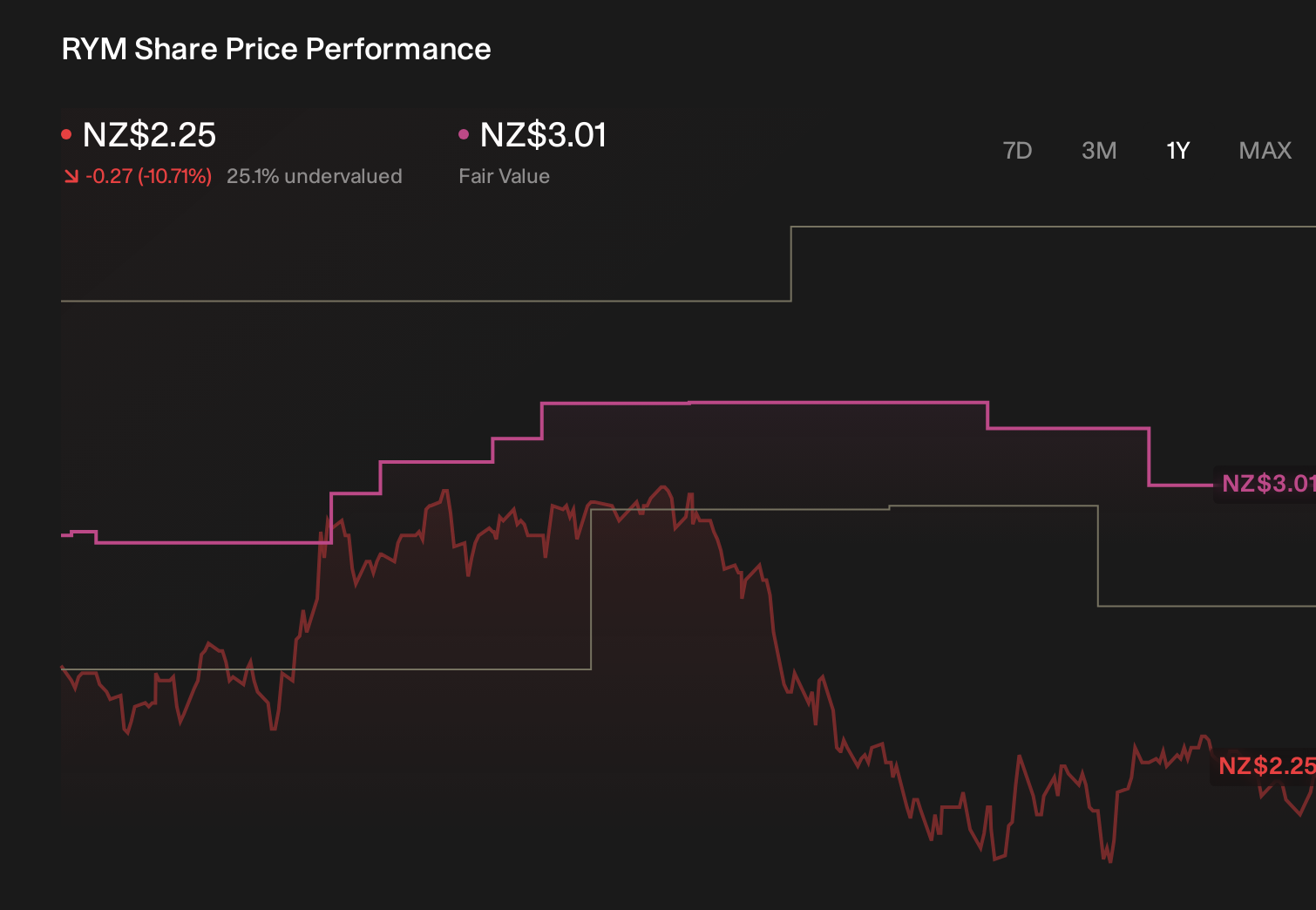
Some of the lowest ranked analysts were already more pessimistic, assuming around NZ$1.0 billion of revenue and NZ$776.4 million of earnings by 2029, so this latest sales update may prompt them to revisit whether interest rate and housing cycle risks could still weigh more heavily than the potential benefits of Ryman’s capacity build and fee structure reset.
Explore 6 other fair value estimates on Ryman Healthcare - why the stock might be worth 13% less than the current price!
Decide For Yourself
Don't just follow the ticker - dig into the data and build a conviction that's truly your own.
- A great starting point for your Ryman Healthcare research is our analysis highlighting 2 key rewards that could impact your investment decision.
- Our free Ryman Healthcare research report provides a comprehensive fundamental analysis summarized in a single visual - the Snowflake - making it easy to evaluate Ryman Healthcare's overall financial health at a glance.
Ready For A Different Approach?
Opportunities like this don't last. These are today's most promising picks. Check them out now:
- Capitalize on the AI infrastructure supercycle with our selection of the 54 best 'picks and shovels' of the AI gold rush converting record-breaking demand into massive cash flow.
- The future of work is here. Discover the 33 top robotics and automation stocks leading the charge in AI-driven automation and industrial transformation.
- The latest GPUs need a type of rare earth metal called Terbium and there are only 29 companies in the world exploring or producing it. Find the list for free.
This article by Simply Wall St is general in nature. We provide commentary based on historical data and analyst forecasts only using an unbiased methodology and our articles are not intended to be financial advice. It does not constitute a recommendation to buy or sell any stock, and does not take account of your objectives, or your financial situation. We aim to bring you long-term focused analysis driven by fundamental data. Note that our analysis may not factor in the latest price-sensitive company announcements or qualitative material. Simply Wall St has no position in any stocks mentioned.
Have feedback on this article? Concerned about the content? Get in touch with us directly. Alternatively, email editorial-team@simplywallst.com