
- PRICING
- LIVE QUOTES
- LEARN
- HELP


EN
Elken Healthcare (01789): The stock price fell for 2 months and finally stepped on Baotong. After Yingxi, did it rebound or reverse?
On the evening of July 21, Elken Healthcare (01789) issued an announcement stating that due to rapid growth in overseas sales and smart device sales, the company expects 2026H1 revenue to increase by about 10% year on year, of which overseas revenue will increase by about 40% year on year; corresponding to 2026H1 net profit will exceed 20% year on year.
However, this profit and profit increase did not immediately receive positive feedback from the market. The Zhitong Finance App observed that on July 22, Elken Healthcare's stock price opened high and fell slightly by 0.69%; on July 23, the company's stock price began to rise and fall after opening, and the subsequent stock price remained below the waterline.
Although there is a certain divergence between the company's short-term stock price trend and fundamentals, for a target that has only been successfully secured and the technical side shows an overbought signal, this probably does not mean the emergence of a clear reversal signal.
What is behind “stepping on the line to keep things safe”
On June 30, Elken Healthcare closed at HK$5.13, ending the “warranty war” since the second half of last year.
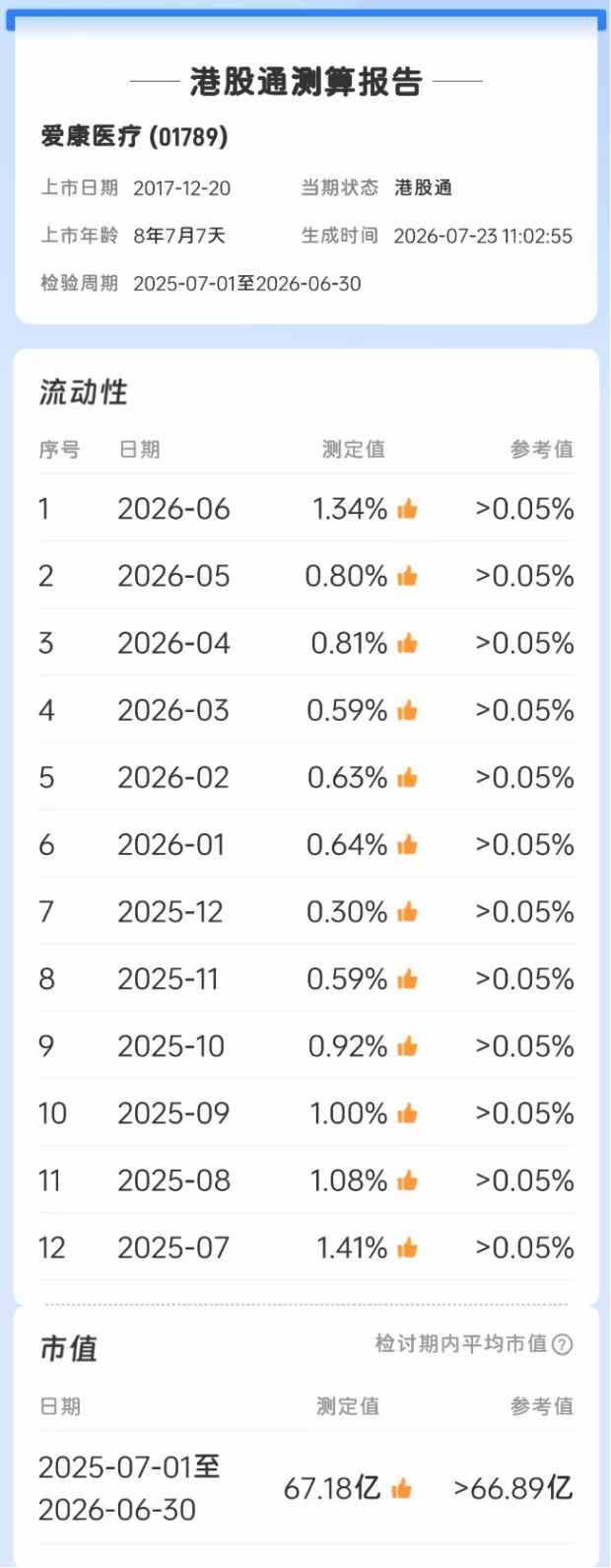
In fact, Elken Healthcare's maintenance pressure this year is greater than in the second half of last year. The first is the Hong Kong Stock Connect threshold. The Hong Kong Stock Connect small-cap threshold has shown a continuous upward trend in recent years. Compared with last year's transfer threshold of around HK$6 billion, this year's transfer threshold has risen to around HK$6.5 billion.
Against this background, the continued decline in stock prices is certainly a dangerous sign for a Hong Kong Stock Connect company. The Zhitong Finance App observed that although Elken Healthcare's stock price rose clearly from late March to early April this year, bringing the stock price to the HK$7 mark, the company's stock price fell all the way after that, and went through a wave of “six consecutive declines” from June 16 to 24. It also hit a low stock price of HK$4.75 on June 24, which is lower than the target price of Baotong at the time.
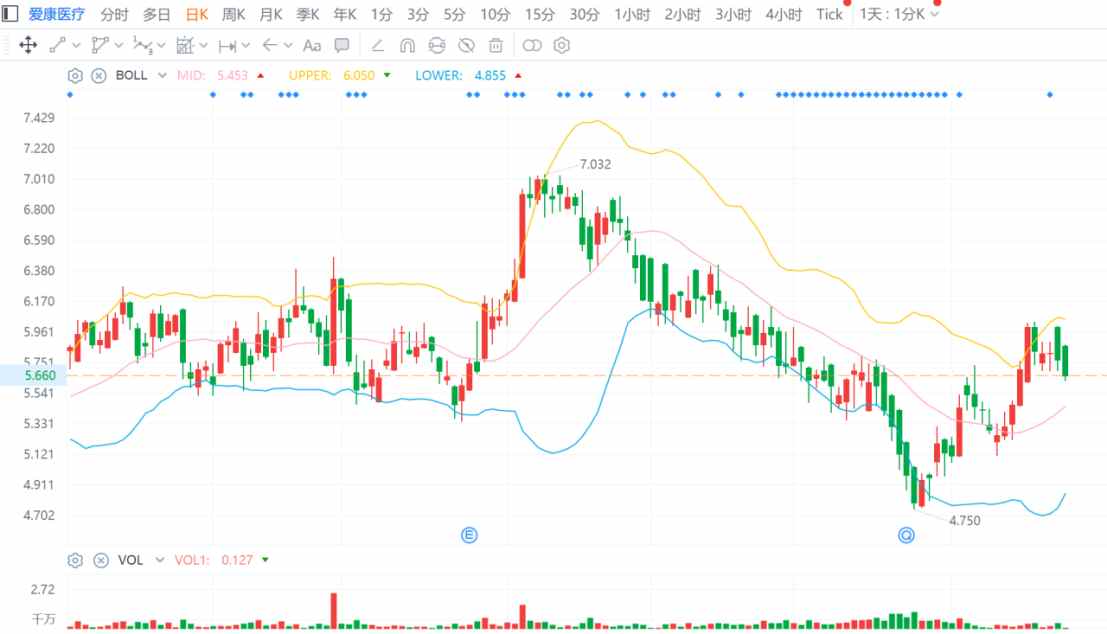
However, the review period for this round of regular adjustments of the Hang Seng Index and Hong Kong Stock Connect is from July 1, 2025 to June 30, 2026. However, after the announcement in the interim report last year, Elken Healthcare began a period of sideways trading for about 3 months. From August 29 to November 25 of last year, the stock price increase in this range was only 0.36%. During this period, buyers' funds used part of the chip pressure to make a deal, and at the same time, they also undertook to sell chips, so that most of their chips were locked in the fund-raising area, and the average cost of chips in the market remained around HK$6. Furthermore, due to the high concentration of chips in the market at the time, the fluctuation in stock prices remained at a low level on a technical level.
In addition, in January-April of this year, the company's stock price and market value basically ran above the Baotong threshold, so even though Elken Healthcare's stock price fell for 2 months, its average daily market value during the review period basically met Baotong's needs. In the end, the company secured with a market capitalization of HK$6.718 billion, which was only HK$29 million above the HK$6.689 billion market capitalization threshold.
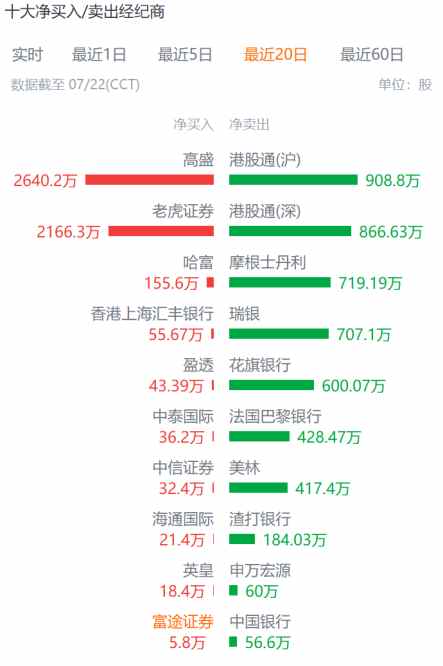
Judging from broker transaction data, Goldman Sachs, Elken Healthcare's largest shareholding broker, and Tiger Securities, the fourth largest broker, became the main protectors in this round of maintenance.
In the past 20 days, Elken Healthcare's top five sellers were Hong Kong Stock Connect (Shanghai), Hong Kong Stock Connect (Shenzhen), Morgan Stanley, UBS, and Citibank, which sold 9.088 million shares, 8.663 million shares, 7.191,900 shares, 7.071,000 shares, and 6.07 million shares, respectively. It is easy to see that since Elken Healthcare's market value remained on the edge of Baotong's threshold at the end of the review period, there is a possibility that it can be released at any time. Whether it is Hong Kong Stock Connect funds or other foreign investment channels, they chose to reduce their holding ratio to avoid possible stock price shocks.
From the buyer's perspective, Goldman Sachs and Tiger Securities were the top two net buyers of Elken Healthcare during the period, with net purchases of 26.402 million shares and 21.663 million shares, respectively. In terms of shareholding ratio, Goldman Sachs's shareholding ratio in Elken Healthcare has now reached 51.17%.
Can speeding up overseas help overtake the decline and rebound the market?
Recently, there has been a strong upward trend in the innovative drug sector in AH and the innovative device sector, yet the performance of the innovative device sector is still sluggish.
According to the Zhitong Finance App, the Hang Seng Innovative Drug Index has rebounded more than 20% since the end of June, and what supports this round of restoration is substantial changes in the fundamentals of innovative drugs in the past two years.
At the fundamental level, the State Drug Administration revealed that by the end of June 2026, a total of 38 Class 1 innovative drugs had been approved for launch in China in the first half of the year, 11 of which were new targets and new mechanism drugs, and all were independently developed by Chinese companies; at the same time, in the first half of this year, China's innovative drug BD reached 110 billion US dollars in overseas transactions, once again setting a new historical record; and at this year's ASCO annual conference, a total of 94 Chinese research projects were selected for oral reporting. The latest breakthrough summary (LBA) reached 12 items, and both figures reached record highs.
The above data all verify the continuous improvement of R&D capabilities and clinical efficiency of Chinese innovative drug companies, and clarify the boom cycle of the domestic innovative drug industry.
However, the innovative device industry has been affected by the restructuring of the domestic medical device industry in recent years, delays in financial funding, and the slowdown in equipment collection. In addition, at the end of last year, the DRG/DIP payment method covered all medical institutions carrying out inpatient services according to plan, leading to a new round of restructuring of the domestic hospital cost control system.
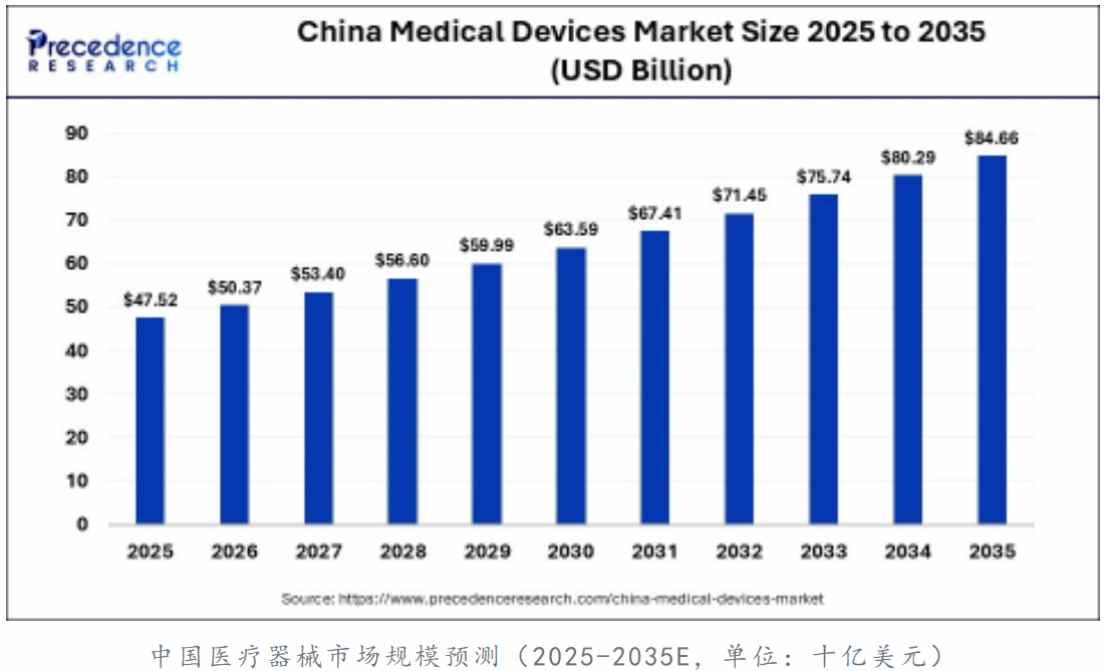
From a market perspective, according to “Fortune” statistics, the global orthopedic medical device market will grow to US$62.22 billion in 2024 and is expected to exceed US$94 billion in 2032, with an average annual growth rate of 5.3%. At a time when the domestic traditional orthopedic market is being collected to compete in the stock market, entering the overseas market has obtained a second growth curve, and has almost become a necessary option for leading companies in the industry. This is one of the reasons why Elken Medical is focusing on the growth rate of overseas revenue in this profit.
In recent years, domestic medical device exports have been undergoing a structural upgrade from “low value consumables” to “high value equipment”. In 2025, total exports of medical devices reached US$68 billion, of which the share of high-value equipment (imaging, endoscopy, surgical robots) increased from 18% in 2020 to 32%. Data from the China Chamber of Commerce for Import and Export of Medicines and Health Products shows that in the 26Q1 quarter, China's medical device exports reached US$12.585 billion, an increase of 8.92% over the previous year.
In the context of the industry speeding up overseas, Elken Healthcare's overseas revenue growth rate and performance are indeed worthy of market attention.
Take the same period last year as an example. As one of the first domestic orthopedic consumables companies in the industry to go overseas, Chunli Medical already accounted for 40% of overseas revenue in the first half of last year. In contrast, Elken Healthcare still focused on domestic business at the time. The company accounted for 18% of overseas revenue during the same period. Although it ranked third among the top 5 companies at the time, there was still a big gap with Chunli Medical and Sanyou Medical. However, Elken Healthcare seems to have accelerated investment in overseas markets this year, and achieved a positive performance of about 40% year-on-year increase in overseas revenue in the first half of this year.
Earlier research by Goldman Sachs showed that Elken Healthcare currently accounts for about 20% of the domestic joint implant market, covering 5,000 hospitals; management expects to ship 20 robotic systems in 2026, corresponding revenue of 40 million yuan, and the number of surgeries will reach 10,000 to 14,000 units. More importantly, Beijing's pricing policy for surgical robots has exceeded expectations, and the growth rate of overseas exports is higher than expected. Robotics and overseas business are expected to become new growth engines different from traditional orthopedic companies.