
- PRICING
- LIVE QUOTES
- LEARN
- HELP


EN
Cui Dongshu: In the January-July NEV duty-free catalogue, there were 21,753 models, of which 595 new models were at a high position in July compared to the same period in the past three years
The Zhitong Finance App learned that on July 23, Cui Dongshu, Secretary General of the Passenger Federation Branch, published an article stating that there were 21,753 NEV duty-free models in the January-July 2026 duty-free catalogue, of which 595 new models were new in July, which is at a high position compared to the same period in the past three years. Pure electric vehicles have become mainstream in the car market. In July, the number of pure electric models among passenger cars reached 81, accounting for a much higher proportion than plug-in hybrid and extended-range models. Currently, there is a large number of electric power exchange models. In 2026, there will be a slight increase, mainly pure electric ones. Among them, passenger car swapping models have slowed slightly, while electric special electric vehicles are growing faster.
The range of new pure electric passenger cars increased rapidly, from 468 kilometers in 2024 and an average of 523 kilometers in 2025 to an average of 603 kilometers in July 2026. In 2026, the number of products with a range greater than 700 km will continue to increase by 35%, and the technology has improved significantly. The battery life of new hybrid products in the narrow sense has exploded, rising from 93 km in 2024 and an average of 120 km in 2025 to an average of 151 km in July 2026. The battery life of new extended-range products has exploded, rising from 140 kilometers in 2024 and an average of 174 kilometers in 2025 to an average of 196 kilometers in July 2026.
The heavy weight of pure electric vehicles is obvious. From 2022, 44% of new cars will be 2 tons or more, and by 2026, 58% will be 2 tons or more. The heavy weight of mixing in the narrow sense is obvious. From 2023, 54% of new cars will be 2 tons or more, and by 2026, 77% will be 2 tons or more. The increase in weight is obvious. From 2022, 83% of new cars were 2 tons or more, and by 2026, 96% were 2 tons or more, and 2.5 tons or more reached 75%. There is a clear trend of obesity in new energy vehicles.
Currently, the electricity consumption of the new pure electric models in July is basically around 13 degrees. The electricity consumption of plug-in hybrid and extended range models is higher. The average electricity consumption of plug-in hybrid models in the narrow sense is 22 degrees per 100 kilometers, and the average power consumption of extended-range models is 21 degrees per 100 kilometers.
1. Overall status of the 2026 duty-free catalogue

From January to July 2026, there were 21,753 models in the NEV duty-free catalogue, of which 595 new models were new in July, which is at a high level compared to the same period in the past three years. The number of catalogue resources for February-July is similar compared to the same period in 2025. There are many new passenger car products, few subsidies, and a sluggish market. New trucks have less subsidies and a better market.
The catalogue of new energy vehicles has gradually been enriched in recent years. The 2024-2026 catalogue of new energy passenger vehicles should be said to be large in total. With the release of tax-free vehicle purchase targets, high-end new vehicle products for new energy vehicles are still booming this year.
2. Changes in the power structure of new cars

Due to the high hydrogen fuel subsidy factor, the performance of hydrogen energy commercial vehicles was strong in the early stages, and hydrogen energy has weakened both domestically and internationally recently. Recently, hydrogen fuel for passenger cars can be ignored or not cared about; there is no room for development in the short term.
Pure electric vehicles have become mainstream in the car market. In July, the number of pure electric models among passenger cars reached 81, accounting for a much higher proportion than plug-in hybrid and extended-range models.
Although the market sales performance of the mixed growth range is weak, the 2026 growth catalog has recently exploded in growth, and there is also a lot of mixed growth. The pure electric bus remained the absolute main force, and the expansion range began to be explored.
Pure electric power is the absolute main force in special vehicles, and hydrogen fuel has become a hot topic. There have been no hydrogen fuel products for passenger cars since April 2026, which is a good thing that meets market demand.
3. Tracking the model of the electric car exchange

Currently, there are a large number of electric models, and there will be a slight increase in 2026, mainly pure electric ones. Among them, there has been a slight slowdown in the exchange of passenger cars for electric trains, while the number of electric special purpose vehicles has increased rapidly.
4. 2026 range of pure electric passenger cars

The overall range of new energy vehicles continues to increase, and the policy promotes the development of new energy vehicles in the direction of high battery life and more batteries.
The range of new pure electric passenger cars increased rapidly, from 468 kilometers in 2024 and an average of 523 kilometers in 2025 to an average of 603 kilometers in July 2026. In 2026, the number of products with a range greater than 700 km will continue to increase by 35%, and the technology has improved significantly.
The battery life of new hybrid products in the narrow sense has exploded, rising from 93 km in 2024 and an average of 120 km in 2025 to an average of 151 km in July 2026.
The battery life of new extended-range products has exploded, rising from 140 kilometers in 2024 and an average of 174 kilometers in 2025 to an average of 196 kilometers in July 2026.
5. Vehicle maintenance quality for new energy vehicles in 2026

As the vehicle preparation quality of new energy vehicles continues to increase in 2026, the average weight of new pure electric vehicles in July was 2,075 kg, the average weight of new plug-in hybrid cars in July was 2,283 kg, and the average weight of new extended-range models in July was 2,515 kg, all reaching heavy levels.
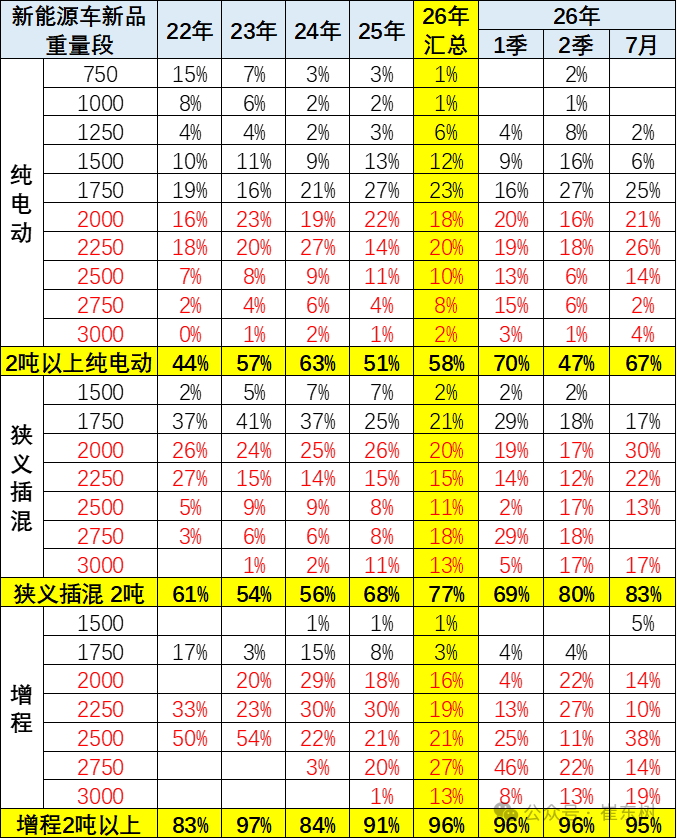
The heavy weight of pure electric vehicles is obvious. From 2022, 44% of new cars will be 2 tons or more, and by 2026, 58% will be 2 tons or more. The heavy weight of mixing in the narrow sense is obvious. From 2023, 54% of new cars will be 2 tons or more, and by 2026, 77% will be 2 tons or more.
The increase in weight is obvious. From 2022, 83% of new cars were 2 tons or more, and by 2026, 96% were 2 tons or more, and 2.5 tons or more reached 75%. There is a clear trend of obesity in new energy vehicles.
6. Battery energy density
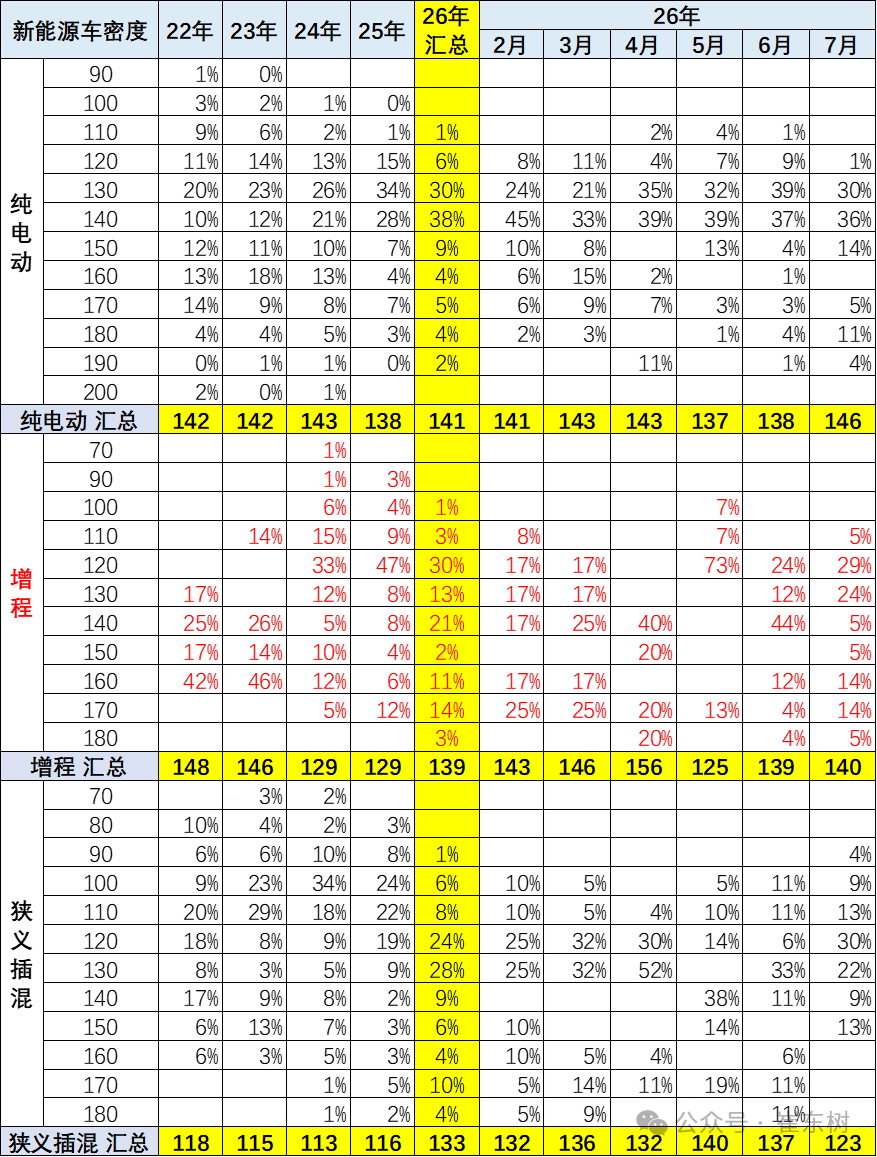
The energy density of pure electric vehicle batteries has slowly increased in recent years, averaging 138 watt-hours/kg in 2025, 144 watt-hours/kg in 2026, and reaching an average of 146 watt-hours/kg in July. There has been an increase in the number of models between 130 watts and 140 watt-hours being introduced.
There are many mixed products with low energy density, with an average of 116 watt-hours/kg in 2025, 133 watt-hours/kg in 2026, and an average of 123 watt-hours/kg in July. There are many products in the 130 watt-hour/kg range. There are also some with high energy density, and there are fewer intermediate products.
Differential development of extended-range and mixed-range products, averaging 129 watt-hours/kg in 2025, 139 watt-hours/kg in 2026, and reaching an average of 140 watt-hours/kg in July. Recently, there are many low-energy density batteries with extended ranges being loaded, and there are many high-energy density batteries with extended ranges.
7. Comprehensive comparison of various models in 2026

The electricity consumption of pure electric models over 300 kilometers is basically around 12-13 degrees, and the increase in electricity consumption for long battery life is not significant. The energy density of batteries with a battery life of more than 400 kilometers is also above 140.
Currently, the electricity consumption of the new pure electric models in July is basically around 13 degrees. The electricity consumption of plug-in hybrid and extended range models is higher. The average electricity consumption of plug-in hybrid models in the narrow sense is 22 degrees per 100 kilometers, and the average power consumption of extended-range models is 21 degrees per 100 kilometers.
Analysis of pure electric passenger cars below 8. 5 meters

In July, there were many independent new energy vehicle products. Most of them were products over 4.8 meters. Models above 5 meters accounted for a high proportion, and high-end products were highly competitive.
Tracking new cars over 9. 5 meters

In July, the proportion of models above 5 meters was high, and high-end products were more competitive. The indicators of products such as the Huawei Questionnaire are good. The electricity consumption of Geely and BAIC is extremely low, and the advantages of practicality are obvious.
Self-owned brands such as BYD, Great Wall, Chery, and Geely, which are new plug-in hybrids, have performed very well. The plug-in hybrid power consumption of some models, such as Geely, has also been reduced to around 16 degrees, and the performance is very good. The energy density of mixed batteries in the narrow sense is generally high, and there is also a large difference in electricity consumption per 100 kilometers.
In July, many new range extended-range products were launched in the duty-free catalogue. Long-range models with a long battery life have lower fuel consumption and electricity consumption, which is also a highlight of future growth. However, recent growth market trends are poor, and new products are expected to activate this market.