
- PRICING
- LIVE QUOTES
- LEARN
- HELP


EN
SK Hynix (SKHY.US) ADR conversion quota has been exhausted! The world's most attractive arbitrage trading channel closed
The Zhitong Finance App has learned that one of the world's most attractive arbitrage opportunities will continue to be closed to investors. The Korea Securities Depositary Authority (KSD) stated that SK Hynix (SKHY.US) has limited the number of Korean-listed shares that can be converted to US Transaction Depositary Receipts (ADR) to less than 2.5% of the company's total tradable shares.
KSD is Korea's central securities custodian and is responsible for supervising the issuance and cancellation of depository certificates linked to Korean stocks. Lee Yun-soo, the agency's CEO, said that the conversion quota has been fully used through SK Hynix's $26.5 billion ADR issuance on July 10. This means that unless existing ADR holders of SK Hynix first convert their ADR traded in the US back to Korean listed stocks to free up space within the quota limit, investors will no longer be able to convert SK Hynix's Korean listed shares to ADR.
This information revealed a key issue that investors have been paying close attention to since SK Hynix hit the US market. Investors have been waiting for a clear answer on whether SK Hynix's Korean-listed shares can be freely converted to ADR, and this conversion mechanism usually helps maintain close synchronization of stock prices between different markets. If the new ADR cannot be freely converted, there will be fewer ways for investors to profit from the price difference between the Seoul and New York markets.
This may cause the US ADR to maintain a premium trading status compared to South Korean-listed stocks for a long time. According to the data, SK Hynix ADR's premium compared to its shares listed in Korea was once as high as 51%, and was still about 33% higher as of Wednesday. However, restrictions on conversion limits increase the possibility that this spread may continue to widen for a long time.
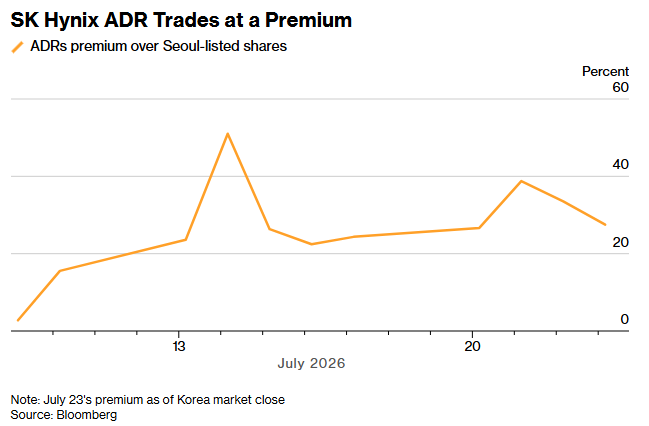
SK Hynix ADR continues to trade at a premium
Restrictions on conversion limits between SK Hynix ADR and shares listed in Korea make it impossible for arbitrage investors to learn from the experience of operating SMC ADR arbitrage transactions in the past. TSMC's ADR can be converted to local stocks in Taiwan, but ADR cannot be freely created directly from Taiwanese listed stocks. As a result, TSMC ADR has generally maintained a premium trading status for a long time. According to data, over the past five years, TSMC's ADR price was 12.6% higher than Taiwan's locally listed stocks on average.
In addition to restrictions on conversion amounts, the lack of historical data also makes SK Hynix ADR's arbitrage transactions more difficult. TSMC ADR has been trading for decades, and investors have a clear understanding of how it usually maintains a premium compared to local stocks. However, soon after SK Hynix ADR went public, arbitrage investors lacked historical benchmarks to determine what kind of premium is at a normal level, and it is even more difficult to determine whether the current price spread is attractive or has widened excessively.
Furthermore, SK Hynix has become one of the most volatile large-cap stocks in Asia in recent years. As investors continue to pour into artificial intelligence (AI) related memory chip concept stocks and leveraged products linked to this stock, their stock prices often fluctuate far above the market average in a single day. This sharp fluctuation further increases the so-called “spread risk,” that is, the price trend between ADR and stocks listed in Seoul, South Korea, may clearly deviate from the direction that arbitrage traders originally placed their bets.