
- PRICING
- LIVE QUOTES
- LEARN
- HELP


EN
When will the Bank of Japan raise interest rates next? Economists expect the most likely December, and the market is betting on October
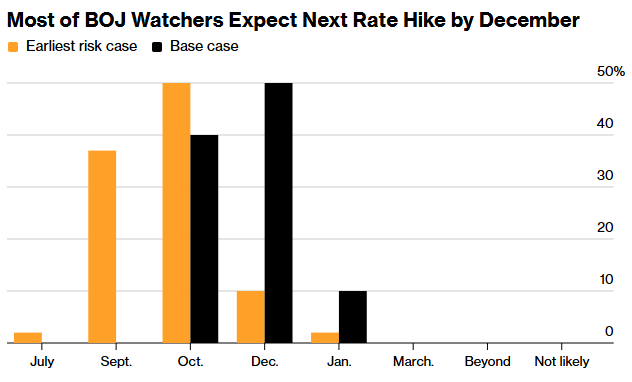
The Zhitong Finance App learned that the Bank of Japan's future rate hikes is facing a new policy game. According to the latest survey, despite continuing inflationary pressure in Japan and the sharp depreciation of the yen, most economists still expect that the Bank of Japan will not rush to tighten policy continuously, and the next interest rate hike window is more likely to fall in December of this year. According to the agency's survey of 52 economists, 50% of respondents think the next time the Bank of Japan raises the benchmark interest rate will most likely occur in December; 40% of economists expect to act in October.
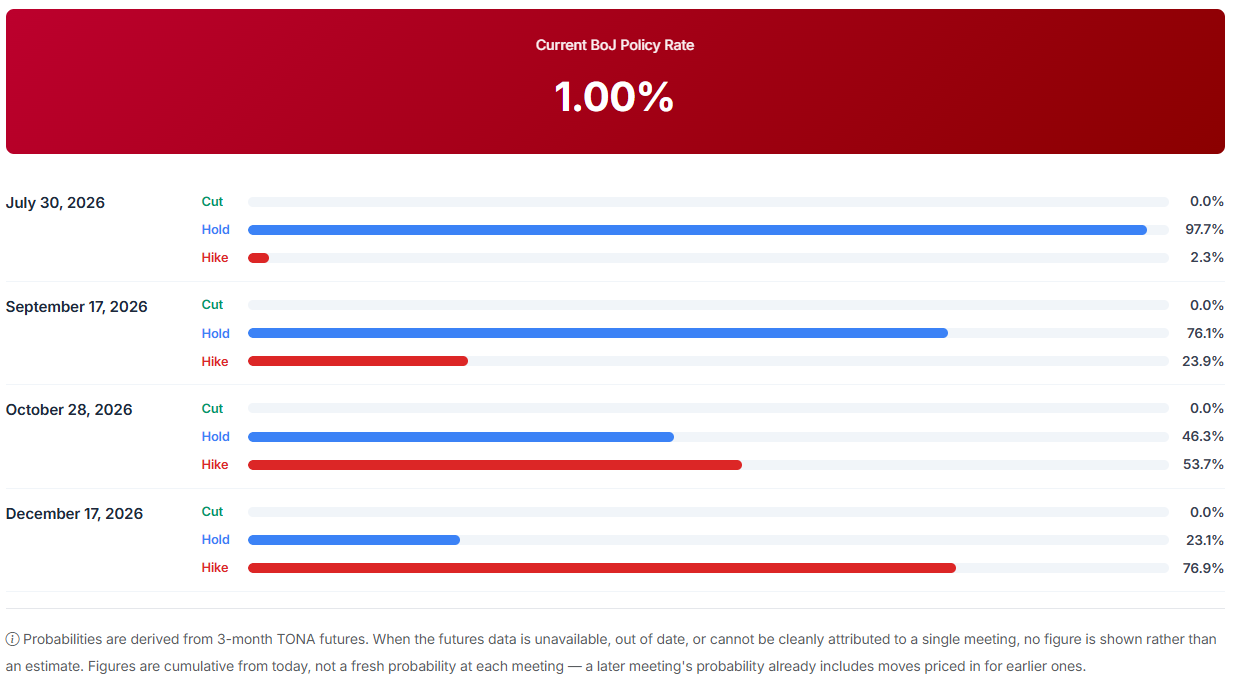
In contrast, market pricing is clearly more aggressive. As of the survey, the Japanese interest rate futures market shows that investors expect the probability that the Bank of Japan will raise interest rates in October to be close to 80%.
The Takaichi government favors an easing policy, which has become the biggest uncertain factor in interest rate hikes
According to the survey, 59% of economists believe that the influence of the Takaichi government on the speed of monetary policy normalization will be an important obstacle for the Bank of Japan to raise interest rates further.
Takaichi Sanae has long been inclined to support a relaxed fiscal and monetary environment. Her economic policy propositions include expanding government spending, supporting industrial investment, and avoiding too rapid tightening of financial conditions. Some economists believe that although the Bank of Japan has already entered a cycle of interest rate hikes, the government's concerns about economic growth and debt costs may limit the speed of its policy adjustments.
The Bank of Japan has previously emphasized the independence of monetary policy. In order to assuage market concerns about “the government forcibly interferes with the independence of the central bank,” the Japanese government specifically revised and added the statement “respecting the Bank of Japan's autonomy” to the annual economic and fiscal policy outline approved a few days ago in an attempt to ease market concerns about the government interfering with the central bank's decisions.
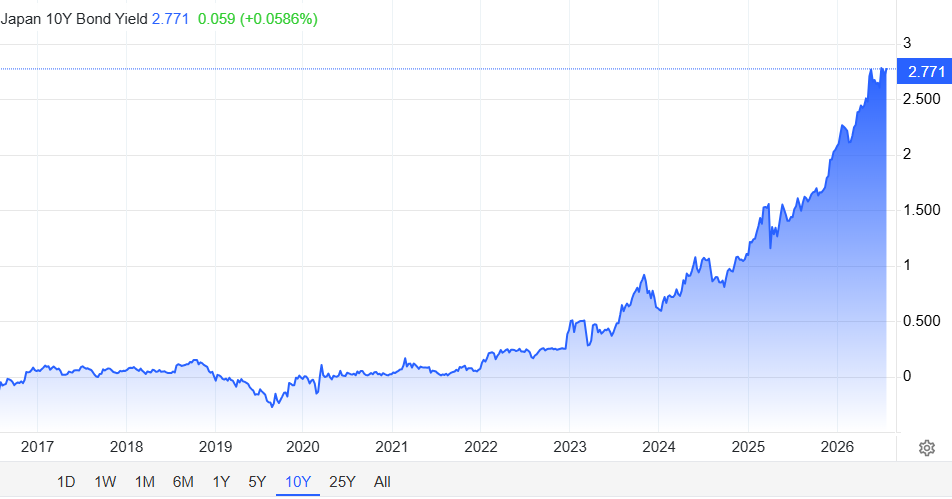
Earlier, the government's draft outline triggered a panic in the bond market, pushing the yield on Japan's 10-year treasury bonds to the highest level in nearly 30 years. However, the government's statement did not completely allay market concerns. About two-thirds of the economists interviewed clearly stated that they did not believe that the government's revised wording in the outline meant that it would stop interfering with the central bank's independent decisions.
However, according to the survey, about two-thirds of economists are still unconvinced that this adjustment means that the government will not try to influence the Bank of Japan in the future. Tsuyoshi Ueno, chief economist at the NLI Institute, said, “Due to differences between the Bank of Japan and the government over the speed of interest rate hikes, the threshold for early rate hikes is still high.”
Divergence between markets and economists
The large gap in expectations between economists and market participants is rare in this monetary policy cycle. The direct catalyst for market participants being more aggressive than economists came from a report released after the survey was completed: People familiar with the matter revealed that since the continued weakness of the yen increased the risk of rising inflation, Bank of Japan officials were open to raising interest rates faster than economists generally expected. Officials are aware that many observers expect the central bank to act approximately every six months, but they are willing to raise interest rates early if necessary, without setting a specific path. According to derivatives market pricing, traders expect that the probability that the central bank will raise interest rates by October is as high as 80% at one point.
Officials said that it is particularly important now to carefully examine additional upward price risks, because the potential inflation rate is finally very close to the 2% target set by the central bank more than 13 years ago. As potential inflation approaches 2%, some officials believe that the central bank's task is changing — policymakers' focus is gradually shifting from driving prices up to ensuring that inflation remains stable near target levels.
Furthermore, officials have seen evidence that inflation is becoming more entrenched — companies are passing on rising costs to customers faster than ever before, reflecting a shift in pricing behavior since the outbreak of the Iranian conflict.
The sharp fall of the yen below 163 and the impact of oil prices: the risk of rising inflation may force the central bank to act early
Despite the political resistance, the possibility that the Bank of Japan will be forced to “push the interest rate hike button ahead of time” under the influence of the exchange rate and the situation in the Middle East cannot be ignored.
At the interest rate meeting on June 16 this year, the Bank of Japan raised the benchmark interest rate to a historic high of 1.0% without receiving clear opposition from the government. 65% of the central bank observers interviewed pointed out that it was because of the continued weakening of the yen and the sharp increase in import costs at the time that the Takaichi government had to passively accept this decision to raise interest rates.
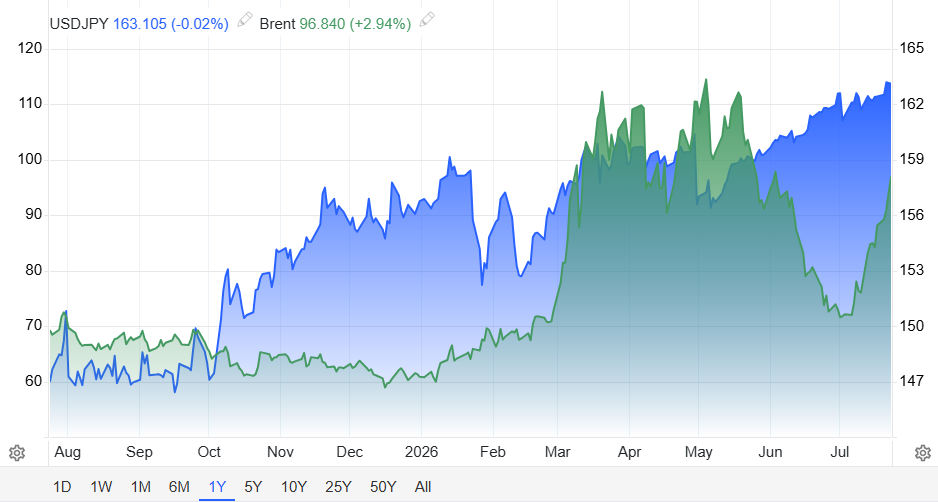
Recently, however, geopolitical risks have once again detonated the foreign exchange and commodity markets: the yen fell below historic lows, the intensification of the US-Iran conflict drove international crude oil prices to soar sharply, and the exchange rate of the yen against the US dollar once fell below the 163 mark, the lowest level since 1986. Imported inflation has intensified, and Japan relies on imports for almost all energy and more than half of its food. The extreme weakness of the yen has directly increased the pressure on the import costs of crude oil and commodities.
In this context, economists' attitude towards “earlier-than-expected interest rate hikes” has relaxed somewhat. When asked about the earliest possible time for the next policy adjustment, 37% of experts chose September of this year (up from 23% of the survey after the June meeting).
Kento Minami, an economist at Daiwa Securities, said, “The depreciation of the yen continues to push up prices, and the upward risk of inflation remains high. The Bank of Japan is shifting the focus of interest rate decisions to deal with the risk of rising inflation, which makes the next rate hike come sooner than previously anticipated.”
Notably, about 65% of Bank of Japan observers believe that it was the continued depreciation of the yen that forced Takaichi Sanae to accept the interest rate hike on June 16 — when the central bank raised the benchmark interest rate to 1%, a 31-year high.
The game between the Japanese government and the central bank: from economic blueprint to bond market turmoil
The tense relationship between the Takaichi Sanae government and the Bank of Japan was revealed in the annual economic and financial operation policy finalized on July 21.
Expressions calling for the implementation of a monetary policy to “boost private demand” have been removed from the earlier draft. After triggering market shocks, the relevant content was further revised to make it clear that the central bank formulates policies aimed at “achieving a steady rise in prices.” The final version of the outline retained the statement urging the central bank to be consistent with government policy, but added a footnote referring to the provisions of the law protecting the independence of the central bank.
However, the market's doubts have not dissipated. The previous version of the draft raised concerns that policy normalization might be delayed, and once pushed the yield on the benchmark 10-year Japanese treasury bond to the highest level in 30 years. In mid-July, the yield on 10-year Japanese bonds once rose to 2.9%, the highest level since September 1996. As of July 23, the 10-year yield remained at around 2.77%.
Eugene Leow, senior interest rate strategist at DBS Group Research, pointed out that since the beginning of 2026, the gap between one-year dollar interest rates and one-year yen interest rates has continued to widen. Investors have switched their expectations of the Federal Reserve from cutting interest rates to raising interest rates, while Japan's interest rate adjustments have been much more moderate. The interest rate spread between the US and Japan still remains a huge gap of about 250 to 275 basis points.
July 31 Conference: Putting down the military is a foregone conclusion; focus shifts to the outlook report
The market generally expects that the Bank of Japan will keep the policy interest rate unchanged at 1.0% at the monetary policy meeting on July 31. Since Governor Ueda and Osamu were absent from the last meeting due to illness, this press conference will be the first opportunity for the outside world to directly evaluate their policy positions.
Mizuho Securities economist Yusuke Matsuo anticipates that Kazuo Ueda will restate his position on further interest rate hikes at next week's press conference, but the relevant statement is unlikely to reverse the weak trend of yen. The market has basically absorbed the expectation of interest rate hikes every six months, so it is difficult to push up the yen exchange rate significantly based on such statements alone. Given the market's expectation that the central bank will determine the timing and intensity of the next rate hike, any position interpreted as dovish may exacerbate the weakening of the yen in an environment where the US dollar is strengthened as a whole.”
At the upcoming policy meeting, the latest quarterly economic outlook forecast announced by the Bank of Japan will be the core basis for the market to evaluate interest rate trends. According to the median forecast of the economists interviewed, the 2026 inflation forecast will be slightly revised down to 2.6% from the 2.8% forecast previously estimated. Real GDP growth forecast for 2026: It will be revised up from the previous estimate to 0.7%.
Can the pace of interest rate hikes every six months continue?
The Bank of Japan is facing an almost inexplicable dilemma: if interest rates are kept low, the inflationary pressure brought about by the weakening yen may increase; however, if interest rates are raised too fast, it may increase debt repayment pressure and drag down an already weak economic recovery.
The consensus of the group of economists is that interest rates are raised approximately every six months. But the yen is hovering at the 163 mark, the US-Iran conflict is driving up oil prices, and interest spreads between the US and Japan continue to widen — these realities are constantly challenging the sustainability of this pace.
The market has given its own answer: the probability of 83% is betting on action before 10 months. Meanwhile, the Bank of Japan official's statement that they are “open to a faster rate hike” provided more fuel for this bet.
“The Bank of Japan is shifting the focus of its interest rate decision to managing the risk of upward inflation,” Minami said. When the risk of inflation collides head-on with political resistance, the Bank of Japan's next rate hike — whether in October or December — will be one of the most important macroeconomic narratives in global capital markets.