
- PRICING
- LIVE QUOTES
- LEARN
- HELP


EN
The two departments issued the “Fifteenth Five-Year Plan” for the Revitalization and Development of Traditional Chinese Medicine: By 2030, the innovation and creativity of the Chinese medicine industry will be greatly enhanced
The Zhitong Finance App learned that on July 23, the State Administration of Traditional Chinese Medicine and the National Development and Reform Commission issued the “Fifteenth Five-Year Plan” for the Revitalization and Development of Traditional Chinese Medicine. Among them, it is proposed that by 2030, the traditional Chinese medicine service system covering the entire population and the entire life cycle will be more complete, new breakthroughs will be made in traditional Chinese medicine prevention and treatment of major diseases, the quality of grass-roots services will be upgraded, basic research capabilities will be greatly improved, the innovation and creativity of the traditional Chinese medicine industry will be greatly enhanced, traditional Chinese medicine culture and international influence will be further enhanced, and the revitalization and development of traditional Chinese medicine will reach a new level, so that everyone can enjoy traditional Chinese medicine services.
The original text is as follows:
National Development and Reform Commission of the State Administration of Traditional Chinese Medicine
Notice on Issuing the “Fifteenth Five-Year Plan for the Revitalization and Development of Traditional Chinese Medicine”
China Traditional Chinese Medicine Regulations Financial Development [2026] No. 8
The people's governments of the provinces, autonomous regions and municipalities directly under the Central Government, the Xinjiang Production and Construction Corps, the ministries, departments and agencies directly under the State Council:
The “Fifteenth Five-Year Plan” for the Revitalization and Development of Traditional Chinese Medicine (hereinafter referred to as the “Plan”) has been approved by the State Council (State Letter [2026] No. 71) and is now being issued to you. Please implement it carefully. In accordance with the State Council's approval spirit, the relevant matters are hereby notified as follows:
1. The implementation of the “Plan” should adhere to Xi Jinping's ideology of socialism with Chinese characteristics in the new era, thoroughly implement the spirit of the 20th National Congress and the 20th Plenary Session of the CPC, earnestly implement General Secretary Xi Jinping's important remarks on building a healthy China and the work of traditional Chinese medicine, unswervingly implement the health and health development path of the new era, adhere to equal emphasis on traditional Chinese medicine, adhere to the rules and characteristics of traditional Chinese medicine, improve the traditional Chinese medicine inheritance, innovation and development mechanism, and accelerate the modernization of traditional Chinese medicine The world provided strong support to promote decisive progress in building a healthy China during the “15th Five-Year Plan” period.
2. The people's governments of all provinces, autonomous regions and municipalities directly under the Central Government should take the revitalization and development of traditional Chinese medicine as an important task for the region's economic and social development during the “15th Five-Year Plan” period, strengthen organizational leadership, clarify the division of responsibilities, improve working mechanisms, refine implementation measures, and ensure that the goals, tasks, policies and measures of the Plan are implemented. Encourage all regions to use their comparative advantages and innovate measures to revitalize and develop traditional Chinese medicine according to local conditions.
3. In accordance with the division of responsibilities, all relevant departments under the State Council should strengthen coordination and coordination, strengthen work guidance, refine specific support measures, and form policy synergies to promote the revitalization and development of traditional Chinese medicine. Important policies, major projects, and key projects involved in the implementation of the Plan must be submitted for approval in accordance with the procedures.
National Development and Reform Commission of the State Administration of Traditional Chinese Medicine
July 16, 2026
“Fifteenth Five-Year Plan” for the Revitalization and Development of Traditional Chinese Medicine
In order to implement the decisions and arrangements of the Party Central Committee and the State Council on traditional Chinese medicine work, and to clarify the goals, tasks and key measures for the revitalization and development of traditional Chinese medicine during the “15th Five-Year Plan” period, this plan was formulated in accordance with the “Outline of the 15th Five-Year Plan for National Economic and Social Development of the People's Republic of China”.
I. General Requirements
Adhere to Xi Jinping's ideology of socialism with Chinese characteristics in the new era as the guide, thoroughly implement the spirit of the 20th National Congress and the 20th Plenary Session of the CPC, earnestly implement General Secretary Xi Jinping's important remarks on building a healthy China and the work of traditional Chinese medicine, unswervingly implement the health and health work policy in the new era, adhere to equal emphasis on traditional Chinese and Western medicine, adhere to integrity and innovation, follow the rules and characteristics of traditional Chinese medicine, improve the inheritance and innovation mechanism of traditional Chinese medicine, coordinate development and safety, and promote high-quality development as the theme of promoting high-quality development to meet the masses The starting point is the growing demand for traditional Chinese medicine health services, based on the comprehensive improvement of traditional Chinese medicine's ability to prevent and treat diseases, supported by scientific and technological innovation and talent team building, to accelerate the modernization of traditional Chinese medicine, promote traditional Chinese medicine to the world, and provide strong support for decisive progress in building a healthy China during the “15th Five-Year Plan” period.
By 2030, the traditional Chinese medicine service system covering the entire population and the entire life cycle will be more complete, new breakthroughs have been made in traditional Chinese medicine prevention and treatment of major diseases, basic research capabilities have been greatly improved, the innovation and creativity of the traditional Chinese medicine industry will be greatly enhanced, traditional Chinese medicine culture and international influence will be further enhanced, and the revitalization and development of traditional Chinese medicine will reach a new level, so that everyone can enjoy traditional Chinese medicine services.
II. Improve the high-quality traditional Chinese medicine service system
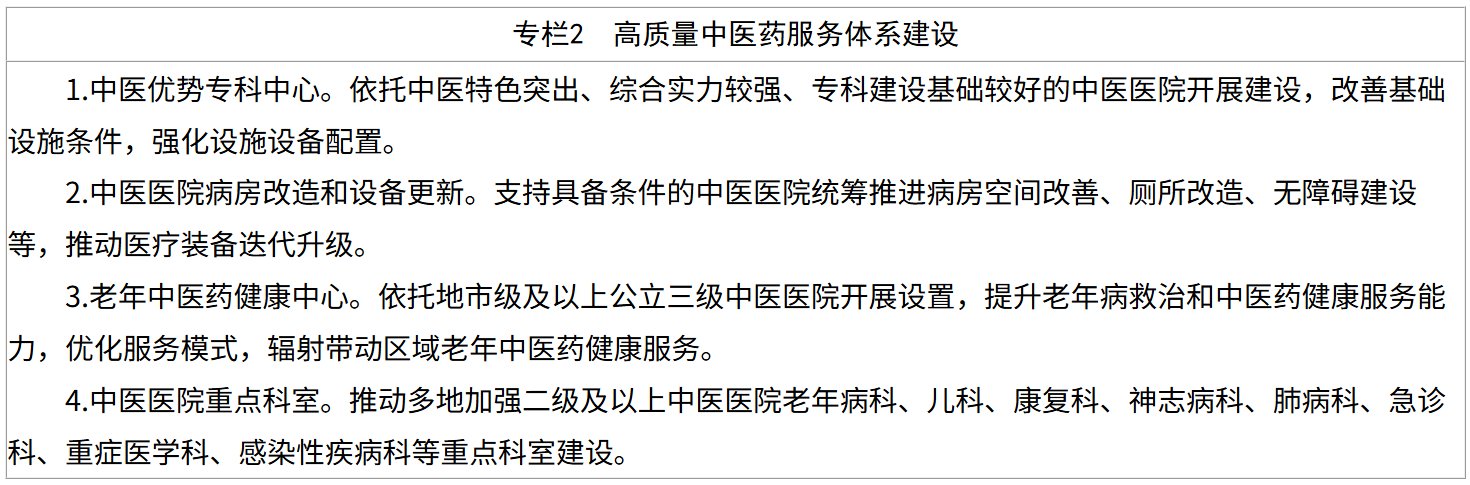
(1) Optimize the allocation of traditional Chinese medicine service resources. Promote the construction of national medical centers in the field of traditional Chinese medicine in a steady and orderly manner, and rely on high-level traditional Chinese medicine hospitals to establish a number of national traditional Chinese medicine centers to promote traditional Chinese medicine breakthroughs in the prevention and treatment of major diseases such as cardiovascular diseases, tumors, nephropathy, and epidemics. Organize traditional Chinese medicine programs at national and regional medical centers to promote the expansion and balanced layout of high-quality traditional Chinese medicine resources. Build a specialty center with the advantage of traditional Chinese medicine, and drive the overall improvement of traditional Chinese medicine service capabilities through specialty (specialty) construction. Strengthen the construction of local and municipal traditional Chinese medicine hospitals and promote their role in hierarchical diagnosis and treatment. Promote the construction of county-level traditional Chinese medicine hospitals so that they generally meet the “Basic Standards for Medical Service Capabilities of County-level Traditional Chinese Medicine Hospitals”. Encourage and support traditional Chinese medicine hospitals that are in a position to do so to take the lead in forming close county medical communities and close-knit urban medical groups. Strengthen the construction of hospitals specializing in traditional Chinese medicine such as acupuncture, bone injury, and anorectal surgery.
(2) Strengthen traditional Chinese medicine service guarantees for key population groups. Strengthen the construction of geriatric departments and pediatric departments in traditional Chinese medicine hospitals. Public hospitals of traditional Chinese medicine level 2 and above generally have geriatrics departments. Traditional Chinese medicine hospitals are encouraged to set up psychiatric clinics and sleep clinics. Promote nursing institutions, palliative care institutions, etc. to strengthen capacity building for traditional Chinese medicine services.
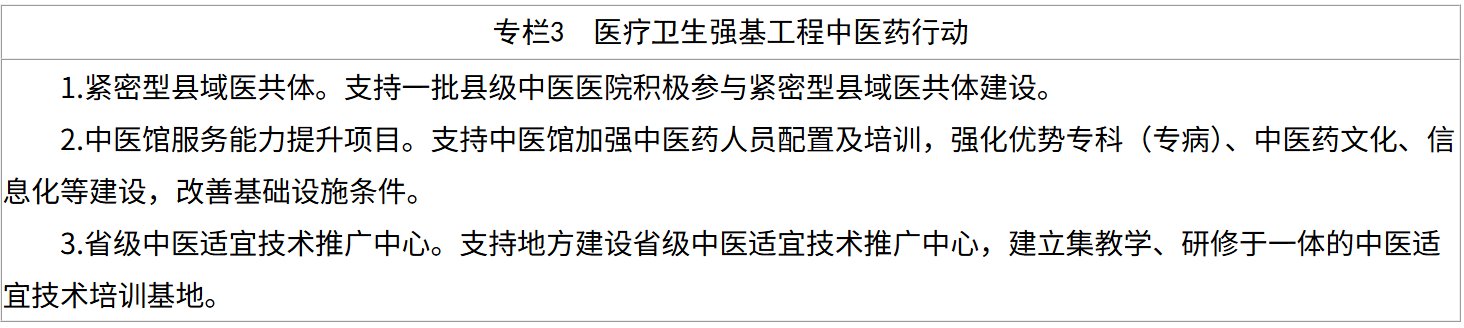
(3) Implement traditional Chinese medicine actions to strengthen medical and health care infrastructure projects. Promote each county-level hospital of traditional Chinese medicine to establish at least 2 specialties with special advantages of traditional Chinese medicine and 1 county-level traditional Chinese medicine appropriate technology promotion center, so as to play a leading role in traditional Chinese medicine treatment, preventive care, characteristic rehabilitation, talent training, promotion of appropriate technology and health education in the county area. Vigorously promote appropriate technology for traditional Chinese medicine at the primary level, promote the construction of traditional Chinese medicine centers and traditional Chinese medicine pavilions, and support primary medical and health institutions to enhance traditional Chinese medicine service capabilities. Continue to carry out roving medical treatment and health assistance. Strengthen the construction of traditional Chinese medicine departments (ethnic minority medical departments) in traditional Chinese medicine medical institutions and general hospitals in remote areas.
III. Enhancing the health service capabilities of traditional Chinese medicine throughout the life cycle
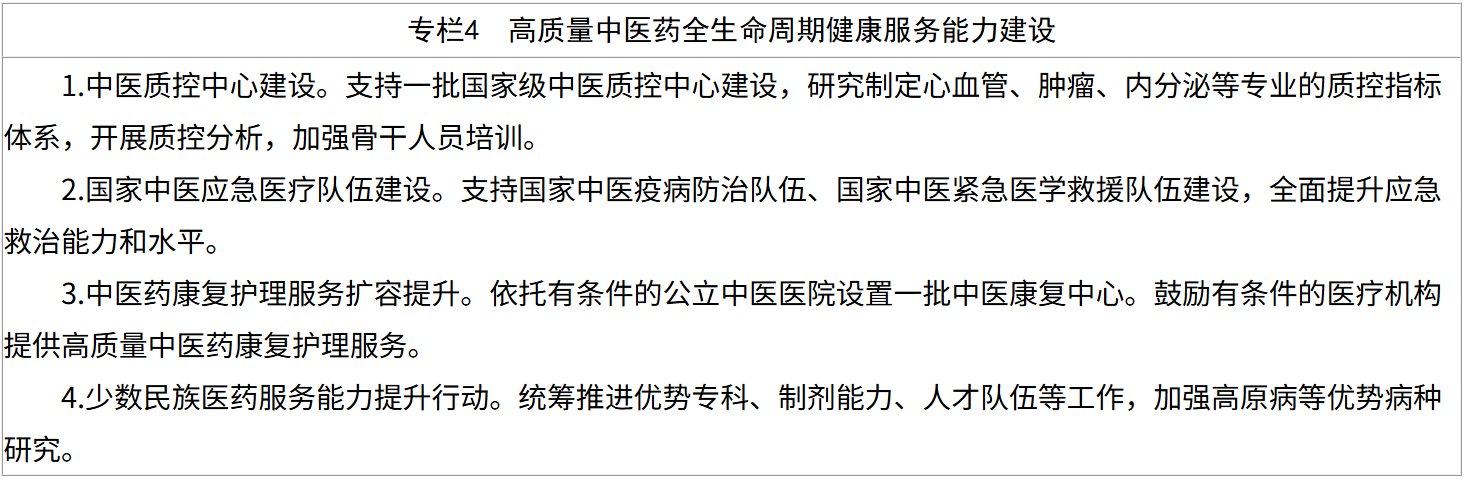
(1) Improve the clinical diagnosis and treatment capabilities of traditional Chinese medicine. Improve clinical efficacy as the core, strengthen the standardization of traditional Chinese medicine's superior specialty (specialty) diagnosis and treatment, and optimize and improve traditional Chinese medicine diagnosis and treatment plans. Promote the establishment of national traditional Chinese medicine advantage specialist consortia and regional and provincial traditional Chinese medicine advantage specialist alliances. Continue to improve the quality of medical care in traditional Chinese medicine hospitals, establish national TCM quality control centers, and promote the construction of provincial, prefectural and municipal TCM quality control centers. Improve the medical service capacity of ethnic minorities.
(2) Improve the emergency treatment capabilities of traditional Chinese medicine. Promote the construction of stroke centers and intensive medicine departments in traditional Chinese medicine hospitals, standardize the construction of infectious disease departments, and generally set up emergency departments in public traditional Chinese medicine hospitals level 2 and above. Strengthen the construction of existing national traditional Chinese medicine epidemic prevention and treatment bases and emergency medicine rescue bases, strengthen training exercises and capacity building for traditional Chinese medicine emergency medical teams, and give full play to the role of traditional Chinese medicine in emergency treatment of major emergencies. Establish a collaborative medical emergency work mechanism for traditional Chinese and Western medicine that combines normal emergency response and responds quickly, and integrate high-level emergency traditional Chinese medicine medical care capabilities into the national emergency medical rescue system.
(3) Strengthen disease prevention and health promotion. Deeply implement healthy Chinese traditional Chinese medicine health promotion activities. Standardize the construction of treatment-free content in public traditional Chinese medicine hospitals at level 2 and above, enhance the ability to provide treatment-free treatment, and integrate the concept of treating no pathology with traditional Chinese medicine into the whole process of diagnosis and treatment services. Guide local authorities to carry out pilot traditional Chinese medicine interventions for myopia, obesity, and scoliosis in children and adolescents. Launch pilot prevention and treatment of traditional Chinese medicine characteristics such as eye health, brain health, bone health, and mental health. Deepen the integration of traditional Chinese medicine and medical prevention at the grassroots level. Optimize traditional Chinese medicine health management services for national basic public health service projects.
(4) Enhance traditional Chinese medicine rehabilitation and nursing service capabilities. Relying on rehabilitation and nursing expansion and upgrading projects, we will promote the construction of rehabilitation departments in traditional Chinese medicine hospitals and strengthen the supply of traditional Chinese medicine rehabilitation services at the grass-roots level. Formulate and promote traditional Chinese medicine rehabilitation programs focusing on chronic diseases, occupational diseases, and endemic diseases. Promote the establishment of traditional Chinese medicine nursing clinics in level-3 public traditional Chinese medicine hospitals.
(5) Improve traditional Chinese medicine pharmacy service capabilities. Strengthen the management of Chinese medicine tablets in medical institutions, rationally allocate traditional Chinese medicine professionals and technicians, and optimize traditional Chinese medicine preparation and processing services. Strengthen the review of traditional Chinese medicine prescriptions. Promote the intelligent upgrading of traditional Chinese medicine pharmacies and herbal medicine rooms in traditional Chinese medicine hospitals. Promote the transfer and use of traditional Chinese medicine preparations in medical institutions according to law and regulations, and increase efforts to promote the use of traditional Chinese medicine preparations in clinical institutions with unique advantages.
IV. Promoting the high-quality development of integrated traditional Chinese and Western medicine
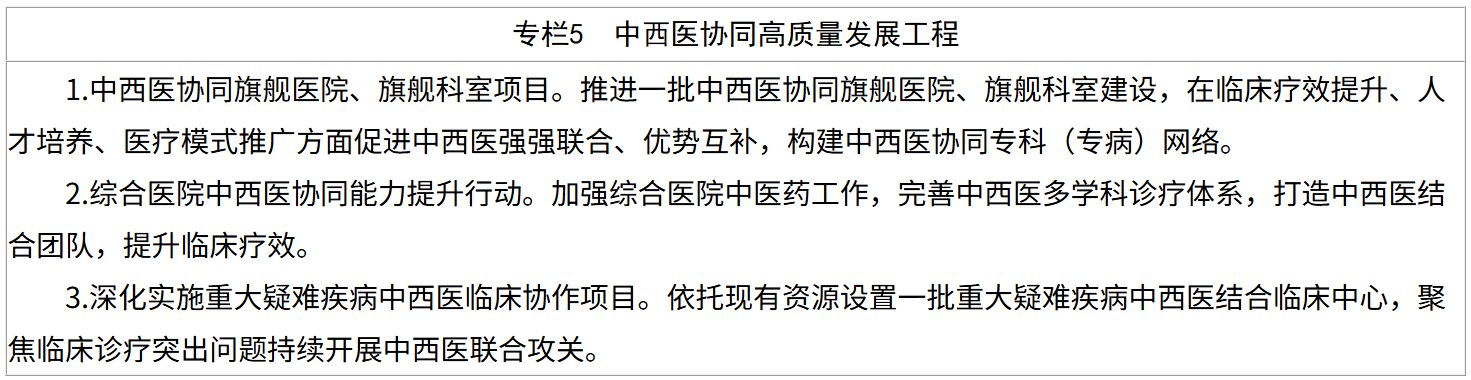
(1) Improve integrated traditional Chinese and Western medicine service capabilities. Strengthen the construction of traditional Chinese medicine clinical departments in general hospitals, specialist hospitals, and maternal and child health care institutions, deeply integrate traditional Chinese medicine diagnosis and treatment services into all relevant clinical departments, encourage the establishment of integrated traditional Chinese and Western medicine specialist groups, and develop collaborative departments of traditional Chinese and Western medicine. Promote the enhancement of the collaborative capabilities of traditional Chinese and Western medicine in general hospitals, and promote the establishment of collaboration mechanisms for traditional Chinese and Western medicine between departments, hospitals, and within medical consortia. Promote the construction of collaborative flagship hospitals and flagship departments of traditional Chinese and Western medicine. Continue clinical collaboration between traditional Chinese and Western medicine, focusing on major and difficult diseases, plateau disease, and rare diseases, and formulate and promote integrated diagnosis and treatment plans with traditional Chinese and Western medicine.
(2) Improve policies to promote integration of traditional Chinese and Western medicine. Strengthen the orientation of integrated traditional Chinese and Western medicine services in the hierarchical diagnosis and treatment system, public hospital reform, and construction of county medical communities. Strengthen the quality management of traditional Chinese medicine in general hospitals, specialist hospitals, and maternal and child health care institutions, and carry out capacity assessments of traditional Chinese medicine clinical departments. Improve the policy for non-traditional Chinese medicine physicians to use traditional Chinese medicine techniques, and support eligible non-traditional Chinese medicine physicians to participate in the evaluation of integrated traditional Chinese and Western medicine titles.
5. Build a team of high-quality traditional Chinese medicine talents
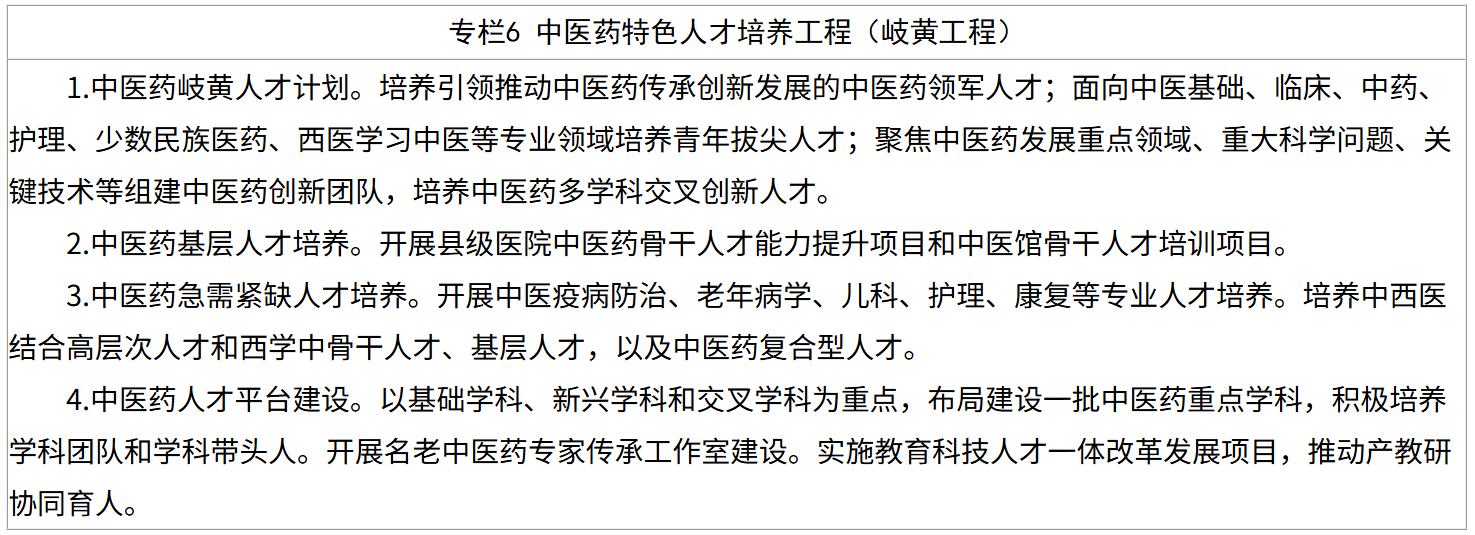
(1) Deepen the comprehensive reform of traditional Chinese medicine education. Continue to strengthen the “double first-class” construction in the field of traditional Chinese medicine. Improve the professional system of traditional Chinese medicine subjects and deepen the reform of curriculum materials. The layout and construction of a number of exemplary colleges with special characteristics in the field of traditional Chinese medicine. Moderately expand the number of schools offering nine-year education majors in traditional Chinese medicine. Adhere to the development of traditional Chinese medicine teacher education, and summarize and promote a training model combining colleges and teacher education. Encourage colleges of higher learning and vocational colleges to train skilled talents in traditional Chinese medicine health services. Strengthen standardized training for traditional Chinese medicine physicians, dynamically adjust standardized training bases, improve training conditions, and enhance training capabilities. Promote the reform of continuing education in traditional Chinese medicine and strengthen the supply of quality continuing education resources.
(2) Strengthen the construction of a team of traditional Chinese medicine talents. Strengthen the construction of a team of traditional Chinese medicine physicians, and promote traditional Chinese medicine hospitals to be fully equipped with strong traditional Chinese medicine physicians. Strengthen the supply of traditional Chinese medicine talents at the primary level, carry out targeted free medical student training for traditional Chinese medicine specialists in rural areas, promote training for traditional Chinese medicine general practitioners, assistant general practitioners, and key traditional Chinese medicine personnel in counties and villages, and expand the number of traditional Chinese medicine professionals enrolled in special programs for college students and rural doctors. Strengthen the work of studying traditional Chinese medicine in Western medicine, cultivate high-level talents integrating traditional Chinese and Western medicine, key talents and grassroots talents in Western studies, and determine a number of training and promotion bases in Western studies. Promote the cultivation of complex talents in the traditional Chinese medicine industry, internationalization, standardization, and digitalization.
(3) Improve the mechanism for the development of traditional Chinese medicine talents. Promote traditional Chinese medicine personnel to participate in family doctor contract services, support local authorities to implement talent usage models such as “county management and rural use” and “township employment and village use”, implement policies such as “targeted evaluation and targeted use” for grassroots personnel title review, and guide the flow of talents to the grassroots level. Improve a talent evaluation system that conforms to the characteristics of traditional Chinese medicine, and explore the establishment of an evaluation system based on entrance examinations and covering the entire growth cycle of traditional Chinese medicine practitioners. Cultivate and select Chinese medicine masters and famous traditional Chinese medicine practitioners from all over the country, and create a favorable environment conducive to the growth of talents.
6. Promoting the Inheritance and Innovation of Traditional Chinese Medicine
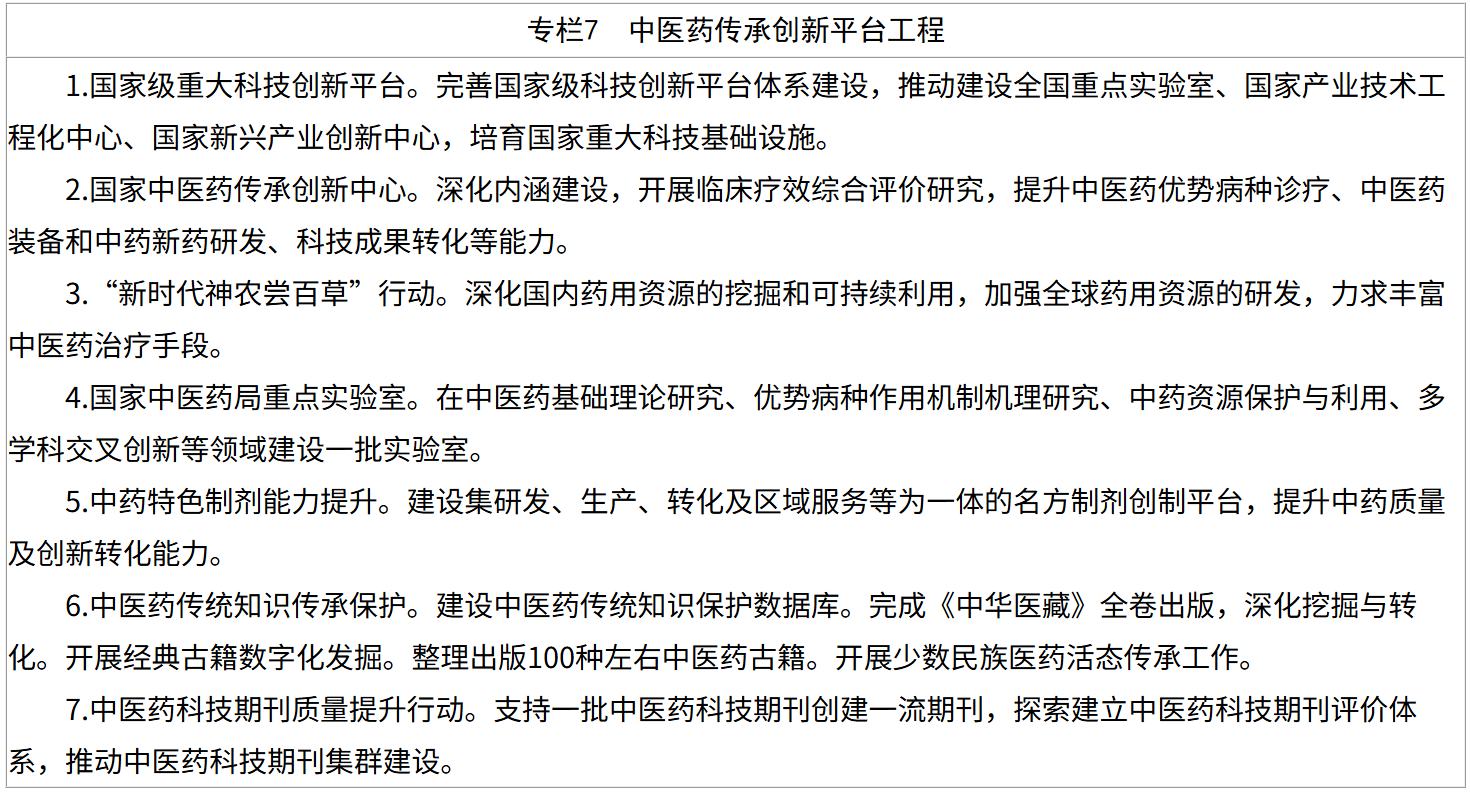
(1) Strengthen basic research and classical heritage of traditional Chinese medicine. Explain the scientific connotation of the original theory of traditional Chinese medicine in a modern context, analyze the mechanism of action of traditional Chinese medicine in disease prevention and treatment, strengthen the intelligent exploration and application of original theories in traditional Chinese medicine books, and innovate common key techniques and methods for basic research. Deepen the construction of a national digital library of ancient Chinese medicine books. Strengthen the active heritage of famous traditional Chinese medicine and old pharmacists, and the discovery and inheritance of ethnic minority medicine and folk traditional Chinese medicine. Promote the construction of traditional Chinese medicine preparation technology transmission bases. Improve the construction of a traditional Chinese medicine traditional knowledge protection database, and draw up and publish a protection list. Promote the construction of high-quality scientific and technological journals for traditional Chinese medicine.
(2) Improve the scientific and technological innovation capabilities of traditional Chinese medicine. Strengthen organized scientific research, strengthen collaboration between the central government and departments, gather multidisciplinary strengths, organize and implement major national scientific and technological projects in the field of traditional Chinese medicine, and carry out high-quality clinical research on traditional Chinese medicine, innovative traditional Chinese medicine drugs, and research and development of traditional Chinese medicine devices, equipment, and key common technologies. Strengthen the discovery and transformation of traditional Chinese medicine preparations and classic famous recipes. Encourage enterprises to form scientific and technological innovation consortia with research institutes, institutions of higher learning, and traditional Chinese medicine hospitals. Strengthen high-level international scientific research cooperation. Improve the traditional Chinese medicine research evaluation system, and strengthen the honest construction and governance of traditional Chinese medicine research. Accelerate the transformation of scientific and technological achievements in traditional Chinese medicine and the protection and application of intellectual property rights. Implement the “New Era Shennong Tastes Baicao” campaign to discover more medicinal plant resources and incorporate them into the traditional Chinese medicine diagnosis and treatment system.
(3) Build a high-level scientific and technological platform for traditional Chinese medicine. Strengthen the layout of national science and technology innovation platform bases in the field of traditional Chinese medicine, and support superior scientific research forces in the field of traditional Chinese medicine to participate in the construction of relevant national laboratories. Strengthen the construction of the National Traditional Chinese Medicine Inheritance and Innovation Center and key laboratories of the State Administration of Traditional Chinese Medicine. Implement the science and technology innovation project of the Chinese Academy of Traditional Chinese Medical Sciences, lay out a number of cutting-edge interdisciplinary disciplines and dominant disciplines in traditional Chinese medicine, and build world-class traditional Chinese medicine research institutions. Promote the construction of an evidence-based network for traditional Chinese medicine. Promote the development of provincial traditional Chinese medicine science and technology innovation platforms.
7. Promoting the modern traditional Chinese medicine industry and health services
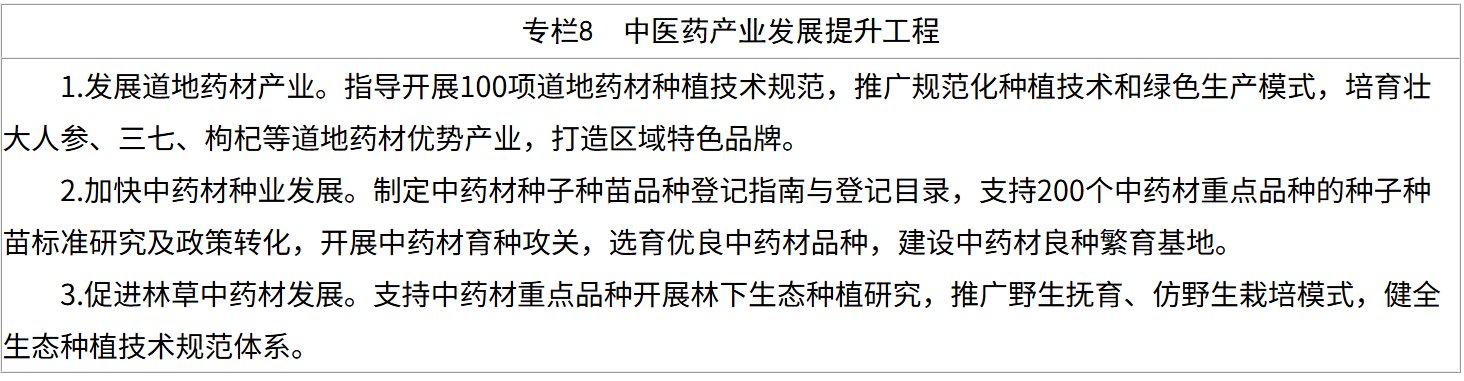
(1) Strengthen the protection and utilization of traditional Chinese medicine resources. Research and revise regulations and systems relating to the protection and management of wild herbal medicine resources and the management of Chinese herbal medicine seeds. Strengthen research on key techniques such as discovery of clinical value of endangered scarce traditional Chinese medicine resources, artificial breeding, artificial substitution, etc., improve the national Chinese herbal medicine germplasm resource bank system by region and variety, strengthen the protection of new varieties of Chinese herbal medicine plants, promote the application of high-quality seeds and seedlings, and strengthen the management of traditional Chinese medicine quality sources.
(2) Raise the level of development of the Chinese herbal medicine industry. Continue to implement the “Quality Management Code for the Production of Chinese Herbal Medicines”, guide traditional Chinese medicine enterprises to extend the quality management system to the entire Chinese herbal medicine production process, and encourage the construction of high-standard traditional Chinese medicine raw materials production bases. Formulate quality traceability standards for Chinese herbal medicines, strictly supervise the quality of Chinese herbal medicines, and ensure the high-quality supply of clinical traditional Chinese medicines. Optimize the production layout of authentic medicinal herbs throughout the country, support the development of herbal medicinal herbs in forest herbs, and guide local subregions to build ecological cultivation, wild nurturing and wild-like cultivation bases for Chinese herbal medicines under forests. Research and promote the construction of a distribution and storage system for Chinese herbal medicines, improve the price supervision mechanism for Chinese herbal medicines, and ensure the stability of the supply and price of Chinese herbal medicines.
(3) Enhance traditional Chinese medicine manufacturing capacity. Deeply implement excellent quality projects in the manufacturing industry, and guide traditional Chinese medicine manufacturers to actively participate in the evaluation of quality management capabilities of manufacturing enterprises. Revise and improve the national regulations for the preparation of Chinese herbal medicine tablets. Strengthen clinical research on proprietary Chinese medicines after marketing. Optimize the management of changes in traditional Chinese medicines after marketing. Strengthen the management of traditional Chinese medicine instructions and enhance clinical guidance on rational medication use. Carry out actions to improve the intelligent manufacturing of traditional Chinese medicine, accelerate the development, promotion and application of digital intelligence and green technology and equipment, focus on breaking through the intelligent production technology system in core links such as production, quality control, and inspection, and ensure the uniform quality of traditional Chinese medicine production. Build a number of traditional Chinese medicine digital intelligent chemical plants and green factories.
(4) Expanding new forms of traditional Chinese medicine health services. Support the standardization, specialization, and branding of traditional Chinese medicine medical institutions organized by social forces. Carry out integrated medical care activities with traditional Chinese medicine, encourage medical institutions to carry out integrated medical care services with traditional Chinese medicine characteristics, and develop integrated medical care service providers with traditional Chinese medicine characteristics. Guide the integration of traditional Chinese medicine culture with tourism, sports and other fields, and promote the popularization of traditional Chinese medicine health care practices. Develop services such as traditional Chinese medicine, dietary nutrition, health care, etc., and encourage the development of health food, cosmetics and other products.
8. Promoting the prosperity and development of traditional Chinese medicine culture
Strengthen research, interpretation and innovative expression of traditional Chinese medicine culture, and strive to form a number of high-quality results. Implement traditional medicine intangible cultural heritage inheritance and development plans. Improve the traditional Chinese medicine museum system led by the National Museum of Traditional Chinese Medicine, promote the upgrading of traditional Chinese medicine culture promotion platforms, build a traditional Chinese medicine culture brand, and promote traditional Chinese medicine culture into the campus. Strengthen the cultural construction of traditional Chinese medicine hospitals, and vigorously promote traditional medical ethics such as “the sincerity of the doctor” and “benevolence”. Increase the supply of high-quality traditional Chinese medicine science content, build a high-level dissemination and popular science team, strengthen the revitalization, utilization and popularization and dissemination of classical medical records, carry out popularized interpretation and modernization, and give full play to the important role of traditional Chinese medicine in promoting a healthy and civilized lifestyle. Conduct a survey on residents' traditional Chinese medicine health culture literacy level. Encourage social forces to participate in promoting the development of the traditional Chinese medicine culture industry.

9. Expanding the open development of traditional Chinese medicine
(i) Actively participate in global health governance. Deepen cooperation with international organizations to establish international rules and standards for traditional medicine. Strengthen cooperation in the field of traditional medicine through multilateral mechanisms and regional cooperation platforms, actively participate in global health governance, and help build a human health community. Rely on existing resources to strengthen the construction of an international traditional medicine clinical trial registration platform. The number of TCM team members has been gradually increased in the Chinese foreign aid medical aid team, and traditional Chinese medicine medical aid teams have continued to be dispatched. Build overseas centers for traditional Chinese medicine, international cooperation bases, service export bases, etc. with high quality, launch pilot projects for inbound consumption of traditional Chinese medicine, build a traditional Chinese medicine brand with international influence, and promote traditional Chinese medicine services and products to the world.
(2) Deepen exchanges and mutual learning. Continue to promote the high-quality integration of traditional Chinese medicine into the joint construction of the “Belt and Road”. Promote the holding of high-level international conferences such as the World Conference on Traditional Medicine. Promote the overseas entry of traditional Chinese medicine practitioners and traditional Chinese medicine products. Develop an international general textbook on traditional Chinese medicine. Promote the construction of a highland of traditional Chinese medicine in the Guangdong-Hong Kong-Macao Greater Bay Area, deepen traditional Chinese medicine exchanges and cooperation between the Mainland, Hong Kong and Macao, and promote the integrated development of traditional Chinese medicine exchanges, cooperation and integration between the two sides of the Strait.

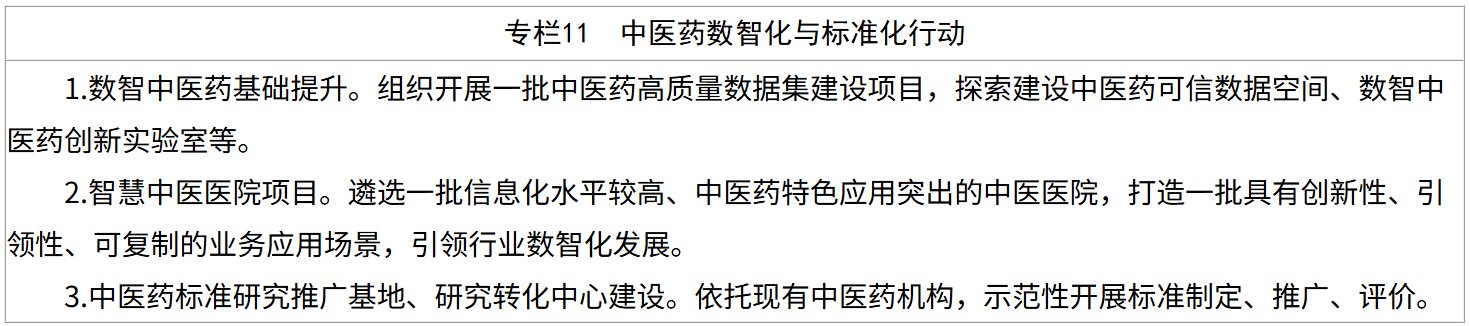
10. Accelerate the digital empowerment and standardization of traditional Chinese medicine
(1) Strengthen the digital intelligence capabilities of traditional Chinese medicine. Promote the construction of an autonomous and controllable digital infrastructure for traditional Chinese medicine. Strengthen the construction of high-quality data sets for artificial intelligence in traditional Chinese medicine. Improve hierarchical classification and protection of data, promote the implementation of basic data systems such as data property rights in the field of traditional Chinese medicine, and promote the safe, compliant and efficient circulation and use of traditional Chinese medicine data. Scenario-based and mapping promote the digital transformation of the traditional Chinese medicine industry. Deepen the construction of a comprehensive statistical system for traditional Chinese medicine and data sharing applications. Strengthen the construction of smart traditional Chinese medicine hospitals and promote the application of technologies such as intelligent assisted diagnosis and treatment of traditional Chinese medicine at the grassroots level.
(2) Promote the high-quality development of standardization of traditional Chinese medicine. Deepen research on the standardization theory, method and technology of traditional Chinese medicine. Improve the traditional Chinese medicine standard system, improve the quality of standards, and increase the supply of standards in key areas such as traditional Chinese medicine health services, intelligent equipment for traditional Chinese medicine, quality improvement of traditional Chinese medicine, and high industrial quality. Promote the interactive development of traditional Chinese medicine standards and scientific and technological innovation, and solidify the latest achievements in clinical and scientific research of traditional Chinese medicine into standards. Promote the implementation, application and evaluation of traditional Chinese medicine standards, and improve application-oriented methods for promoting traditional Chinese medicine standards.
11. Deepening reform and governance in the field of traditional Chinese medicine
(1) Promote the collaborative development of medical treatment, medical insurance and medicine. Support provinces that are in a position to do so to carry out comprehensive reform of traditional Chinese medicine, promote pilot work on the inheritance, innovation and development of traditional Chinese medicine on a municipal basis, and test first and actively explore. Deeply promote the traditional Chinese medicine heritage and innovative practices of Sanming's medical reform. Highlight the public welfare and functional positioning of public traditional Chinese medicine hospitals, optimize index systems such as rating review and performance monitoring, deepen the reform of the remuneration system, and establish a mechanism for dynamic adjustment of the preparation. Optimize the price formation mechanism for traditional Chinese medicine, improve traditional Chinese medicine procurement policies, and promote clinical application of innovative traditional Chinese medicine medicines. Improve medical insurance payment methods that meet the characteristics of traditional Chinese medicine, and deepen pilot payment of dominant diseases in traditional Chinese medicine according to disease type. Improve the “three integration” evaluation evidence system for traditional Chinese medicine theory, human use experience, and clinical trials, establish a mechanism for medical institutions to standardize the collection and collation of human use experience data, strengthen research and evaluation of traditional Chinese medicine after marketing, and develop a catalogue of Chinese herbal medicines and Chinese medicine tablets for approval and management. Cultivate more health insurance management personnel familiar with the characteristics of traditional Chinese medicine, and raise the level of standardized use of health insurance funds in the industry.
(2) Strengthen the rule of law, supervision and management of traditional Chinese medicine. Promote research on the revision of the Traditional Chinese Medicine Law, introduce and implement regulations such as the “Regulations on the Protection of Traditional Chinese Medicine”, and promote the further improvement of local traditional Chinese medicine regulations. Strengthen the rule of law in traditional Chinese medicine medical institutions, consolidate hospital compliance management responsibilities, and strictly implement patient privacy and personal diagnosis and treatment information protection systems. Promote comprehensive cross-departmental supervision, strengthen medical management and service supervision team building, and enhance traditional Chinese medicine supervision and enforcement capabilities and the level of informatization. Strengthen the supervision of medical services and strictly crack down on illegal acts such as illegal practice of medicine, false and exaggerated publicity, fraudulent insurance fraud, and the production and sale of counterfeit and inferior Chinese medicine tablets and proprietary Chinese medicines. Strengthen the construction of medical practices, strengthen the construction of a clean government in the field of traditional Chinese medicine, and correct irregularities in the industry.

12. Strengthen organizational implementation
Adhere to the Party's leadership throughout the process of inheriting, innovating, developing and implementing plans for traditional Chinese medicine. All regions should further improve the working mechanisms of Party Committee leadership, government leadership, and multi-departmental participation, and establish and improve traditional Chinese medicine management systems at the provincial, municipal, and county levels. To establish a diversified funding mechanism for the development of traditional Chinese medicine, governments at all levels should implement investment policies for public traditional Chinese medicine hospitals in accordance with the plan in accordance with regulations. Organize and carry out dynamic monitoring, mid-term evaluation and summary evaluation of the implementation of the plan in due course to strengthen positive publicity and guidance to ensure the smooth implementation of the plan.
Comrades in charge of the State Administration of Traditional Chinese Medicine and the National Development and Reform Commission discussed the “15th Five-Year Plan for the Revitalization and Development of Traditional Chinese Medicine”
Answer to reporters' questions
Recently, with the approval of the State Council, the State Administration of Traditional Chinese Medicine and the National Development and Reform Commission jointly issued the “Fifteenth Five-Year Plan” for the Revitalization and Development of Traditional Chinese Medicine (hereinafter referred to as the “Plan”). Comrades in charge of the State Administration of Traditional Chinese Medicine and the National Development and Reform Commission answered questions from reporters on the situation relating to the “Plan”.
Q: What is the background and significance of the introduction of the “Plan”?
Inheriting, innovating and developing traditional Chinese medicine is an important part of the cause of socialism with Chinese characteristics in the new era, and a major event for the great rejuvenation of the Chinese nation. General Secretary Xi Jinping has repeatedly given important instructions and instructions on the work of traditional Chinese medicine, stressing the need to effectively inherit, develop, and make good use of traditional Chinese medicine, a valuable asset left to us by our ancestors. The Fourth Plenary Session of the 20th CPC Central Committee made arrangements to promote the inheritance and innovation of traditional Chinese medicine and promote cooperation between Chinese and Western medicine. The “Outline of the Fifteenth Five-Year Plan for National Economic and Social Development of the People's Republic of China” clarifies specific requirements for “promoting the inheritance and innovation of traditional Chinese medicine.”
During the “14th Five-Year Plan” period, the inheritance, innovation and development of traditional Chinese medicine made a series of breakthroughs. It actively served national strategies such as a healthy China, a strong country in science and technology, and rural revitalization, and integrated into the “Belt and Road” initiative. Various fields of traditional Chinese medicine have developed comprehensively, a high-quality and efficient traditional Chinese medicine service system has been accelerated, and disease prevention and treatment capabilities have continued to improve. By the end of 2025, the total number of traditional Chinese medicine diagnoses and treatments reached 1.82 billion, and the number of beds in public traditional Chinese medicine hospitals per 1,000 population reached 0.82, basically achieving full coverage of county-run traditional Chinese medicine medical institutions. 96.26% of public general hospitals at level 2 and above have traditional Chinese medicine clinical departments. Research on traditional Chinese medicine to prevent and treat major and difficult diseases has achieved important results. Traditional Chinese medicine talent work has been incorporated into the strategic layout of a new era of talent power, the protection and utilization of traditional Chinese medicine resources has been continuously strengthened, the registration classification of traditional Chinese medicine has been further optimized, the quality of traditional Chinese medicine has been continuously improved, and the creative transformation and innovative development of traditional Chinese medicine culture has been promoted. The level of traditional Chinese medicine health culture literacy among citizens has been raised to 28.1%, and traditional Chinese medicine has actively served foreign diplomacy with Chinese characteristics to help build a human health community.
The “15th Five-Year Plan” period is a critical period for basic socialist modernization, consolidating the foundation and comprehensive strength. China's development environment is facing profound and complex changes. The aging population and declining birthrate continue to deepen, the threat of multiple diseases is intertwined with diverse health influencing factors, and the health needs of people at many levels are growing. In order to implement the decisions and arrangements of the Party Central Committee and the State Council, the State Administration of Traditional Chinese Medicine, together with the National Development and Reform Commission, jointly planned and promoted the “Plan”. The publication and implementation of the “Plan” is conducive to thoroughly implementing the spirit of General Secretary Xi Jinping's important instructions and the decisions and deployment requirements of the Party Central Committee and the State Council on the inheritance, innovation and development of traditional Chinese medicine, forming joint efforts among relevant departments, local party committees and governments to jointly promote the revitalization and development of traditional Chinese medicine, fully mobilizing local and social forces, implementing key tasks and major policy initiatives, and making the development results of traditional Chinese medicine better benefit the masses.
Q: What are the main considerations in preparing the Plan?
The first is to focus on benchmarking, thoroughly implement General Secretary Xi Jinping's important remarks on building a healthy China and the work of traditional Chinese medicine, resolutely implement the spirit of decision-making and deployment of the Party Central Committee and the State Council, anchor the requirements for making decisive progress in serving the construction of a healthy China, focus on making up shortcomings, promote advantages, and break bottlenecks, so that everyone can enjoy traditional Chinese medicine services, and inject new connotations into the path of health and healthy development with Chinese characteristics. The second is to focus on leveraging the unique advantages of traditional Chinese medicine for disease prevention and treatment, based on the core task of improving the clinical efficacy of traditional Chinese medicine and highlighting the remarkable advantages of complementary and coordinated development of Chinese and Western medicine, focusing on major and difficult diseases to carry out clinical collaboration between traditional Chinese and Western medicine, and giving full play to the unique advantages of traditional Chinese medicine in continuous hierarchical diagnosis and treatment services. The third is to focus on strengthening scientific and technological innovation leadership, focusing on “explaining clearly and clearly explaining the curative effects of traditional Chinese medicine”, highlighting basic research and classical heritage of traditional Chinese medicine, strengthening organized scientific research, using new technologies such as artificial intelligence to explore and pass on the essence of the treasure trove of traditional Chinese medicine, and accelerate the inheritance and innovation of traditional Chinese medicine. Fourth, focus on improving the traditional Chinese medicine policy mechanism, making good use of the State Council's work coordination mechanisms such as deepening the reform of public hospitals and promoting the development of biomedicine, studying and improving medical insurance methods and systems such as the review and approval of new drugs that meet the characteristics of traditional Chinese medicine, and embark on a unique path of traditional medicine development. Fifth, focus on overall development and safety, insist on breaking first, and planning projects that lay the foundation, benefit the long term, and seek breakthroughs. Establish a bottom-line mindset, strengthen the supervision of traditional Chinese medicine medical services and the construction of the traditional Chinese medicine system, strengthen publicity and guidance, “eliminate evil and correct”, and create a clean development environment.
Q: What are the goals for the development of traditional Chinese medicine in the “15th Five-Year Plan”?
The “Plan” proposes that by 2030, the traditional Chinese medicine service system covering the entire population and the entire life cycle will be more complete, new breakthroughs will be made in traditional Chinese medicine prevention and treatment of major diseases, basic research capabilities will be greatly improved, the innovation and creativity of the traditional Chinese medicine industry will be greatly enhanced, traditional Chinese medicine culture and international influence will be further enhanced, and the revitalization and development of traditional Chinese medicine will reach a new level, so that everyone can enjoy traditional Chinese medicine services.
Traditional Chinese medicine services for all mean that the whole society participates in the traditional Chinese medicine business, covers the entire population and the entire life cycle based on 15-minute medical service points, and is accessible, obtainable, and affordable throughout the entire chain. In 2016, the State Council issued the “Outline of the Strategic Plan for the Development of Traditional Chinese Medicine (2016-2030)”, which first proposed the development goal of achieving basic traditional Chinese medicine services for all by 2020. Achieving traditional Chinese medicine services for all is an important goal of the Party and the country to promote the inheritance, innovation and development of traditional Chinese medicine in the new era. It reflects the country's strategic direction of developing traditional Chinese medicine, a livelihood orientation that protects people's health rights and interests, a vivid practice of leveraging the two resource advantages of modern medicine and traditional medicine and embarking on the path of socialist health and health development with Chinese characteristics. It is the Chinese wisdom and Chinese plan to promote the solution of medical reform as a worldwide development problem.
Q: What are the considerations for setting the main development indicators in the “15th Five-Year Plan”?
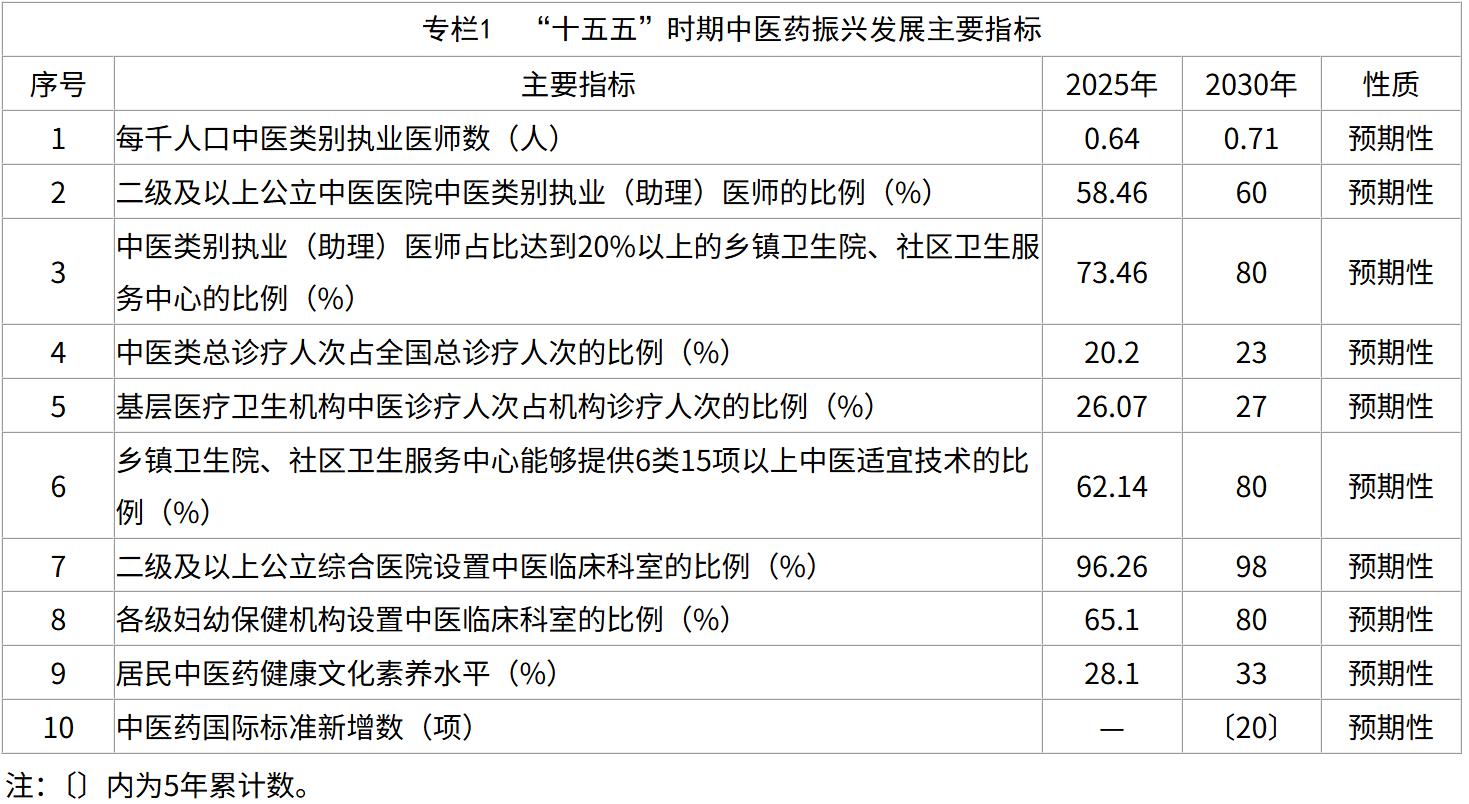
The “Plan” takes into account the connection and guidance of development indicators, goals, and key tasks in an integrated manner, fully reflects the requirements for the high-quality development of traditional Chinese medicine in the new era, focuses on the sustainable development of resource factors such as manpower and services, and proposes 10 indicators for the open development of traditional Chinese medicine resources, services, culture, and open development. The first is to target the outline of the country's “15th Five-Year Plan” and propose indicators for the number of traditional Chinese medicine practitioners in the 1000 population; the second is to focus on improving traditional Chinese medicine service capacity, setting indicators such as the ratio of traditional Chinese medicine physicians in public traditional Chinese medicine hospitals and the proportion of total TCM patients, and no longer setting large-scale indicators such as institutions and beds; third, to promote the development of integrated traditional Chinese medicine and Western medicine, setting up indicators such as the proportion of traditional Chinese medicine clinical departments in general hospitals and the proportion of traditional Chinese medicine clinical departments in maternal and child health care institutions at all levels; the fourth is to focus on consolidating the grass-roots service foundation and setting up TCM personnel and appropriate TCM personnel in primary medical and health care institutions Indicators such as technology provision and medical service volume; fifth, emphasis is placed Medicine plays a role in health promotion, accelerates the spread of traditional Chinese medicine to the world, and sets new indicators for residents' traditional Chinese medicine health culture literacy and international standards for traditional Chinese medicine.
Q: What are the key tasks identified in the “Plan”?
The “Plan” takes into account key areas of traditional Chinese medicine development, such as medical treatment, scientific research, talent, industry, culture, and open development. A total of ten key tasks are proposed. The first is to improve the high-quality traditional Chinese medicine service system. Specific measures are proposed in three areas: optimizing the allocation of traditional Chinese medicine service resources, strengthening traditional Chinese medicine service guarantees for key population groups, and implementing traditional Chinese medicine actions to strengthen medical and health care infrastructure projects. The second is to enhance the health service capabilities of traditional Chinese medicine throughout the life cycle. Specific measures are proposed in five areas: improving the clinical diagnosis and treatment capabilities of traditional Chinese medicine, improving the emergency treatment capabilities of traditional Chinese medicine, strengthening disease prevention and health promotion, improving the rehabilitation and nursing service capabilities of traditional Chinese medicine, and improving the pharmaceutical service capacity of traditional Chinese medicine. The third is to promote the high-quality development of integrated traditional Chinese and Western medicine. Specific measures are proposed in two areas: improving integrated traditional Chinese and Western medicine service capabilities and improving policies to promote integrated traditional Chinese and Western medicine. The fourth is to build a team of high-quality traditional Chinese medicine talents. Specific measures are proposed in three areas: deepening the comprehensive reform of traditional Chinese medicine education, strengthening the traditional Chinese medicine talent team building, and improving the traditional Chinese medicine talent development mechanism. The fifth is to promote the inheritance and innovation of traditional Chinese medicine. Specific measures are proposed in three areas: strengthening basic research and classical heritage of traditional Chinese medicine, improving the scientific and technological innovation capabilities of traditional Chinese medicine, and building a high-level scientific and technological platform for traditional Chinese medicine. The sixth is to promote the modern traditional Chinese medicine industry and health services. Specific measures are proposed in four areas: strengthening the protection and utilization of traditional Chinese medicine resources, raising the level of development of the Chinese herbal medicine industry, improving traditional Chinese medicine manufacturing capacity, and expanding new forms of traditional Chinese medicine health services. The seventh is to promote the prosperity and development of traditional Chinese medicine culture. Eighth is to expand the open development of traditional Chinese medicine. Specific measures are proposed in two areas: actively participating in global health governance and deepening exchanges and mutual appreciation. The ninth is to accelerate the digital intelligence empowerment and standardization of traditional Chinese medicine. Specific measures are proposed in two areas: strengthening the digital and intellectual empowerment of traditional Chinese medicine and promoting the standardized high-quality development of traditional Chinese medicine. The tenth is to deepen reform and governance in the field of traditional Chinese medicine. Specific measures are proposed to promote the collaborative development of medical treatment, medical insurance, and medicine, and strengthen the rule of law and supervision and administration of traditional Chinese medicine.
Q: How to ensure the organizational implementation of the “Plan”?
The first is to adhere to the Party's overall leadership of traditional Chinese medicine, fully understand the importance of the implementation of the “Plan” in comprehensively promoting the construction of a healthy China and providing strong support for people's health, improve the work pattern of Party committee leaders, government leadership, and multi-departmental participation at all levels, and form joint efforts. The second is to establish a stable and diversified funding mechanism for the development of traditional Chinese medicine to push governments at all levels to effectively implement investment policies for public traditional Chinese medicine hospitals in line with the plan. The third is to strengthen monitoring of plan implementation, carry out mid-term evaluations and summary evaluations in due course, strengthen positive publicity and guidance, interpret policies well, and create a good social atmosphere.
This article was selected from the official website of the “State Administration of Traditional Chinese Medicine”, Zhitong Finance Editor: Li Fu.