
- PRICING
- LIVE QUOTES
- LEARN
- HELP


EN
The “blue giant” IBM (IBM.US) transformation hit an obstacle: mainframe sales plummeted by 42%! Annual revenue forecast lowered to 4%-5% growth
The Zhitong Finance App learned that on Wednesday local time, IBM (IBM.US) released its 2026 Q2 financial report and lowered its annual revenue forecast. At the same time, it lowered the annual sales growth rate of the software business, which the market is particularly concerned about, mainly due to a marked decline in demand for its mainframe business.
IBM said in the announcement that total quarterly revenue was about US$17.2 billion, up about 1% year on year, with quarterly adjusted earnings of 2.93 US dollars, and mainframe sales fell 42% month-on-month in the second quarter; revenue for the full year of 2026 is expected to increase 4% to 5%, lower than the previously given “more than 5%” guideline; Chief Financial Officer Jim Kavanaugh further revealed in an interview that the annual revenue growth rate of the software business is expected to be in the range of 6% to 8%.
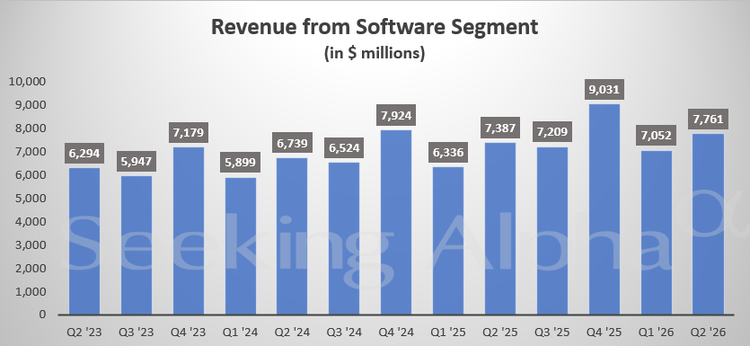
Looking at specific business segments, the growth rate of the software business has slowed sharply. Software revenue increased by only 5% year over year, and the company clearly expected the annual software business growth rate to reach “more than 10%” during the first quarter earnings call. Looking at the breakdown, the hybrid cloud platform Red Hat grew 11%, and the data business grew 19%, but transaction processing software (related to mainframe strength) was dragged down by mainframe sales, and performance was weak. J.P. Morgan Chase pointed out earlier that although the software business only accounts for about 45% of total revenue, it contributes about two-thirds of the consolidated profit, which is the cornerstone of the company's profit quality.
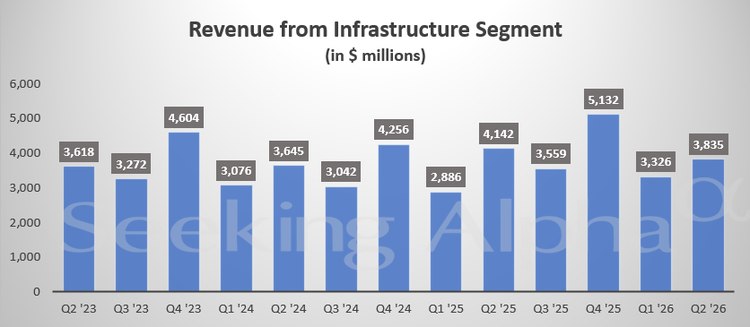
Infrastructure business: dragging down the overall picture. Infrastructure revenue declined 7% year over year, and the core reason was that mainframe z17 sales plummeted by 42%. Instead, distributed infrastructure (Power servers and storage hardware) grew by 37%, the best quarterly performance in history — which just confirms that customer capital is shifting from mainframes to AI-related hardware.
Consulting business: growth stalled. Consulting business revenue remained flat year over year (1% increase at fixed exchange rates), reflecting that corporate clients' spending on traditional consulting services was also squeezed during the IT budget reallocation process.
The core cause of performance falling short of expectations: AI's “crowding out effect”
CEO Arvind Krishna admits in a letter to shareholders that in the last few weeks of June, customers suddenly switched quarterly capital expenses to server, storage, and memory purchases to lock in tight supply of AI infrastructure before anticipated price increases. The company “did not anticipate the magnitude of capital expenditure realignment”, and many large-scale transactions failed to be completed as expected.
This phenomenon is interpreted by the market as the “crowding out effect” of AI hardware on traditional software and services — the total IT budget of enterprises has not increased significantly, but has been reallocated in a limited pool of funds: large amounts of capital are flocking to AI computing power infrastructure, directly squeezing the share of software procurement and mainframe upgrades. The Goldman Sachs team pointed out in the first research report that the IBM incident “will fully confirm the bear market scenario in the software industry,” and it is expected that the software and service sector will face extensive selling pressure. Morningstar analyst Luke Yang summed this up as a new trend of “hardware eats everyone's lunch.”
Evercore ISI analyst Amit Daryanani pointed out in a research report after the earnings report was released that this reduction was “better than market concerns.” The week before, IBM had disclosed preliminary results in advance, showing weak sales of infrastructure and related software. Wall Street generally expected the company to officially lower its target for the whole year. Kavanaugh explained that the current forecast reduction only covered the above business segments, and that the rest of the business performance was “very strong.”
In recent years, through the acquisition of Red Hat, HashiCorp, and Confluent, IBM is trying to reinvent itself as a high-growth software company. However, the new strategy has also made the company the focus of investors' attention — the market is concerned that artificial intelligence tools will have a disruptive impact on traditional software business models. Notably, despite the shift in strategic focus to software, a new round of strong sales of mainframe products has significantly boosted revenue growth since last year; in the second quarter ending June 30, mainframe sales plummeted 42% month-on-month.
Accelerate cost reduction plans to support free cash flow
On the cost side, IBM said it will accelerate the cost reduction plan and maintain the expectation of an additional 1 billion US dollars in free cash flow throughout the year. Kavanaugh said that this goal will be achieved by reducing third-party technology expenses, optimizing supply chain management, and reducing administrative expenses, and the total number of employees is expected to remain roughly the same throughout the year.
Industry analyst Anurag Rana said in an interview that the company's full-year outlook suggests “there will be improvements in the second half of the year.” In terms of stock prices, IBM closed at $205.77 during regular trading hours, rising about 2% in after-hours trading. However, so far this year (as of Wednesday's close), the stock has fallen 31% cumulatively, including a sharp drop of 25% in a single day on the day the preliminary results were announced.
Earlier this month, it was reported that Starbucks is considering using self-developed tools to replace software from suppliers such as IBM. In response, Kavanaugh responded that Starbucks spends about 2 million US dollars on an IBM application every year. He acknowledged that the application is “very easily disrupted by AI”; however, he stressed that most IBM software is much more difficult to replace because it is closer to the enterprise infrastructure and data layer, and the moat is relatively deeper.