
- PRICING
- LIVE QUOTES
- LEARN
- HELP


EN
Tesla (TSLA.US) Q2 net profit fell short of expectations, and gross margin declined further, free cash flow turned negative, and stock prices plummeted by more than 4% after the market
The Zhitong Finance App learned that Tesla (TSLA.US) announced results for the second quarter of 2026. Although revenue exceeded market expectations, net profit, earnings per share, and gross margin fell short of Wall Street expectations, and free cash flow was negative, reflecting the profit pressure brought about by the company's continued increase in investment in artificial intelligence (AI) and robotics. Affected by performance, Tesla's stock price fell more than 4% after the market on Wednesday.
According to financial reports, Tesla's second-quarter adjusted earnings per share (EPS) was $0.33, lower than market expectations of $0.51 billion; revenue was US$28.24 billion, higher than market expectations of US$25.71 billion, an increase of 26% over the previous year.
However, the company's profitability continues to be under pressure. Net profit for the second quarter fell 5% year-on-year to US$1.11 billion, which fell short of expectations, or $0.32 per share, compared to US$1.17 billion and US$0.33, respectively, in the same period last year.
By business, revenue from the automotive business increased 23% year on year to US$20.52 billion; revenue from the energy business (including solar energy and energy storage systems) increased 13% year over year to US$3.14 billion; and revenue from services and other businesses surged 50% year over year to US$4.58 billion.
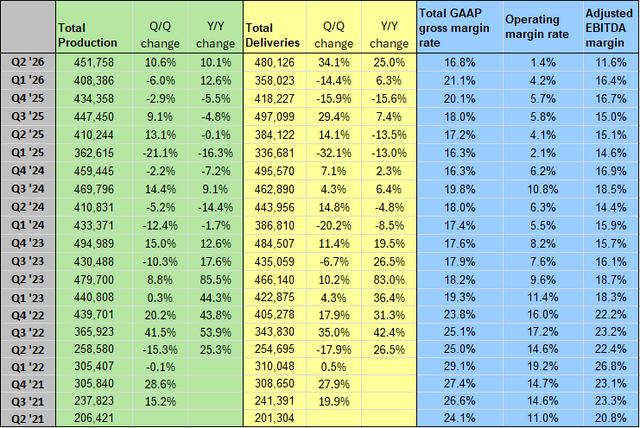
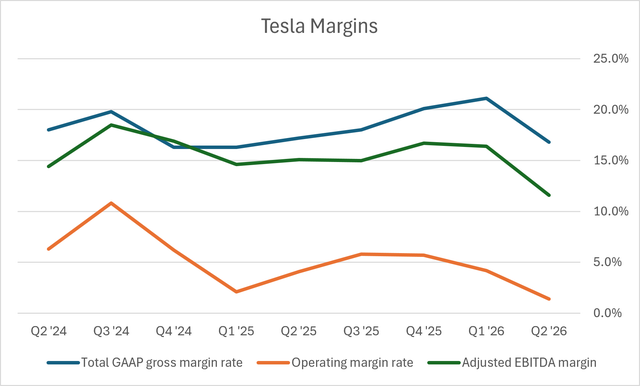
Although the automobile business's revenue performance was better than expected, Tesla's gross margin declined further due to a drop in the average sales price of bicycles and a decrease in regulatory credit revenue. The gross margin for the second quarter fell to 16.8% from 17.2% in the same period last year, lower than market expectations of 19.4%.
Financial reports show that Tesla stopped selling the more expensive Model S and Model X models this quarter and began selling the lower-priced Model 3 and Model Y, which dragged down overall profitability.
At the same time, the company's operating expenses surged 47% year on year to US$4.35 billion. The growth rate was significantly faster than revenue growth. Mainly due to continued increases in AI and R&D investment, the operating profit margin dropped sharply to 1.4% from 4.1% in the same period last year.
In terms of cash flow, Tesla's free cash flow turned negative at 1.1 billion US dollars in the second quarter, compared to positive 146 million US dollars in the same period last year, and reached 1.44 billion US dollars in the first quarter of this year.
However, the company said it will continue to maintain a steady balance sheet and sufficient liquidity to provide financial support for future product roadmaps and long-term capacity expansion plans (including further promotion of vertical integration).
Meanwhile, capital expenditure surged 142% year over year to US$5.79 billion. Tesla's chief financial officer Vaibhav Taneja previously stated that the company's capital expenditure for the full year 2026 is expected to exceed $25 billion.
Tesla said that many multi-year infrastructure construction projects involving AI computing power, solar energy, battery materials, and semiconductor manufacturing have already started.
In recent years, as car companies such as BYD, NIO.US (NIO.US), and Xiaomi Group have continued to launch cost-effective smart electric vehicles, Tesla car deliveries have been declining continuously for many years. Furthermore, Musk's political remarks and cooperation with the Trump administration have also triggered some consumers to boycott the Tesla brand.
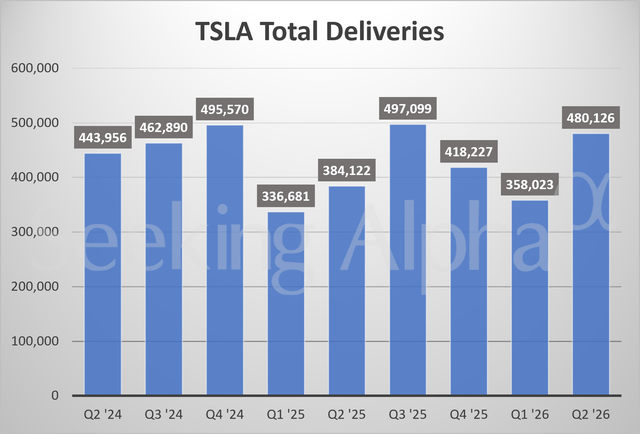
However, the conflict between the US and Iran led to a rise in gasoline prices, which to a certain extent stimulated demand for electric vehicles in the first half of this year, and sales in the European market improved.
Currently, Tesla is gradually shifting its strategic focus from car sales to artificial intelligence and autonomous driving businesses. Musk is speeding up the Robotaxi driverless taxi service and Cybercab driverless car mass production plans, and transforming the Fremont plant production line in California to prepare for the production of the Optimus humanoid robot.
The company said in the financial report that the first Optimus production line has begun to be installed and production will begin soon. The first batch of robots will be mainly used for training data collection and function development, rather than directly delivered to customers.
Meanwhile, Tesla's advanced driver assistance system FSD subscription business continues to grow. The company said that active FSD subscribers increased 56% year-on-year in the second quarter, and the total number of subscribers reached 1.48 million.