
- PRICING
- LIVE QUOTES
- LEARN
- HELP


EN
Pathward Financial (NASDAQ:CASH) Reports Sales Below Analyst Estimates In Q2 CY2026 Earnings, Stock Drops 12.6%

Financial services company Pathward Financial (NASDAQ:CASH) missed Wall Street’s revenue expectations in Q2 CY2026, with sales falling 3.1% year on year to $189.6 million. Its GAAP profit of $1.37 per share was 29.6% below analysts’ consensus estimates.
Is now the time to buy Pathward Financial? Find out by accessing our full research report, it’s free.
Pathward Financial (CASH) Q2 CY2026 Highlights:
- Net Interest Income: $112.9 million vs analyst estimates of $117.3 million (7.7% year-on-year decline, 3.7% miss)
- Net Interest Margin: 6.6% vs analyst estimates of 6.9% (35 basis point miss)
- Revenue: $189.6 million vs analyst estimates of $191.1 million (3.1% year-on-year decline, 0.8% miss)
- EPS (GAAP): $1.37 vs analyst expectations of $1.95 (29.6% miss)
- Tangible Book Value per Share: $25.83 vs analyst estimates of $26.19 (16.8% year-on-year growth, 1.4% miss)
- Market Capitalization: $1.87 billion
Company Overview
Formerly known as Meta Financial until its 2022 rebranding, Pathward Financial (NASDAQ:CASH) provides banking-as-a-service solutions and commercial finance products, enabling partners to offer financial services like prepaid cards, payment processing, and lending options.
Sales Growth
From lending activities to service fees, most banks build their revenue model around two income sources. Interest rate spreads between loans and deposits create the first stream, with the second coming from charges on everything from basic bank accounts to complex investment banking transactions. Over the last five years, Pathward Financial grew its revenue at a mediocre 9.2% compounded annual growth rate. This wasn’t a great result compared to the rest of the banking sector, but there are still things to like about Pathward Financial.
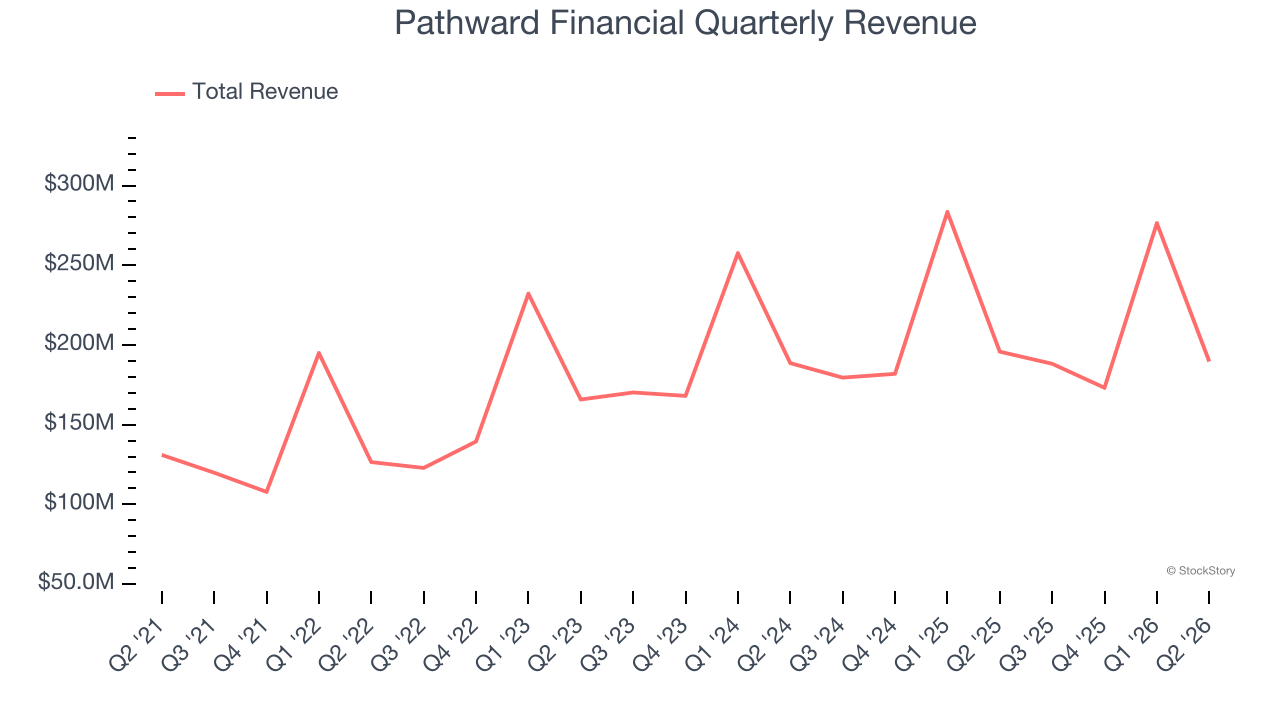
We at StockStory place the most emphasis on long-term growth, but within financials, a half-decade historical view may miss recent interest rate changes, market returns, and industry trends. Pathward Financial’s recent performance shows its demand has slowed as its annualized revenue growth of 2.7% over the last two years was below its five-year trend. We’re wary when companies in the sector see decelerations in revenue growth, as it could signal changing consumer tastes aided by low switching costs. 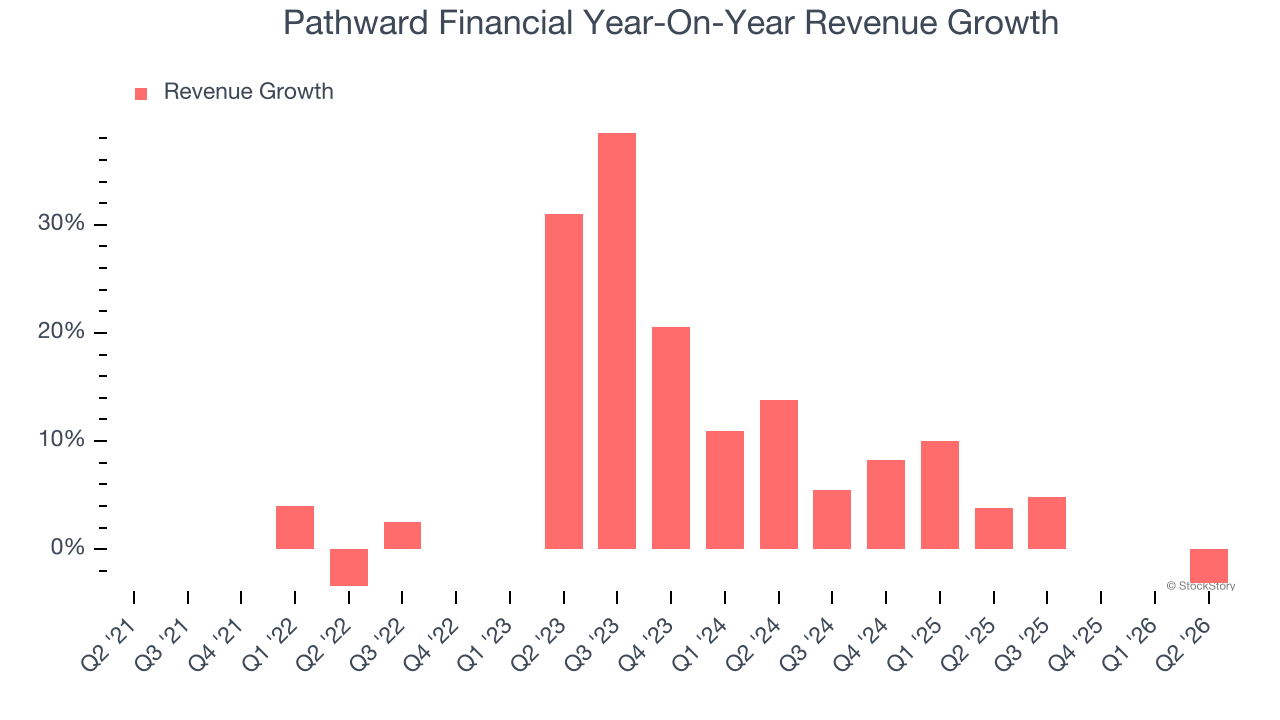 Note: Quarters not shown were determined to be outliers because they were impacted by outsized investment gains/losses that are not indicative of the recurring fundamentals of the business.
This quarter, Pathward Financial missed Wall Street’s estimates and reported a rather uninspiring 3.1% year-on-year revenue decline, generating $189.6 million of revenue.
Net interest income made up 59.5% of the company’s total revenue during the last five years, meaning Pathward Financial’s growth drivers strike a balance between lending and non-lending activities.
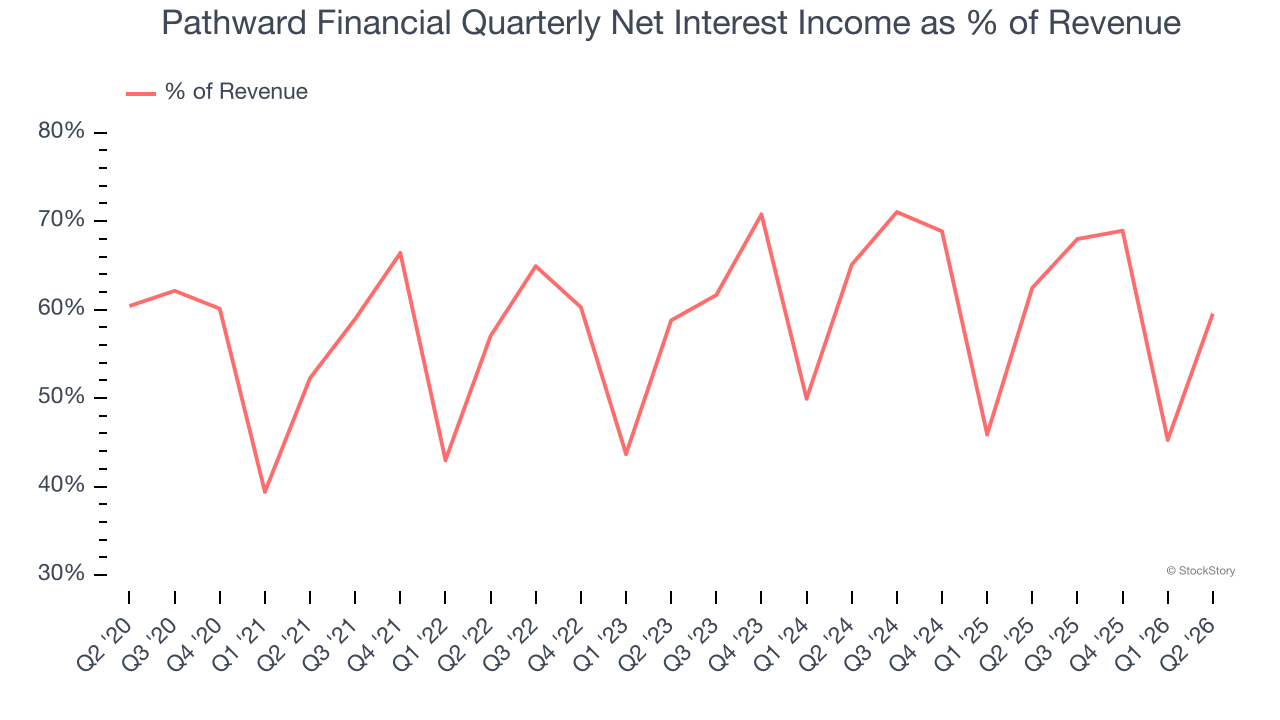
Markets consistently prioritize net interest income growth over fee-based revenue, recognizing its superior quality and recurring nature compared to the more unpredictable non-interest income streams.
ONE MORE THING: The $21 AI Application Stock Wall Street Forgot. While Wall Street obsesses over who’s building AI, one company is already using it to print money. And nobody’s paying attention.
AI chip stocks trade at ridiculous valuations. This company processes a trillion consumer signals monthly using AI and trades at a third of the price. The gap won’t last. The institutions will figure it out. You need to see this first. Read the FREE Report Before They Notice.
Tangible Book Value Per Share (TBVPS)
Banks are balance sheet-driven businesses because they generate earnings primarily through borrowing and lending. They’re also valued based on their balance sheet strength and ability to compound book value (another name for shareholders’ equity) over time.
This is why we consider tangible book value per share (TBVPS) the most important metric to track for banks. TBVPS represents the real, liquid net worth per share of a bank, excluding intangible assets that have debatable value upon liquidation. Traditional metrics like EPS are helpful but face distortion from M&A activity and loan loss accounting rules.
Pathward Financial’s TBVPS grew at an exceptional 9.2% annual clip over the last five years. TBVPS growth has also accelerated recently, growing by 21.5% annually over the last two years from $17.49 to $25.83 per share.
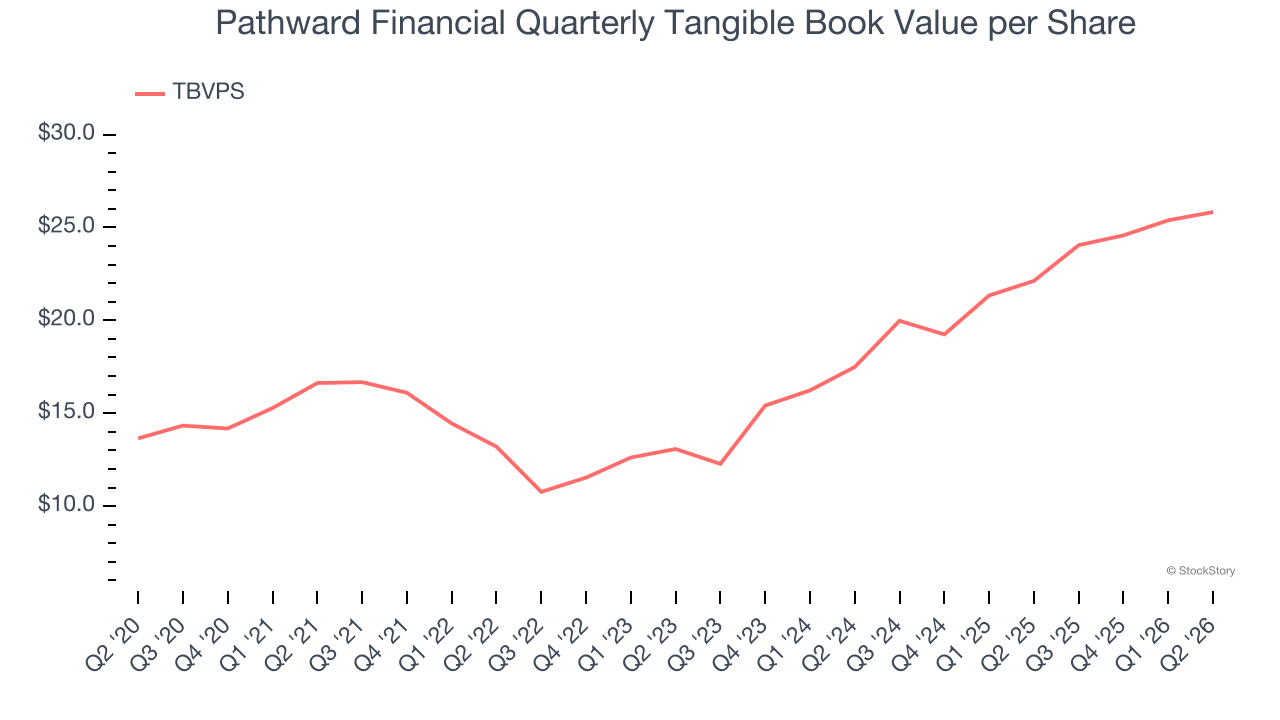
Over the next 12 months, Consensus estimates call for Pathward Financial’s TBVPS to grow by 19.9% to $30.97, top-notch growth rate.
Key Takeaways from Pathward Financial’s Q2 Results
We struggled to find many positives in these results. Its net interest income missed and its EPS fell short of Wall Street’s estimates. Overall, this was a softer quarter. The stock traded down 12.6% to $77.45 immediately after reporting.
Pathward Financial’s latest earnings report disappointed. One quarter doesn’t define a company’s quality, so let’s explore whether the stock is a buy at the current price. When making that decision, it’s important to consider its valuation, business qualities, as well as what has happened in the latest quarter. We cover that in our actionable full research report which you can read here (it’s free).