
- PRICING
- LIVE QUOTES
- LEARN
- HELP


EN
The 30-year US Treasury yield hit the longest “5% record” since the financial crisis. The market re-examines the risk of US debt
The Zhitong Finance App learned that the yield on US 30-year treasury bonds has remained stable at more than 5%, the longest since the 2007 financial crisis, reflecting market concerns about the growing US fiscal deficit and inflationary resilience.
The data shows that since this year, the yield on US 30-year Treasury bonds has been higher than 5% for 27 trading days, accounting for about 19% of all trading days, the highest level since 2007. That year, the yield was higher than 5% for a total of 50 trading days.
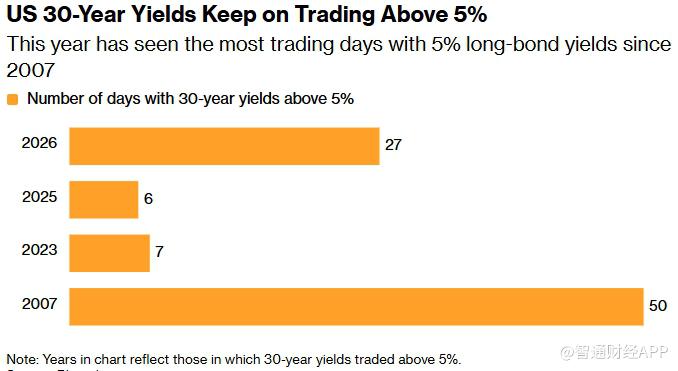
It is worth noting that compared with 2007, the Federal Reserve's benchmark interest rate is still about 150 basis points lower, which means that investors are demanding higher risk compensation by holding US ultra-long-term treasury bonds, which highlights the growing market's concerns about long-term fiscal risk.
Industry insiders believe that the main factors driving long-term treasury yields to continue to rise include the deterioration of the US fiscal situation and the huge demand for financing brought about by AI infrastructure construction, which together drive up long-term capital costs.
Tony Rodriguez, head of fixed income strategy at Nuveen Asset Management, said that America's huge sovereign debt and fiscal deficit are continuing to push up long-term interest rates.
The data shows that since 2007, the size of the US Treasury bond market has expanded from about 4.5 trillion US dollars to about 31 trillion US dollars, and the share of government debt in GDP has also risen from about 50% to more than 100%. Long-term fiscal spending expansion has brought America's annual interest expenses to over $1 trillion.
Although the debt scale of the world's major economies has generally risen since the COVID-19 pandemic, with the exception of the UK, the yield on US 30-year treasury bonds is currently higher than that of major developed economies such as Japan and France. Fitch Ratings also recently warned that America's debt burden is far higher than other countries with the same AA rating.
Hoisington Investment Management, which has long been bullish on US Treasury bonds, also rarely changed its position this month. The agency said that larger fiscal deficits and growing capital demand are putting new structural pressure on them, which may keep inflation and long-term treasury bond yields high.
At the same time, the rapid expansion of the AI industry is further intensifying competition in the long-term financing market. The market expects that the scale of financing related to AI infrastructure has exceeded 500 billion US dollars, and the surge in corporate bond issuance is competing with US Treasury bonds for long-term funding sources.
Alex Payne, senior portfolio manager at Vanguard Capital Management, said that in the past few years, every time the yield on 30-year treasury bonds rose to around 5%, the market quickly began to buy, but now traditional long-term funds such as pensions and insurance companies have more investment options, so a yield of 5% or more may become the new normal. Currently, the yield may not have peaked.
Rodriguez also pointed out that governments, hyperscale cloud service providers, and other companies are now competing for the same group of investors in the long-term bond market, and competition for financing has clearly intensified.
As of Wednesday, the yield on US 30-year Treasury bonds is expected to remain above 5% for 12 consecutive trading days, surpassing the record for 11 consecutive trading days in May this year. At that time, the yield rose to 5.2%, the highest level since 2007. Meanwhile, the US 30-year real yield (adjusted for inflation) has accumulated a cumulative increase of about 50 basis points this year, approaching 3%, reaching the highest level since 2008.
Although the US Treasury has relied more on short-term treasury bill financing in recent years and has maintained a relatively stable issuance scale of long-term treasury bonds, most Tier 1 Wall Street traders expect that the US Treasury will increase the 2- to 30-year interest-bearing treasury bond auction scale as soon as May 2027 to meet growing financing needs.
Kevin Flanagan, head of investment strategy at WisdomTree, said that when evaluating the value of long-term treasury bonds, the fiscal deficit, the size of debt, and the amount of treasury bonds that may increase in the future are all important factors that cannot be ignored.
In contrast, although 2-10 year US Treasury yields have recently rebounded, overall they have only recovered to levels close to the beginning of 2025. Currently, most institutional investors prefer to allocate 5 to 7 year treasury bonds to reduce the price risk caused by further increases in long-term interest rates.
Hank Smith, head of investment strategy at Haverford Trust, said that the company will currently not allocate US Treasury bonds with a term of 10 years or more to non-tax-exempt customers, and has increased the allocation of short-term US bonds. He pointed out that over the past 20 years, customers have been concerned about US debt issues, and the bond market will eventually tell investors whether debt has become a real risk.
Smith warned that although demand for US treasury bond auctions has not deteriorated significantly at present, if financial problems continue to ferment, “Bond Vigilantes” (Bond Vigilantes) will return to the market and may become one of the biggest risks facing the stock market and bond market in the future.