- PRICING
- LIVE QUOTES
- LEARN
- HELP


EN
Silicon Industry Branch: This week's polysilicon supply and demand conflict has not been resolved, and the market is weak and bottoming out
The Zhitong Finance App learned that on July 22, the Silicon Industry Branch released the Polysilicon Weekly Review. Trading in the domestic polysilicon market continued its weak trend this week. The overall number of orders signed fell month-on-month. There were about 5 companies participating in the signing of new orders, and the price focus dropped further. The main reasons for falling prices and shrinking transactions this week are: first, demand for terminals has not recovered significantly, inventories of industry companies continue to accumulate, and resistance to silicon shipments has increased; second, due to changes in battery-side related policies, downstream cost pressure is expected to rise, so the overall procurement attitude of the industry remains cautious.
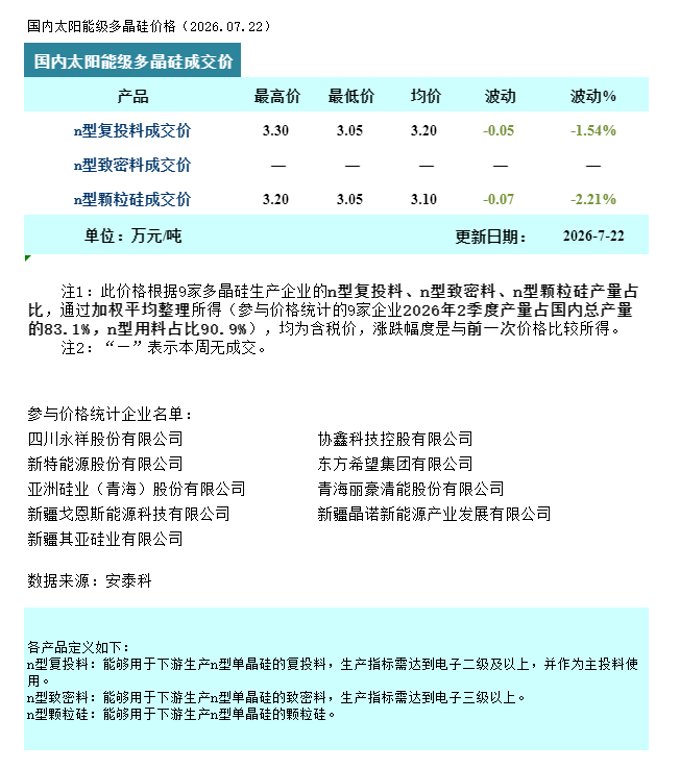
According to Antec statistics, this week's n-type composite feed (rod-shaped silicon) transaction price range was 305-33,000 yuan/ton, with an average transaction price of 32,000 yuan/ton, down 1.54% from month to month; the transaction price range for n-type granular silicon was 3.05 to 32,000 yuan/ton, and the average transaction price was 310,000 yuan/ton, down 2.21% from month to month.
This week, some major first-tier manufacturers in the polysilicon sector are still in the phase of resuming production. The operating rate of the downstream silicon wafer process remains low. The procurement of silicon materials is mainly based on inventory replenishment as needed, and there is insufficient enthusiasm for stocking up. Taken together, the current polysilicon market is still facing high inventory pressure and weak demand expectations, and the conflict between supply and demand has not been effectively resolved. Currently, prices are already close to the cash cost line of most companies, and there is relatively limited room for continued decline; however, until inventories are effectively removed and downstream demand is not repaired, the market lacks a clear upward drive, and the overall situation will remain weak and bottoming out.