
- PRICING
- LIVE QUOTES
- LEARN
- HELP


EN
The market was “empty and happy”! SK Hynix (SKHY.US) refutes rumors about the acquisition of the Intel (INTC.US) Ohio fab, and 100 billion mergers and acquisitions are in vain
The Zhitong Finance App learned that South Korean memory chip giant SK Hynix (SKHY.US) officially denied market rumors on Wednesday that it is negotiating the acquisition of Intel (INTC.US)'s New Albany Semiconductor Campus in Ohio. The company clarified through official regulatory documents submitted by the Korea Exchange (DART) that although it has been evaluating global investment opportunities, it “has neither sought nor decided to acquire Intel's plant and fab in Ohio.” SK Hynix's gains in the Seoul stock market narrowed sharply after this denial was issued.
Behind this “Oolong” incident, it reflects the desire of storage giants for future manufacturing capacity in North America under the AI wave, as well as Intel's capital difficulties under the pressure of huge losses and operational delays in foundry manufacturing.
The beginning and end of the rumor: a potential deal for the $100 billion park
The central target of this rumor is Intel's giant semiconductor campus in New Albany, Ohio. The 1,000-acre complex initially broke ground in 2022 and is one of the core pillars of Intel's IDM 2.0 strategy. The park is designed to accommodate up to 8 manufacturing plants, and the long-term development cost is estimated to be as high as 100 billion US dollars. However, due to operational delays, the initial production target has been postponed to 2030-2031, while the project also faces broader restructuring of the foundry business and yield challenges.
Rumor has it that this acquisition will help SK Hynix further expand from its already planned 3.87 billion US dollar packaging plant to front-end DRAM wafer manufacturing and achieve the layout of the entire memory chip industry chain in the US. For Intel, the sale of the Ohio campus may provide much-needed working capital for its continuously losing money — Intel's foundry business lost 2.2 billion US dollars last year and another 2.4 billion US dollars in the first quarter of this year.
Kim Woo-hyun, chief disclosure officer and head of finance at SK Hynix, said in a regulatory filing: “The company has been evaluating global investment opportunities, but has neither sought nor decided to acquire Intel's plant and fab in Ohio.” This wording leaves room for possible future investments — “always evaluating global investment opportunities” suggests that the company is indeed actively looking for a path to US expansion, but only denies a specific deal with Intel's Ohio plant.
Why did the rumor trigger an orgy? The strategic pain points of the two sides fit
Stock prices of SK Hynix and Intel both surged on Tuesday. Although the deal was eventually proven to be a false rumor, the reason the market paid close attention at the first time was that this assumption perfectly fits the two key contradictions in the current restructuring of the global semiconductor industry chain: the storage giant's “North American manufacturing anxiety” and the “funding gap” of Intel's foundry business.
Behind this market reaction is investors' strong expectation that SK Hynix will accelerate its manufacturing layout in the US. Earlier, SK Hynix announced the construction of an advanced packaging plant in West Lafayette, Indiana, and mass production is scheduled to begin in the second half of 2028. The expansion from packaging to front-end wafer manufacturing is in line with its strategic logic to establish a complete memory chip supply chain in the US. Although the specific deal was denied, the market believes that SK Hynix's production capacity expansion in the US is “imperative.”
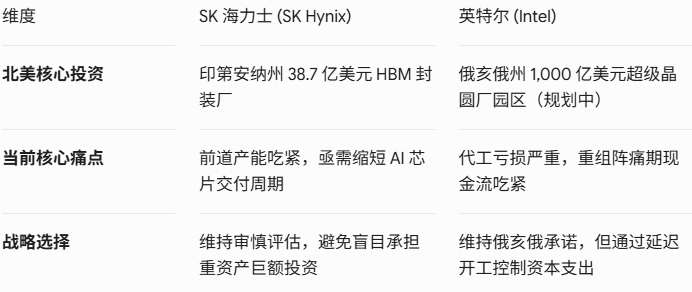
SK Hynix: Ambition to expand from back-end packaging to front-end wafer manufacturing
As the core supplier of NVIDIA (NVIDIA) high-bandwidth memory (HBM), SK Hynix is facing unprecedented demand for AI memory chips.
Industrial chain extension needs: Currently, SK Hynix's substantial investment in the US is a $3.87 billion advanced HBM back-end packaging and R&D center located in West Lafayette (West Lafayette), Indiana. Being able to directly take over an existing fab will help it quickly expand its business to the future of DRAM wafer manufacturing.
Policy and geographical considerations: In the context of the US government's vigorous promotion of localized manufacturing of advanced memory chips, setting up a pioneering fab in North America is an important option for Korean storage giants to avoid supply chain risks.
Judging from strategic necessity, there is a real need for SK Hynix to establish front-end manufacturing capacity in the US. As demand for AI chips explodes, the strategic position of high-end memory chips such as HBM (High Bandwidth Memory) is becoming more and more prominent. Establishing a complete supply chain from wafer manufacturing to package testing in the US is an inevitable choice not only to meet customer needs, but also to spread geopolitical risks.
Intel's Dilemma: The Ohio Project's “Sword of Damocles”
The future of Intel's Ohio project is still up in the air. Despite the company's renewed commitment to this multi-billion dollar investment, operational delays, yield challenges, and continued losses in the foundry business continue to drain investors' patience.
Intel Foundry (Intel Foundry) has become the biggest drag on the company's financial performance. In the first quarter of 2026, the OEM division's revenue declined by about 15% year over year to US$4.2 billion, and operating losses reached US$2.4 billion. Intel has announced plans to cut costs by $2 billion in 2026 and listed the sale of non-core businesses as an option. In this context, the possibility of selling Ohio campus assets in exchange for working capital is not entirely impossible.
However, this option also faces significant hurdles. Intel has received huge subsidies from the US Chip and Science Act, and selling such an important strategic asset may involve complex government approvals and changes in subsidy provisions. Furthermore, the expectations of the Ohio state government and local community for this huge project also constituted political resistance.
Major semiconductor manufacturers' North American localization abacus and the pain of reality
Rumors about the acquisition of SK Hynix essentially reflect the fundamental restructuring that the global semiconductor manufacturing landscape is undergoing. On the one hand, the US is using the Chip and Science Act to attract global semiconductor manufacturers to build local factories. TSMC's Arizona plant, Samsung's Texas plant, and SK Hynix's Indiana plant are all products in this context. On the other hand, traditional IDM giants such as Intel are facing the pain of OEM business model transformation, and asset restructuring and strategic contraction have become inevitable choices.
For SK Hynix, it is only a matter of time, not whether, to establish front-end manufacturing capacity in the US. The question is — build a new plant or buy existing production capacity? Did you choose Ohio or another location? The answers to these questions will determine the future direction of the global memory chip supply chain.
Industry analysts pointed out that the construction or acquisition of a Qiandao fab not only required tens of billions of dollars of capital to sink, but also involved extremely complex relocation of process equipment, infrastructure support such as electricity and water conservancy, and local supply chain ecology. SK Hynix chose to clarify and refute the rumor, reflecting the storage giant's high degree of rationality and prudence in the face of huge capital expenses (CapEx) and operational risks.
For Intel, the sharp reaction of the capital market to its stock price suggests that investors have strong expectations for the company to ease the pressure on OEM cash flow through asset revitalization, strategic cooperation, or introduction of external capital. How to balance the financial leverage of the short-term OEM business while maintaining long-term manufacturing autonomy will be a serious test that Intel management will have to face in the next few years.