
- PRICING
- LIVE QUOTES
- LEARN
- HELP


EN
The continued weakness of the yen exacerbates the risk of rising inflation, and rumor has it that the Bank of Japan is open to raising interest rates faster
The Zhitong Finance App learned that, according to people familiar with the matter, Bank of Japan officials are open to raising interest rates at a faster pace than economists generally expect due to the continued weakness of the yen, which further increases the risk of rising inflation.
The market generally expects that the Bank of Japan will keep monetary policy unchanged at the July 31 policy meeting. Most BOJ observers expect the next rate hike to take place in December after the Bank of Japan raised the benchmark interest rate to 1% last month. In an economists' survey conducted before the interest rate hike on June 16, about 70% of respondents expected the Bank of Japan to raise interest rates approximately every six months.
People familiar with the matter said that Bank of Japan officials have learned that many market observers expect the central bank to raise interest rates approximately every six months, but if necessary, officials are willing to act earlier than this time. Currently, no fixed path has been set for interest rate hikes. People familiar with the matter added that officials believe that at this stage, it is particularly important to closely examine the risk of further upward inflation, because potential inflation is finally very close to the 2% target set by the Bank of Japan more than 13 years ago.
On Wednesday, the exchange rate of the yen rose from 163.13 yen to the dollar to 162.69 yen per dollar. Meanwhile, the yield on Japan's 2-year treasury bonds rose to the highest level since 1995, and the yield on 5-year treasury bonds rose to 1.995%.
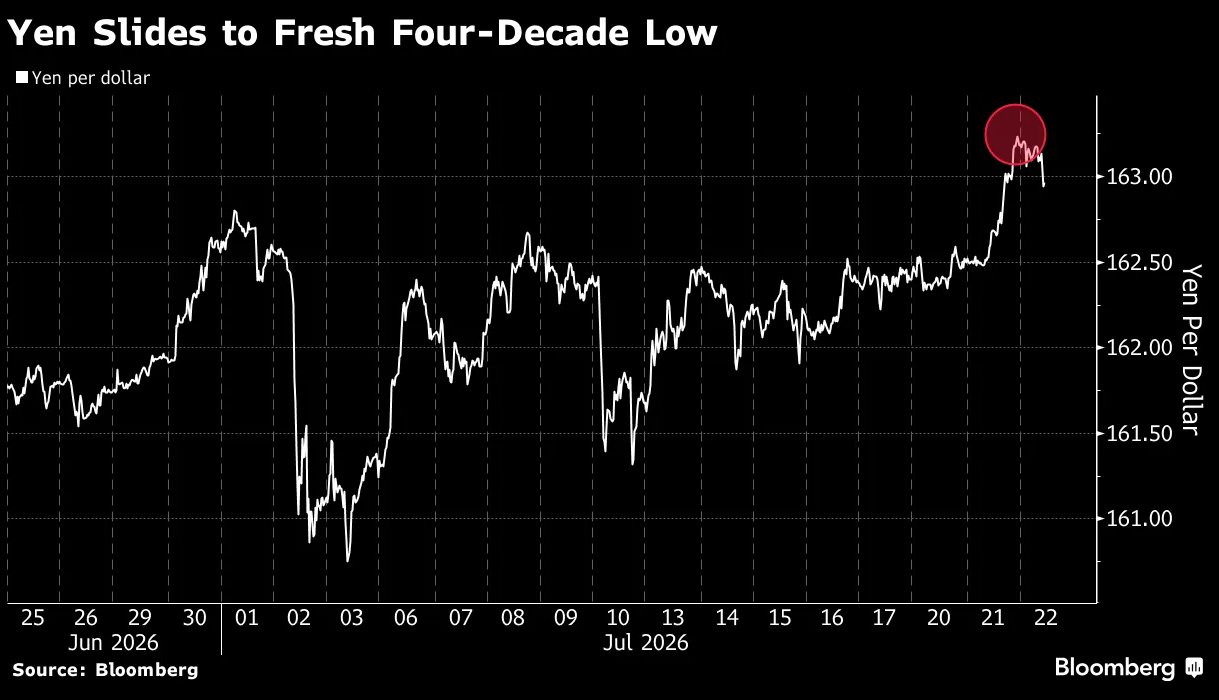
In overnight trading, the yen once fell to its lowest level in about 40 years against the US dollar, prompting the Japanese government to issue another warning of possible action on Wednesday. People familiar with the matter said that Bank of Japan officials still emphasized that monetary policy is not intended to target specific exchange rate levels, but the impact of exchange rates on prices deserves close attention.
Although the Japanese authorities used a record 11.73 trillion yen (about 72.3 billion US dollars) to interfere in the foreign exchange market from April 28 to May 27 to support the yen, the yen continued to weaken. Traders believe that the Japanese government has repeatedly warned that it will take decisive action to curb the depreciation of the yen, and that it will be difficult to bring about real relief in the long term. Many investors believe that even if the Japanese authorities intervene in the foreign exchange market to support the yen, it will only temporarily slow down the decline, because the market generally judges that Japan is slow to curb inflation through interest rate hikes, which is a structural factor in the long-term weakness of the yen.
Junpei Tanaka, head of investment strategy at Patek Asset Management in Switzerland in Japan, said, “As market concerns about the expansionary fiscal policies of the Takaichi Sanae government continue to grow, more and more people may think that only intervention in the foreign exchange market can have limited effect in curbing the depreciation of the yen.”
Furthermore, people familiar with the matter said that another factor supporting the Bank of Japan to act more quickly is a growing number of signs that inflation is becoming more entrenched. Officials found that more and more companies are passing on rising costs to consumers faster than in the past, reflecting changes in corporate pricing behavior since the Middle East conflict broke out at the end of February. Against this backdrop, another weakening of the yen may further stimulate companies to raise prices for goods and services.
People familiar with the matter said that some officials also believe that as potential inflation gradually approaches 2%, the Bank of Japan's policy tasks are also changing. Policymakers' focus is gradually shifting from driving inflation up further to ensuring that inflation can be stably anchored at a target level of around 2%.
Market participants have now begun to bet that the Bank of Japan will raise interest rates faster than economists' expectations. The market is already wary, and the Bank of Japan may raise interest rates again as early as December. Currently, the overnight index swap (OIS) market shows that the probability that the Bank of Japan will raise interest rates again by October is about 72%.