
- PRICING
- LIVE QUOTES
- LEARN
- HELP


EN
HDFC Bank Stock Leads This India Watchlist as Volatility Tests Bank and Gas Shares
Market volatility around F&O expiry, geopolitical tension affecting energy markets, and mixed Q1 earnings from companies like HDFC Bank, Adani Total Gas and Bandhan Bank are creating sharp moves in select stocks. Instead of treating the noise as random, you can use it as a filter to spot where pressure might be temporary or where strong business trends are attracting fresh attention. This article unpacks three stocks from our Key Indian Bank and Gas Companies Amid Market Volatility screener, two where recent news could be supportive and one where index-related or sentiment-driven headwinds may warrant extra caution.
HDFC Bank (NSEI:HDFCBANK)
Overview: HDFC Bank is a large private sector bank headquartered in Mumbai that offers a broad range of retail and corporate banking services, from savings accounts and cards to home, car, business and rural loans, across India and select international markets.
Operations: HDFC Bank generates most of its revenue from Retail Banking at about ₹3,025.4b, supported by Wholesale Banking at ₹1,783.9b and Insurance Business at ₹1,124.1b, with additional contributions from Treasury at ₹742.5b and Other Banking Operations at ₹371.9b.
Market Cap: ₹11,727.3b
HDFC Bank is on many investors’ watchlists, but the current setup looks more fragile than headlines suggest. The stock is acting as a key drag during F&O expiry as banking shares come under pressure, while analysts expect revenue to decline around 3.1% a year even as earnings growth forecasts sit below the broader market. The bank has a strong franchise and solid asset quality; however, weakening loan momentum, a softer CASA base and lower net interest margins leave profitability relying heavily on cost cuts and technology efficiency. Governance refresh and leadership changes may help over time, but they also add another layer of uncertainty just as valuation already prices in a recovery that is far from assured.
HDFC Bank’s story hinges on whether slowing revenue expectations, softer margins and a fragile sentiment reset are early warning signs or just a pause. Before assuming resilience holds, scan the 4 key rewards and 1 important warning sign

Adani Total Gas (NSEI:ATGL)
Overview: Adani Total Gas is a city gas distribution company that supplies piped natural gas and compressed natural gas across homes, businesses, industries and transport, while also expanding into cleaner fuels like biogas, biofuels, EV charging and hydrogen solutions across India.
Operations: Adani Total Gas generates all its ₹58,944.1m in revenue from selling and distributing natural gas within India.
Market Cap: ₹770.3b
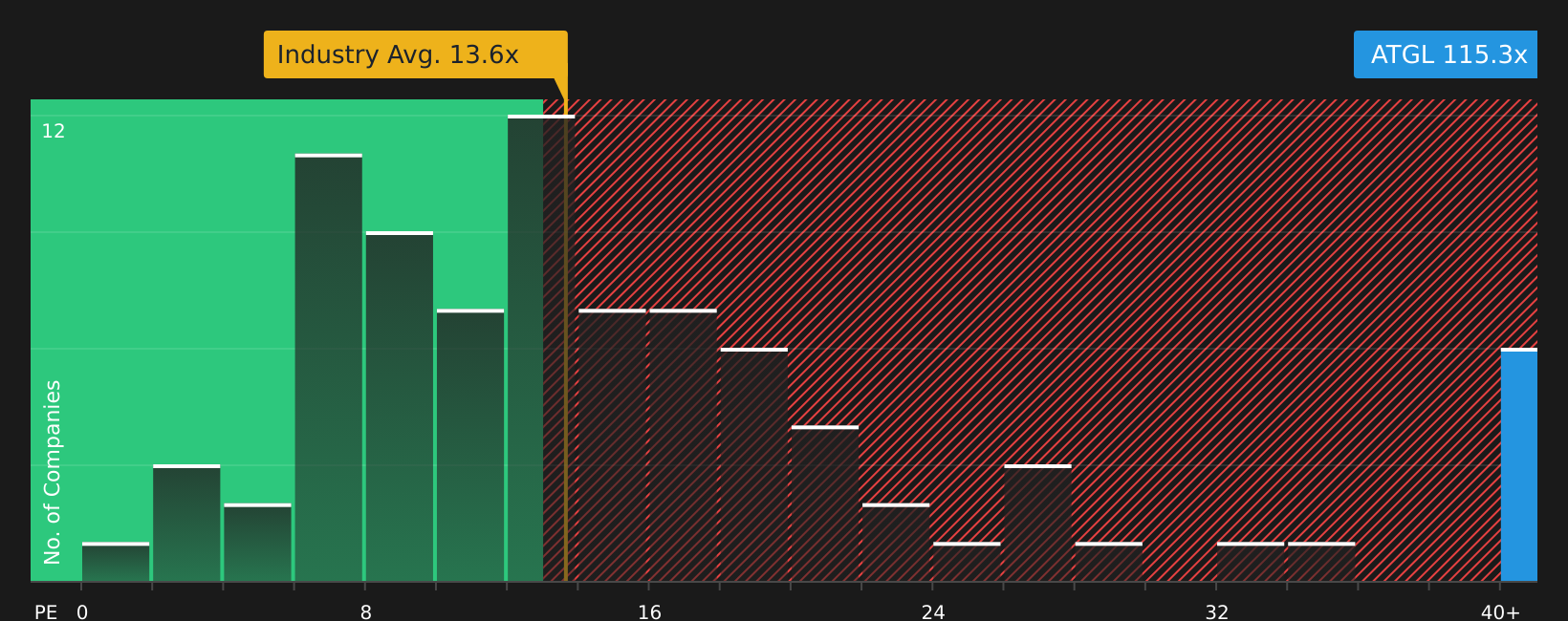
Adani Total Gas is drawing attention because its revenue performance is holding up even as gas procurement costs are affected by the West Asia conflict, suggesting that underlying demand for its city gas network is resilient. Recent quarterly numbers show revenue of ₹19,197.7m and full year FY2026 revenue of ₹64,464.0m, with net income of ₹6,557.2m, which supports the case that this is a real operating business, not just a sentiment story. At the same time, a very high P/E of 117.5x, dependence on external borrowing and a modest 13.5% ROE mean expectations are already demanding. The key question is whether the current mix of earnings quality, governance changes and growth in cleaner fuels can justify that premium over time.
Adani Total Gas looks like a real operating business with revenue, earnings and expansion into cleaner fuels, yet a 117.5x P/E and modest 13.5% ROE raise big questions about what the market is really pricing in. The 1 key reward and 1 important warning sign starts to unpack this but does not fully answer it.
Bandhan Bank (NSEI:BANDHANBNK)
Overview: Bandhan Bank is a Kolkata based bank that focuses on serving retail customers and small to medium businesses across India, offering everything from savings accounts and deposits to home, vehicle, gold and business loans, alongside payment, remittance and insurance services.
Operations: Bandhan Bank generates most of its revenue from Retail Banking at about ₹219.1b, supported by Treasury at ₹30.8b, Wholesale Banking at ₹27.3b and Other Banking Operations at ₹5.5b, with inter segment revenue offsets of ₹38.5b.
Market Cap: ₹336.4b
Bandhan Bank is drawing attention because strong Q1 FY2027 profit growth of 35% year on year to ₹5,016.7m and return on assets of 1.0% suggest that efforts to clean up the balance sheet and diversify beyond microfinance are starting to show through in the numbers, even as credit costs and funding pressures remain in focus. At the same time, a high level of bad loans at 3.3%, relatively low coverage at 74% and board turnover point to governance and asset quality questions that are important to consider. For investors trying to distinguish a potential earnings reset from a short term sentiment bounce linked to F&O volatility and recent share price movements, this mix of improving metrics and unresolved risks is central to assessing Bandhan Bank.
Bandhan Bank’s turnaround story is accelerating, but the real question is whether the current profit and ROA profile can last through the next credit cycle, so review the 1 key reward and 4 important warning signs

Take Control of Your Investment Journey
If Adani Total Gas or any of these companies have caught your attention, register for FREE with Simply Wall St and add your companies to a Watchlist to monitor the share price against the fair value and track any new developments as they happen. Once you've made your move, manage your holdings with our Portfolio Command Center that filters out the noise to deliver only the most critical, actionable updates. Throughout your journey, our Community allows you to filter the best ideas from thousands of investor perspectives. By uncovering hidden catalysts and risks early, you'll accelerate your decision-making and stay one step ahead of the market.
Seeking Alternatives Beyond These Headlines?
Fresh ideas do not wait. While attention clusters around HDFC Bank, Adani Total Gas and Bandhan Bank, other stocks may be building quiet breakout momentum under the radar for now, act now.
- Spot resilient, low turbulence movers and track 293 resilient stocks with low risk scores to help you stay in the game when volatility picks up again.
- Look for cash generative, value driven opportunities by screening a curated 235 high quality undervalued stocks before prices move and the easy entry points are gone.
- Explore long term income trends by scanning 465 dividend fortresses built to highlight companies where yield and staying power currently move in the same direction.
This article by Simply Wall St is general in nature. We provide commentary based on historical data and analyst forecasts only using an unbiased methodology and our articles are not intended to be financial advice. It does not constitute a recommendation to buy or sell any stock, and does not take account of your objectives, or your financial situation. We aim to bring you long-term focused analysis driven by fundamental data. Note that our analysis may not factor in the latest price-sensitive company announcements or qualitative material. Simply Wall St has no position in any stocks mentioned.
Have feedback on this article? Concerned about the content? Get in touch with us directly. Alternatively, email editorial-team@simplywallst.com