
- PRICING
- LIVE QUOTES
- LEARN
- HELP


EN
The “AI transformation” cannot hide the weak subscription revenue, and Damo slashes the target price of CRM.US (CRM.US) to $185
The Zhitong Finance App learned that Morgan Stanley recently downgraded the CRM.US (CRM.US) rating from “overbearing” to “neutral,” and the target price was drastically lowered by about 35% to $185 from $287. It bluntly stated that there is a significant disconnect between its rapid progress in AI and the continued weakness in subscription revenue growth.
AI's “high-profile” failure to drive a fundamental inflection point
In the context of the restructuring of the overall valuation of technology stocks, Morgan Stanley analyst Adam Wood released a research report stating that although SEFTSE “is actively disrupting itself,” its core organic growth (Organic Growth) has yet to turn around. The cumulative decline in SAFTSE's stock price since this year has widened to about 34%, a sharp retracement from its 52-week high of $274.
“Agentforce's key performance indicators (KPIs) are changing, but due to continued drag on traditional assets (mainly Commerce and Tableau), the momentum of artificial intelligence has yet to reverse CrPO (current remaining performance obligations) /organic revenue growth,” Wood wrote. For the SaaS giant led by Marc Benioff (Marc Benioff), Wood's recent performance was described by Wood as a “Tale of Two Cities”: on the one hand, AI smart products continue to grow, and on the other hand, subscription revenue growth continues to deteriorate or lack room for growth, and visible forward-looking indicators. The two cancel each other out, leaving the growth story in an awkward situation.
Core contradiction: strategic correctness does not equal an inflection point in growth
The core issue that the market is currently concerned about is how long the transformation cycle of SAFTSE's old and new businesses will take. In the report, Wood deeply analyzed the impact of this disconnect on the capital market: “The mismatch between strong proxy KPIs and organic growth indicators that lack an inflection point has led to a sharp drop in stock prices. Investors are all focused on one key question: When will Agentforce and the new headless profit program offset the structural drag from underperforming sectors (Commerce, Tableau) in the portfolio to drive continued growth in subscription revenue?”
Although Saifushi is accelerating the deep integration of acquisitions and internal assets such as Informatica, MuleSoft, Data 360, and Slack in an attempt to build an enterprise-grade intelligent AI control platform, and Wood also recognizes that its transformation to headless software and agentic (smart) is “strategically correct,” the vagueness of the monetization path makes it difficult for investors to buy.
Profitability is in its infancy: Wood added that although the transformation path is in the right direction, its profitability is still in its “infancy,” and the process of accelerating growth may be slower than some expected.
Capital expenditure squeezes leverage space: While company profit margins may rise, any reinvestment in Agentforce, Data 360, and headless architectures could limit any leverage, thereby “delaying self-service returns.”
The review is too early: Wood emphasized: “We believe that the fusion of Informatica, MuleSoft, Data 360, and Slack provides a strong argument for SAFTSE to build an enterprise-grade intelligent AI control platform, but we also realise that strategic correctness is not the same as an inflection point in growth, and that inflection point is critical for investors to refocus on SFC's stock. As a result, the challenge for SAFTSE remains how to translate intelligent activity into predictable subscription growth, and we believe the current pricing path is the clearest indication that it is too early to evaluate Seflex's future.”
Wall Street Divergence Intensifies: The Reshaping Pain of the SaaS Model in the AI Era
Saifushi's downgrade is not an isolated incident; it reflects the common dilemma faced by the SaaS software sector in the AI era — that is, the traditional per-seat (per-seat) model is being squeezed by AI agents, and the new pay-for-performance/usage monetization system is still being explored.
Currently, Wall Street is clearly divided over the future direction of SEFTSE:
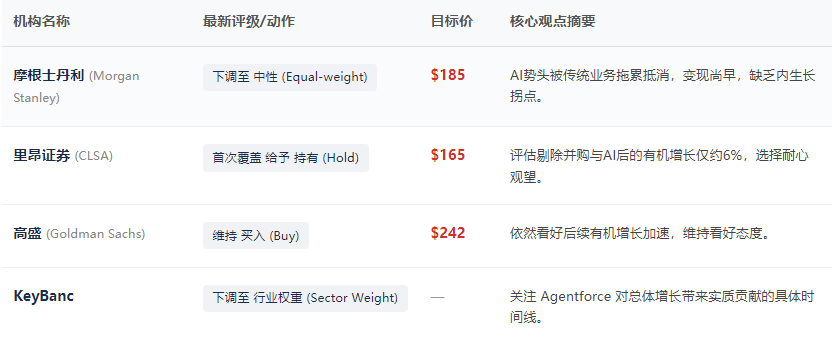
Saifushi has taken a series of aggressive transformation initiatives in recent years, including restructuring the internal service team, deploying the customer service AI robot Agentforce, and making a huge acquisition of the AI customer service platform Fin. However, during the transition period where traditional business growth is slowing down and new AI businesses have yet to generate large-scale recurring revenue, the market's patience with the “alternation of old and new” is being tested.
For SAFTSE and its CEO Benioff, how to break through the embarrassing situation where “AI concepts are hot and traditional subscriptions are weakening” and turn smart metrics into actual recurring revenue and subscription growth will be the key to whether it can regain the trust of Wall Street.