
- PRICING
- LIVE QUOTES
- LEARN
- HELP


EN
Omdia: Global large OLED display panel shipments are expected to increase 18.8% year-on-year to 38.8 million pieces in 2026
The Zhitong Finance App learned that according to the latest forecast from Omdia's “Large Area Display Market Tracker (Large Area Display Market Tracker)”, global large OLED display panel shipments are expected to increase 18.8% year-on-year in 2026 to reach 38.8 million pieces. This growth will be mainly driven by demand for OLED panels for monitors (monitors) and notebook PCs (notebook PCs). These two major applications are still key layout areas for Korean OLED panel manufacturers. In contrast, global shipments of large display panels, including LCDs, are expected to drop 2.3% year over year to 916.9 million pieces.
Although the first half of 2026 was driven by early stocking demand, market demand remained resilient, but it is expected that the market demand for large display panels will gradually weaken throughout the year. This is mainly affected by factors such as rising parts prices, recent geopolitical tension between the US and Iran, and heightened global economic uncertainty, especially in the second half of 2026.
Among them, shipments of large LCD panels are expected to drop 3.0% year on year to 888.1 million pieces; the total revenue of the global large display panel market is expected to drop 1.7% year on year to 69.9 billion US dollars. However, OLED panels for laptops and displays will continue to grow strongly. Shipments are expected to increase 66.0% and 34.0% year-on-year respectively, helping to ease the downward pressure on the overall large display market revenue.
In addition, the trend towards larger LCD TV panels will also support market revenue. TV panel shipments under 65 inches are expected to decrease by 5.9% year on year, while shipments of TV panels of 65 inches and above are expected to increase by 8.4% year on year, further driving the product structure to continue upgrading to larger sizes.
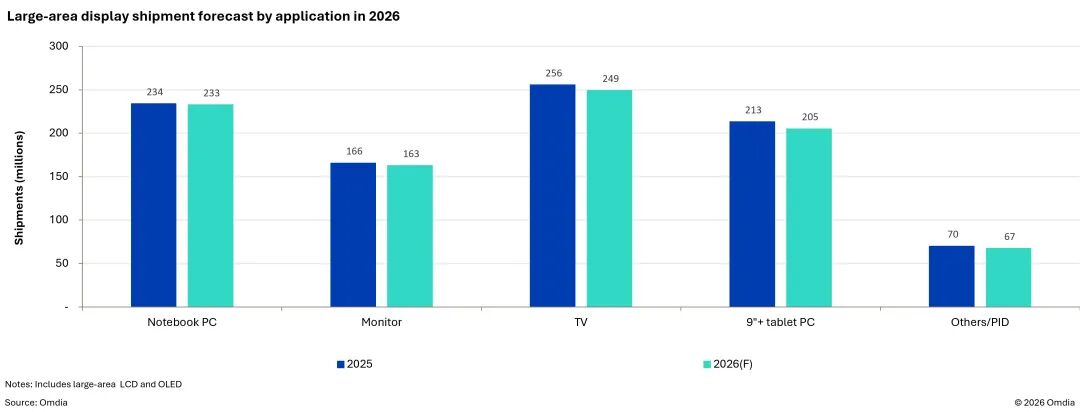
YS Chung, Omdia Display Panel Industry Research Business Leader (Practice Leader), said, “It is expected that the prices of memory, CPU and other PC components will continue to rise in 2026. Affected by this, PC product prices have continued to rise since the beginning of the year, and consumer demand has been suppressed as a result. Monitor panel shipments are expected to drop 1.8% year on year in 2026, and laptop panel shipments are expected to drop 0.6% and 3.8% year on year, respectively.
TV brands and OEMs are also facing cost pressure from rising memory and other component prices. However, unlike IT equipment, it is difficult for TV brands to pass on the additional costs to consumers by increasing retail prices. As TV brands and OEMs complete the advance preparation of TV panels, it is expected that the demand for TV panel procurement will begin to decline from the third quarter of 2026. As a result, TV display panel shipments are expected to drop 2.5% year-on-year in 2026.”
Chung also added, “Although the overall market environment is still weak, the volume of large OLED panel shipments will continue to grow in 2026. Korean manufacturers plan to increase shipments of monitor and laptop OLED panels by shifting part of the 8.5th generation OLED production line (Gen 8.5 OLED) production capacity from TV panels to display panels. In addition, Samsung Display and BOE (BOE) will begin mass production on the 8.6th generation IT OLED production line (Gen 8.6 IT OLED) in mid-2026, and production will focus on laptop OLED display panels.”
Omdia will host the 2026 Omdia Korean Display Conference (2026) at the EL Tower in Yangjae (Yangjae), Seoul, Korea from September 3 to 4, 2026. At that time, YS Chung and a number of Omdia analysts will share the latest trends in the large display market based on Omdia's in-depth research and industry analysis. Attendees will also hear in-depth interpretations from leading industry analysts on the latest developments in the display industry and its application market.