
- PRICING
- LIVE QUOTES
- LEARN
- HELP


EN
Add another spark to the chip frenzy! After leveraged ETFs were limited, South Korean retail investors turned their heads to riskier CFDs
The Zhitong Finance App learned that Korean individual investors are known for their high risk appetite, and they are now flocking to a leveraged instrument that has caused huge losses in the past. As the stock market turbulence intensifies, market concerns that this batch of positions may be suddenly closed are also heating up.
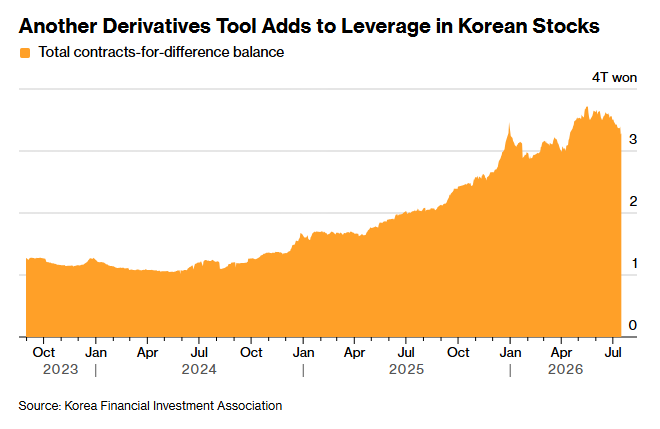
This type of product, contracts-for-difference (CFD), has been banned from being offered to retail investors in the US, but South Korea still allows investors with account balances to trade. Investors can obtain corresponding market exposure through CFDs without actually holding the underlying asset. According to data from the Korea Financial Investment Association, as of this Monday, the country's CFD product holdings have jumped by nearly two-thirds from a year ago to about 3.3 trillion won (about 2.2 billion US dollars).
The appeal of CFDs is their leverage effect — investors only need to pay a deposit of 40% of the position value to gain full market exposure. However, the return of this tool comes at a time when the market is sensitive. Previously, CFDs caused market turmoil in 2023 and were then severely restricted. Currently, leveraged ETFs linked to chip makers have greatly increased market fluctuations, and even prompted regulators to stop the listing of new single-stock leveraged ETFs.
“An increase in the overall level of leverage within the system will inevitably drive up risk,” said Natasha Sibley, portfolio manager of the Janus Henderson Diversified Alternative Investments Team. “If other investors who have bought Korean chip stocks through CFDs or financing are forced to close their positions, the stock price will inevitably be under pressure, which in turn will amplify price fluctuations.”
CFDs influence the market in a similar way to leveraged ETFs: investors' counterparties — usually banks — need to manage their risk exposure through hedging; a common practice is to hold the underlying stock. This means that once a client's CFD position is forcibly closed, the bank will sell off the underlying asset accordingly, thereby increasing the market trend, similar to the impact caused by leveraged ETF rebalancing operations.
The difference is that leveraged ETFs are rebalanced on a daily basis, while CFD-induced forced sell-offs occur when margin is added. Maxence Visseau, chief investment officer of Dubai hedge fund Arkevium Capital, pointed out that this has made the CFD market impact “more concentrated and more intense,” and that there is already a precedent.
In 2023, many individual natural gas stocks in South Korea fell one after another due to CFD positions triggering additional margin, hitting the biggest daily decline for several days in a row. At the time, over 96% of participants in CFD product trading were retail investors. The subsequent wave of sell-offs triggered heavy regulatory overhauls, causing the CFD position size to drop to an all-time low for a while.
CFD is also one of the leverage tools used by Bill Hwang's Archegos Capital Management in the 2021 liquidation event. At the time, several banks forcibly closed their positions, and multi-billion dollar investments were sold off, which eventually led to the collapse of the fund.
“We've seen this scene before,” Visseau said. “CFD trading exists in its own OTC liquidity pool. When this pool has to be sold to the open market all at once, it brings not an orderly adjustment, but a sharp cliff.”
In the US, CFDs are prohibited from being opened to non-professional investors. However, in South Korea, any investor with an average monthly balance of 300 million won or more in stocks or derivatives within five years can participate in CFD trading. However, the recent rise in the market has further increased the popularity of this product.
According to data from the Korea Financial Investment Association, as of July 20, long positions in the KOSPI Index CFD were close to their all-time peak. Looking at individual stock capital flows, CFD holdings have closely followed the market star target in the past year: SK Hynix (SKHY.US) CFD holdings soared by nearly 2,500% to 235 billion won; Samsung Electronics (SSNLF.US) CFD holdings increased fivefold to 217 billion won. Currently, this derivative has even been extended to leveraged ETFs for related individual stocks.
Although the size of the CFD market in South Korea is still small compared to the overall stock market (around US$3.9 trillion), investors and analysts have warned of the potential risks as the financing balance reached a high point last month.
“If leveraged positions are concentrated in the same direction and margin requirements cannot be met, forced liquidation may be initiated, further increasing market volatility,” said Lee Hyoseob, head of financial services at the Korea Capital Market Research Institute.