- PRICING
- LIVE QUOTES
- LEARN
- HELP


EN
Omdia: India's smartphone shipments fell 13% year on year in the second quarter, and vivo continues to rank first in the market
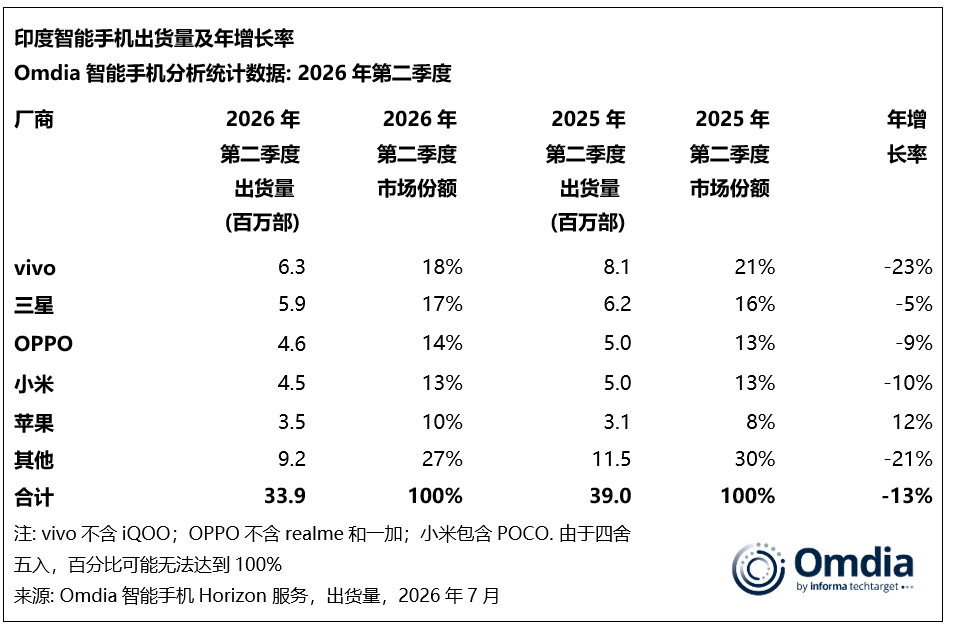
According to Omdia's latest research, smartphone shipments in India fell 13% year-on-year to 33.9 million units in the second quarter of 2026. The continued rise in memory costs has driven up the price of mobile phones continuously, weakening the purchasing power of mass market consumers. Furthermore, factors such as consumers waiting for holiday promotions to upgrade equipment, depreciation of the Indian rupee, inflationary pressure, and weak offline retail customer flow in summer have further dampened market demand. Although the launch of new models in the second quarter was still active, manufacturers remained cautious about channel replenishment due to the slowdown in terminal sales and the continued rise in channel inventory costs.
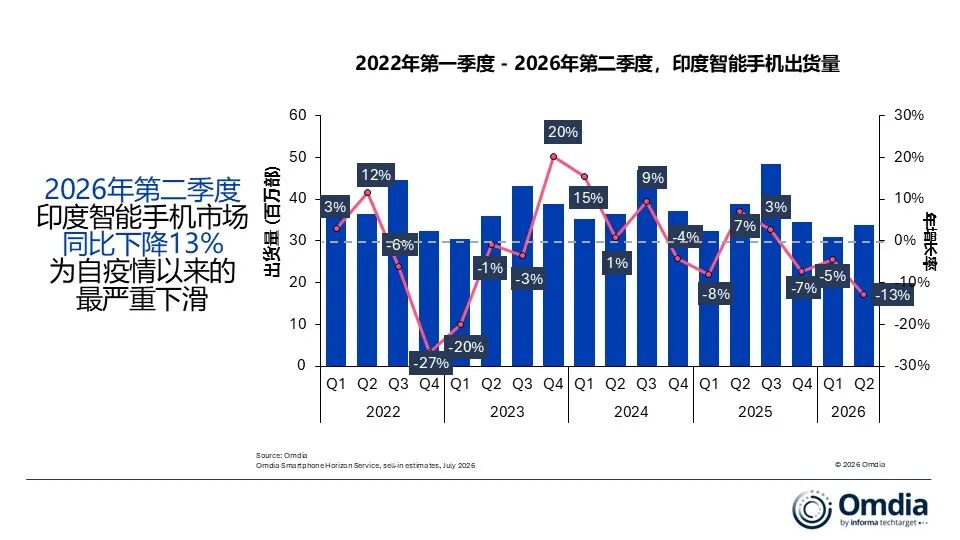
Vendor performance for the second quarter of 2026:
vivo continues to rank first in the market with a shipment volume of 6.3 million units. Although affected by rising prices, mass market demand was under pressure, and shipments experienced a double-digit decline, Vivo further lowered the entry threshold for the V Series and consolidated its leading position in the market by streamlining the entry-level product portfolio around core models such as the Y11 5G and Y21 5G, while also launching the more user-friendly V70 FE.
Samsung followed with 5.9 million units shipped, showing the strongest market resilience among major manufacturers. The Galaxy A07 and Galaxy A17 became the main sales drivers, and projects such as the Galaxy Forever Program, trade-in, repurchase, and dealer financing effectively supported Galaxy S26 series sales and boosted channel confidence.
OPPO ranked third with 4.6 million units shipped. Due to multiple price adjustments for products on sale, there is some pressure on the overall shipment volume. However, OPPO continues to strengthen its mid-range and flagship product layout, launch the F33 series, further expand the Reno 15 series product line, and improve the Find X9 series product matrix.
Xiaomi (01810) ranked fourth with 4.5 million units shipped, mainly benefiting from the market performance of the Xiaomi 15A and 15C. Meanwhile, 4G products such as Redmi A7 4G and Redmi A7 Pro 4G continue to meet the needs of the entry-level market. In addition, Xiaomi is also relaunching the T series in collaboration with Leica to further improve the high-end product upgrade path.
Apple (AAPL.US) ranked fifth with 3.5 million units shipped. Due to the market's expectation that the iPhone price will rise further, and the iPhone 18 basic version is not expected to be released this year, the channel is preparing the iPhone 17 in advance, driving the increase in shipments. At the same time, promotional programs such as installment payments, trade-in, and cashback have further boosted sales of high-end products.
Omdia Principal Analyst (Principal Analyst) Sanyam Chaurasia said, “In the second quarter of 2026, manufacturers will further streamline and reposition their product portfolios to improve profitability, strengthen product differentiation, and improve channel operation efficiency. The strategies of various brands in the entry-level market are also more focused, giving priority to building core models (Hero Models), extending the product life cycle, and releasing new products through false peaks to better match the pace of inventory and terminal sales; at the same time, high-end product lines are being re-planned around a more clear upgrade path. As terminal sales prices rise and channel inventory value continues to increase, retailers are also more inclined to invest in brands with more stable terminal sales performance and better financing support. As a result, in a context where retailers prioritize brands with lower inventory risk and higher demand for high-end products, Samsung and Apple have an advantage in obtaining a larger share of channel inventory.”
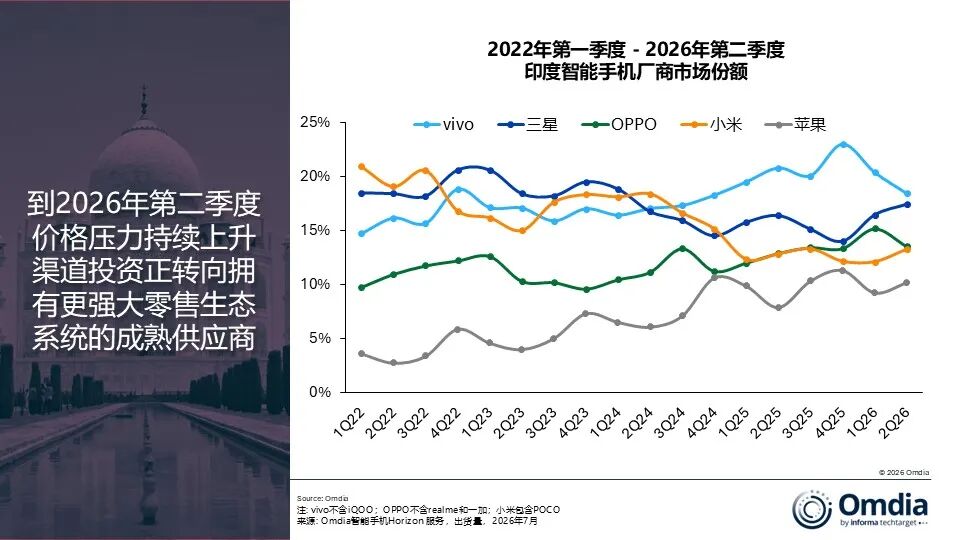
Omdia predicts that the Indian smartphone market will still experience a double-digit decline in 2026, and consumer demand will continue to be affected by macroeconomic pressure and high terminal sales prices. Continued inflation, depreciation of the Indian rupee, and rising cost of living are expected to further curb consumers' discretionary spending; at the same time, lower rainfall than year-round levels may also weaken the income of residents in rural areas and have a further impact on demand during the peak holiday sales season. Furthermore, continued high memory costs are expected to continue to drive up smartphone prices for the rest of 2026. Omdia believes that the full return of smartphone prices to normal levels is not expected until the first half of 2027 at the earliest.
Chaurasia concluded, “In this market environment, manufacturers should adhere to the stability of price strategies, fully reflect rising parts costs while maintaining consumer affordability through channel-led promotions, rather than simply relying on larger price discounts. Brands should make more use of installment payments, trade-in, cashback, and value-added service packages to enhance product value perception. As terminal prices continue to rise, consumer demand for solutions such as installment payments, old phone replacement, and package packages will further increase. Manufacturers should deepen cooperation with large retail channels while continuing to support the development of traditional channels (General Trade) through more detailed inventory planning and more efficient terminal retail execution.”