
- PRICING
- LIVE QUOTES
- LEARN
- HELP


EN
Prediction: Microsoft Stock Will Go Parabolic After July 29. Here's Why.
Key Points
Microsoft is the poorest-performing "Magnificent Seven" stock so far this year.
Investors are concerned about the payoffs for its artificial intelligence (AI) infrastructure spending.
Azure continues to grow impressively, while Microsoft's other AI-enabled offerings could drive revenue increases and margin expansion.
Microsoft (NASDAQ: MSFT) stock has struggled mightily throughout 2026. As of this writing (July 20), shares are down 18% on the year -- a stark contrast to the S&P 500's gain of 9%. Within the "Magnificent Seven" tech stocks, Microsoft stands out as the clear laggard.
Investor skepticism around the company's huge artificial intelligence (AI) infrastructure spending has weighed on sentiment despite the company's underlying business momentum. With earnings scheduled for July 29, I think there is a strong case for a sharp rebound in Microsoft stock. Read on to learn why.
Where to invest $1,000 right now? Our analyst team just revealed what they believe are the 10 best stocks to buy right now, when you join Stock Advisor. See the stocks »

Image source: Getty Images.
Why is Microsoft stock down this year?
The primary culprit behind the stock's decline is widespread concern over the return on the company's aggressive capital expenditures (capex). Management has accelerated spending on AI data centers, with 2026 capex guidance projected at $190 billion. These infrastructure investments are pressuring free cash flow, raising questions about near-term profit margins as depreciation on GPUs and related hardware accelerates.

MSFT Capital Expenditures (TTM) data by YCharts; TTM = trailing 12 months.
Growth in its Azure cloud segment is also facing heightened scrutiny. It delivered 40% annual growth last quarter -- outpacing Amazon Web Services' (AWS) 28% pace -- but some investors are beginning to worry about Microsoft's ability to sustain leadership in the AI cloud landscape without even higher spending.
What is Wall Street expecting?
According to consensus estimates, Wall Street analysts are looking for Microsoft to report revenue of $87.7 billion and earnings per share (EPS) of $4.24. Management's own guidance calls for total revenue between $86.7 billion and $87.8 billion, with Azure forecast to have 39% to 40% growth based on constant currency.
These figures include continued enterprise momentum offset by softer consumer hardware trends. In my eyes, this is a relatively achievable bar that leaves room for an earnings beat if AI demand proves stronger than forecast.
Analyzing Microsoft's valuation
I see a few reasons that could drive better-than-expected results in Microsoft's upcoming earnings report. Azure growth could accelerate even further as newly added capacity comes online and utilization improves, allowing the company to capture incremental AI workloads.
Moreover, if Copilot adoption continues expanding across Microsoft 365, the company's revenue profile should shift toward higher-margin, usage-based models -- supporting acceleration in the Productivity segment.
Microsoft's robust commercial backlog, ongoing AI infrastructure partnerships, and efficiencies in data center operations position the company for further revenue reacceleration and gradual margin expansion as fixed costs are leveraged more effectively. While these will take time to fully manifest themselves, I think investors may be underestimating the potential here.
On valuation, Microsoft trades at a forward price-to-earnings (P/E) multiple of roughly 20. This is the cheapest the stock has been in several years -- making shares both reasonable and attractive at current prices.
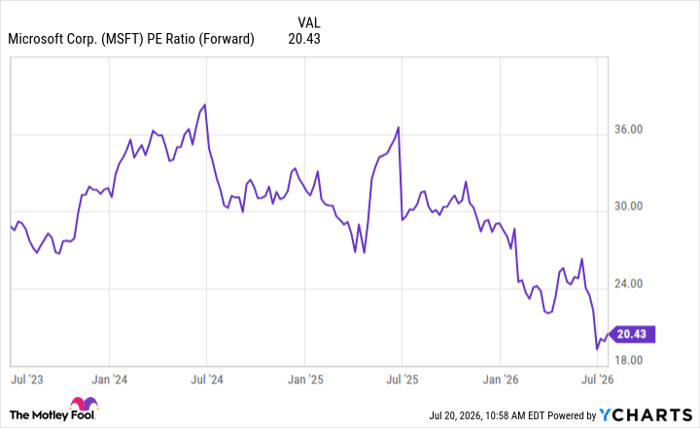
MSFT PE Ratio (Forward) data by YCharts.
With AI tailwinds still early in the adoption curve, smart investors will see that the current discount to historical averages reflects short-term concerns around capex and competition rather than a fundamental weakness for Microsoft. A clean beat on Azure forecasts and encouraging commentary on capacity utilization could swiftly rerate Microsoft stock higher.
Overall, the upcoming report offers Microsoft a chance to reset the growth narrative. If the company demonstrates that its infrastructure investments are translating into revenue growth and improving profitability, shares could fly as investors shift from worrying about spending to acknowledging the payoff.
Adam Spatacco has positions in Amazon and Microsoft. The Motley Fool has positions in and recommends Amazon and Microsoft. The Motley Fool has a disclosure policy.