
- PRICING
- LIVE QUOTES
- LEARN
- HELP


EN
Ball (BALL) Stock Looks Below Fair Value With Weak Returns and Solid Earnings
Ball stock is trading at US$62.25 after a period where the share price has risen in the shorter term but is still down 18.1% over five years, while both a Discounted Cash Flow (DCF) intrinsic value estimate and market multiples currently suggest the shares may be undervalued.
- Over the last five years Ball has delivered a total return that declined 18.1%, which means long term holders have not yet seen the benefit that recent gains suggest.
- Expectations for continued earnings strength highlighted in recent coverage can support the current valuation, but any disappointment in profit growth or cash generation may quickly challenge the case that the stock is trading below intrinsic value.
- On Simply Wall St's broader checks, Ball scores 4 out of 6 on valuation, which points to a mixed picture rather than a clear bargain or clear overvaluation.
The issue now is whether Ball's recent share price recovery still leaves a sufficient discount to the intrinsic value estimate to appeal to new and existing investors.
Does Ball Look Undervalued on Cash Flow?
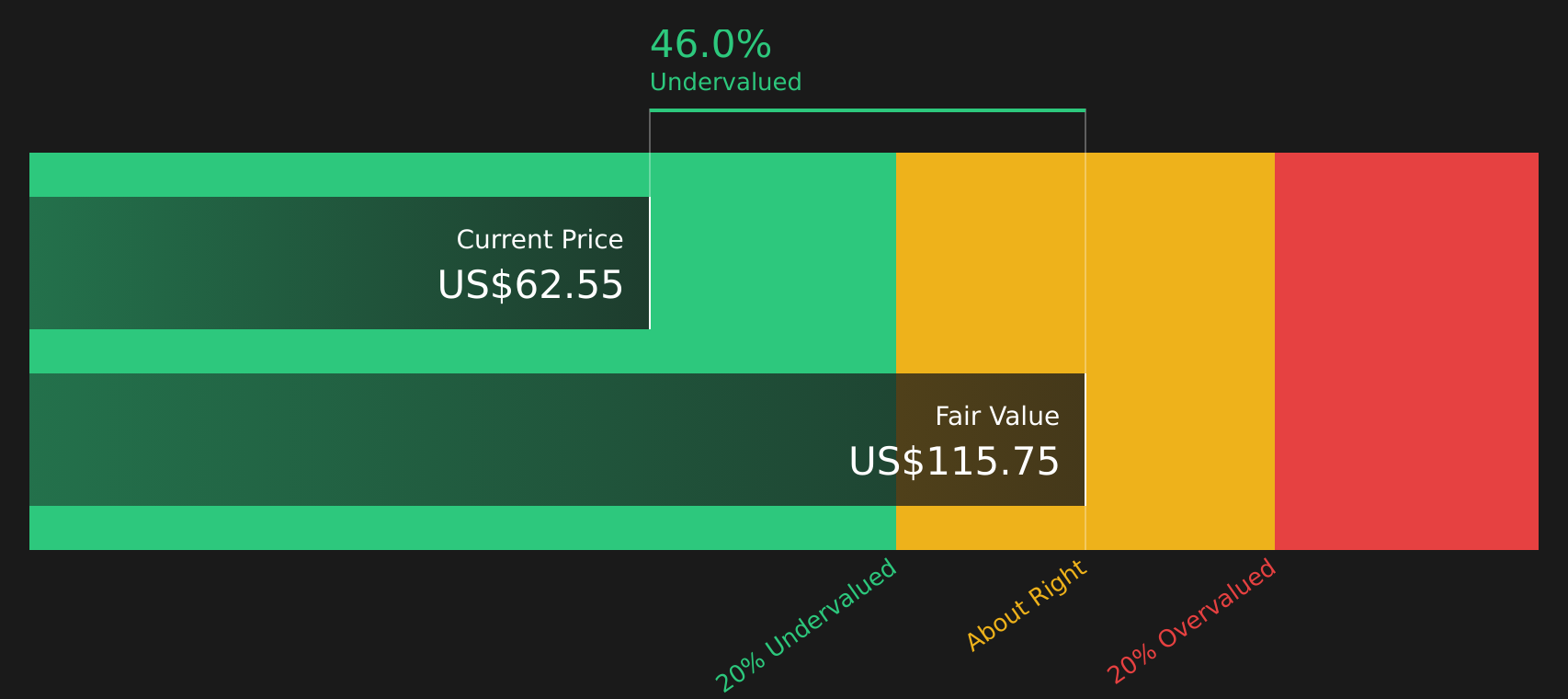
The Discounted Cash Flow (DCF) model values Ball by projecting future free cash flows and discounting them back to today. For Ball, the latest twelve month free cash flow is about US$488.8 million, and the model assumes these cash flows continue growing rather than shrinking. On that basis, the two stage free cash flow to equity model arrives at an estimated intrinsic value of about $115.59 per share.
Compared with the current $62.25 share price, this points to the stock trading at roughly a 46.1% discount to that intrinsic value estimate. This indicates that Ball screens as undervalued on this cash flow view. Because Ball Corporation is expected to report another quarter of solid earnings on 4 August 2026, the current market price may not yet fully reflect the level of cash generation implied by the DCF model.
On this analysis, Ball stock appears undervalued relative to the cash flows implied in the DCF valuation.
Our Discounted Cash Flow (DCF) analysis suggests Ball is undervalued by 46.1%. Track this in your watchlist or portfolio, or discover 45 more high quality undervalued stocks.
Is Ball Still Cheap on Earnings?
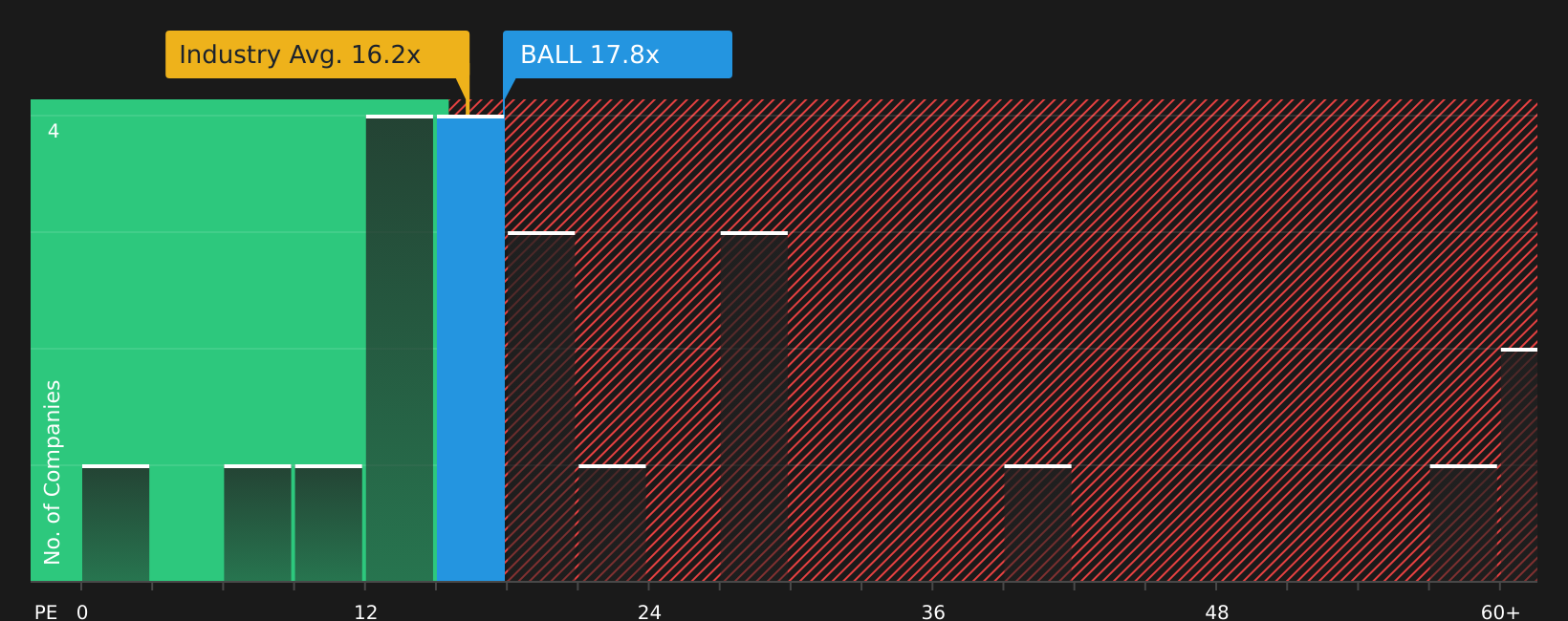
The P/E ratio is a useful way to look at Ball because earnings are a key driver for how investors typically value packaging stocks. Ball currently trades on a P/E of about 17.7x, which is above the Packaging industry average of roughly 16.0x but slightly below the peer group average of about 18.9x.
Simply Wall St's fair P/E estimate for Ball is around 19.9x, based on the company’s profile and risk characteristics. Against that yardstick, the current 17.7x multiple sits at a discount, suggesting the market is not fully pricing Ball in line with what this framework considers a reasonable earnings multiple.
On the P/E comparison, Ball stock appears undervalued relative to the earnings multiple implied by this fair value benchmark.
See what the numbers say about this price — find out in our valuation breakdown.
The Ball Narrative: What Would Justify Today's Price?
Simply Wall St Narratives pick up where the valuation puzzle for Ball leaves off by spelling out which paths for Ball's growth, margins and earnings would need to play out for the stock to be worth materially more or materially less than today. These narratives sit on the company’s Community page. Each narrative links its number to a clear view of how Ball's growth, profitability and risks could evolve, giving you something concrete to revisit as new information comes through.
The Ball debate on Simply Wall St is split between investors who see tight can supply and contracts as a support for upside and those who worry that execution and demand risks keep the stock closer to fairly valued.
Bull case: 12% undervalued
"Increasing contract coverage (over 90% of 2026 volumes under contract in North America) paired with long-standing customer relationships provides revenue and earnings visibility, mitigating downside risks and enabling further stability in free cash flow and earnings trajectory…"
Read the full Bull Case to see why Ball could be undervalued
Bear case: roughly fairly valued
"The volume growth in North America is uncertain and largely dependent on economic conditions and consumer behavior…"
Read the full Bear Case to see why Ball could be overvalued
Do you think there's more to the story for Ball? Head over to our Community to see what others are saying!
The Bottom Line
For Ball, both the Discounted Cash Flow (DCF) intrinsic value estimate and the current earnings multiple point to the stock looking undervalued rather than stretched, even if the broader checks are only mixed. That means the key question is not whether Ball is statistically cheap, but whether the earnings and cash flow profile investors are assuming actually holds up. The core of the bull versus bear debate is whether demand, volumes and execution can support the cash generation implied in the models, or whether the current discount is the market correctly pricing in those risks.
This article by Simply Wall St is general in nature. We provide commentary based on historical data and analyst forecasts only using an unbiased methodology and our articles are not intended to be financial advice. It does not constitute a recommendation to buy or sell any stock, and does not take account of your objectives, or your financial situation. We aim to bring you long-term focused analysis driven by fundamental data. Note that our analysis may not factor in the latest price-sensitive company announcements or qualitative material. Simply Wall St has no position in any stocks mentioned.
Have feedback on this article? Concerned about the content? Get in touch with us directly. Alternatively, email editorial-team@simplywallst.com