
- PRICING
- LIVE QUOTES
- LEARN
- HELP


EN
The biggest winner isn't AI! Biotech became the “dark horse” of US stock IPOs, with an average return of 55%, outperforming the overall market
The Zhitong Finance App learned that the biggest winners in the US initial public offering (IPO) market this year were not artificial intelligence (AI) companies, but the biotech sector. Driven by improvements in industry fundamentals, active mergers and acquisitions of large pharmaceutical companies, and continued capital inflows, biotech IPOs significantly outperformed the overall market and attracted more and more companies to take advantage of the summer window to speed up the pace of listing.
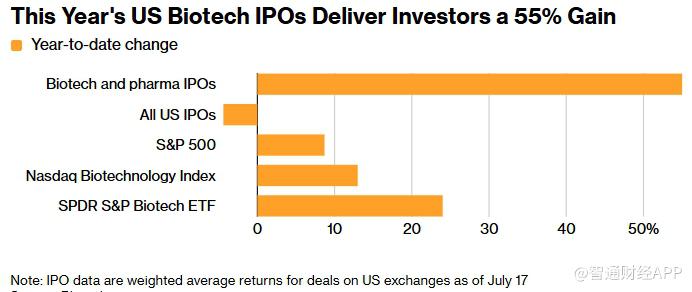
According to the data, since 2026, the weighted average return on IPOs of US biotech and pharmaceutical companies has reached 55%, while excluding special purpose acquisition companies (SPACs) and other financial instruments, the overall weighted average return on the US IPO market is a loss of 4.4%.
Strong market performance is driving companies to go public faster. This month alone, at least 6 biotech companies submitted IPO applications, including Scribe Therapeutics, which focuses on CRISPR gene-editing therapy. Related companies are expected to complete their listing from the end of July to the beginning of August, and complete financing just before the summer IPO market enters the traditional off-season.
“This is the healthiest biotech IPO market in recent years,” said Jack Bannister, senior managing director of equity capital markets at investment bank Leerink Partners.
The market originally generally anticipated that 2026 will be a big year of IPOs for AI, aerospace, and defense companies. Among them, SpaceX, which is expected to complete a record IPO, received the most attention. However, as investors began to worry that the AI market is overvalued, the weighted average share price of the 10 largest IPOs in the US has dropped by 6.3% this year, and the popularity of AI concept IPOs has clearly cooled down.
In contrast, the biotech sector continues to be sought after by funding. Factors driving the industry's leading performance include a cumulative increase of about 13% in the NASDAQ Biotech Index this year, stabilizing the regulatory environment, positive breakthroughs in clinical trials, and continuing mergers and acquisitions by large pharmaceutical companies.
Over the past month, the industry has successively launched three major acquisitions worth over $10 billion, including ABBV.US (ABBV.US)'s acquisition of Apogee Therapeutics, GSK.US's acquisition of Nuvalent, and Vertex Pharmaceuticals (VRTX.US)'s acquisition of Crinetics Pharmaceuticals. These deals not only boosted the overall valuation of the industry, but also allowed investment institutions to obtain large amounts of exit capital and further return to the IPO market.
Seth Rubin, head of global equity capital markets at Stifel Financial, said that at present, some of the world's largest funds are continuing to increase their allocation ratio in the healthcare sector, and the excellent returns of small to medium market capitalization biotech companies have further strengthened investors' confidence in the industry.
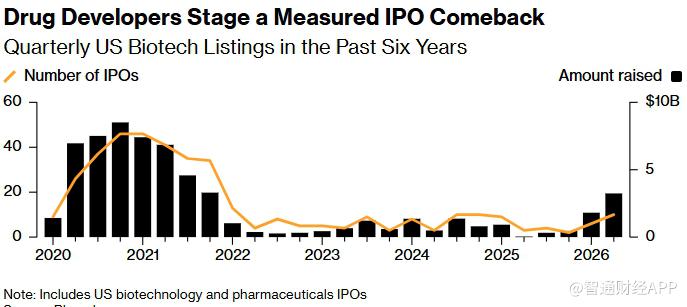
According to the data, up to now, the number of US biotech IPOs in 2026 has surpassed the level of only 8 companies in 2025. However, compared to the peak of centralized listing of more than 200 biotech companies during the 2020 to 2021 pandemic, the market is still in a relatively rational recovery phase.
Rubin said that at present, the market is not significantly overheated, and the overall pace of financing is still relatively healthy.
In terms of financing scale, the total amount raised in US biotech IPOs this year has exceeded 5 billion US dollars, about three times that of last year. Among them, Parabilis Medicines, which focuses on rare cancer treatment, completed an IPO of 770.6 million US dollars last month, setting the record for the largest IPO in the history of the US biotech industry.
In terms of individual stock performance, Veradermics, a drug research and development company to treat hair loss, has accumulated a cumulative increase of more than 500% since its launch in February this year, making it the best-performing IPO in the US in 2026; the stock price of Hemab Therapeutics, which focuses on treating blood diseases, has also more than doubled since its May IPO.
However, market participants still warned that if the Federal Reserve maintains high interest rates longer than expected, the biotech industry may still face valuation pressure. Since biotech companies generally rely on future cash flow for valuation, interest rate hike cycles have historically put some pressure on the sector.
Bannister said that interest rate hikes may indeed be a risk factor facing the industry in the future, but the current trend in the biotech sector is clearly independent of the AI market, and is not clearly affected by interest rate factors.
He said, “We always need to find a direction for allocating capital. Compared to other current investment opportunities, biotechnology is not only a relatively stable safe haven, but also still has a lot of room for growth.”