
- PRICING
- LIVE QUOTES
- LEARN
- HELP


EN
General Motors (GM.US) showed resilience during the painful transformation period: Q2 net profit fell 31% due to the “strategic contraction” of electric vehicles, and the annual profit guidelines were raised again during the year
The Zhitong Finance App learned that on July 21, GM (GM.US) released a highly “two-sided” second-quarter financial report: adjusted profit before interest and tax (EBIT) surged 29.8% year on year to US$3.9 billion, adjusted earnings per share of US$3.57 far exceeded expectations of US$3.19, profit margin jumped 6.4% to 8.2%, and revenue of US$48.03 billion increased 1.9% year over year, which also exceeded expectations; however, net profit attributable to shareholders fell 31% to US$1.3 billion due to a special expenses related to electric vehicles of 2.3 billion US dollars. Despite a setback in net profit, the company announced a second increase in its full-year profit guidelines during the year.
Based on the strong momentum of the first half of the year, GM announced a second annual performance increase in 2026: this year's adjusted EBIT will be between US$14 billion and US$16 billion, higher than the April forecast of US$13.5 billion to US$15.5 billion for 2026, and higher than the January forecast of US$13 billion to US$15 billion. The adjusted median earnings per share guide was $13, higher than analysts' unanimous expectations of $12.79.

However, the net profit guidelines attributable to shareholders were lowered by at least US$1.5 billion to the US$8.4-9.8 billion range. The divergence between net profit and core profit trends is rooted in the electric vehicle strategy contraction that GM is experiencing
Electric vehicle “strategic contraction”: net profit plummeted by 31%, new expenses of 2.3 billion yuan, cumulative impairment reached 10.9 billion US dollars
GM's net profit attributable to shareholders of GAAP for the second quarter was US$1.3 billion, down 31.1% from US$1.9 billion in the same period last year. The culprit behind the sharp decline in net profit was a special “electric vehicle strategic restructuring” project of about 2.3 billion US dollars.
The composition of this fee is complex: it includes both non-cash impairment and cash expenses to resolve vendor claims because the electric vehicle market is less than anticipated. GM spokesman David Caldwell said the fee was a “combination of non-cash and cash expenses” to resolve supplier claims due to the electric vehicle market being smaller than expected.
This is not a one-off event. Since the contraction of the electric vehicle strategy began in the second half of 2025, the cumulative impairment costs associated with electric vehicles calculated by GM have reached 10.9 billion US dollars. Signalbloom's analysis indicates that in the first half of 2026 alone, the total cost of such “strategic restructuring of electric vehicles” reached US$3.36 billion. The company expects this round of contraction to generate $7.2 billion in cash expenses, and has paid 4.5 billion US dollars by the end of the second quarter. The company said that the depreciation accrual work for large assets has basically been completed.
This accounting operation raised the adjusted EBIT margin to 8.2% (up 180 basis points from the previous year), while the GAAP net profit margin was reduced to only 2.7%. GM is using non-GAAP metrics to tell a story of “profit growth,” while GAAP data reveals the reality that a “cost of strategic contraction” continues to erode shareholder returns.
The background of this strategic adjustment is that GM is stepping back from aggressive electrification goals and focusing more on the profit engine of fuel vehicles and hybrid models. Bora emphasized in the shareholder letter that the company has “multiple profit margin expansion and growth engines” while maintaining “capital discipline.”
North American fuel vehicle engines run at full speed: pickups and SUVs support 8.6% profit margin
GM's profit growth was driven entirely by its North American core business. The adjusted profit before interest and tax in the North American market reached US$3.45 billion, up 42.7% year on year, and the profit margin increased sharply to 8.6% from 6.1% a year ago.
GM achieved a contrarian expansion in profit margins against the backdrop of declining sales. US sales fell 4.2% to about 715,000 units in the second quarter, but the company maintained profitability through strict inventory management and pricing discipline. GM CEO Mary Bora said in a letter to shareholders: “Our 8.6% adjusted EBIT margin in North America increased 2.5 percentage points year over year, while continuing to reduce warranty costs, reduce electric vehicle losses, and improve operational efficiency.”
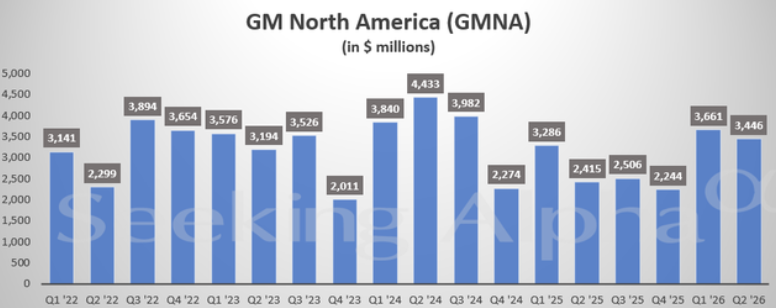
This profit miracle is built on two pillars. The first is the firm control of pricing power — GM strictly controlled car purchase subsidies in the second quarter, and the average vehicle transaction price remained high at 52,000 US dollars; incentives accounted for only 4.7% of MSRP, which is lower than the industry average of 6.3%. The second is product structure optimization — demand for high-profit pickup trucks and SUVs continues to be strong. CEO Marie Bora said in a letter to shareholders that the North American market's pickup truck and SUV product portfolio “continues to see strong consumer demand.”
At the same time, dealer inventory fell 3% year over year, and the number of inventory days remained within the target range of 50 to 60 days. China's business equity revenue was US$83 million, up from US$71 million in the same period last year. Revenue from digital services increased 20% year over year.
Chief Financial Officer Paul Jacobson said in an earnings conference call that the company's earnings per share after adjustments in the first half of the year reached a record high, up 25% year over year, adding that the current share price of about 75 US dollars is “extremely valuable for investment.”
Declining sales and loss of market share: hidden concerns
However, under the guise of rising profits, concerns about declining sales are building up. GM's sales volume in the US fell 4.2% year on year in the second quarter to about 715,000 units. The company said the decline in sales was mainly due to discontinued models (Cadillac XT4, XT6, and Chevrolet Malibu) and a sharp drop in demand for electric vehicles after the federal electric vehicle tax credit expired — a policy that overdrew demand ahead of schedule until the end of 2025. GM's total deliveries fell 6.8% year over year in the first half of this year.
Market share is also under pressure. In the US market, GM's market share contracted 80 basis points year over year to 16.6%. In the Chinese market, the market share declined further to 6.6%. Although GM's equity revenue in China increased from 71 million US dollars in the same period last year to 83 million US dollars, this is the third consecutive quarter of profit, which is still far lower than the first quarter's 165 million US dollars, and GM's sales in the Chinese market plummeted by more than 20% year on year.
Unabated tariff pressure: a heavy shackle of 2.5 billion to 3.5 billion US dollars
The Trump administration's tariff policy continues to erode GM's profits. The company kept the annual tariff cost estimate unchanged, which is still 2.5 billion to 3.5 billion US dollars.
However, the situation has improved compared to last year. In the second quarter of last year, GM incurred huge expenses of 1.1 billion US dollars due to the Trump administration's 25% tariff on all imported cars and parts. This year, after the Supreme Court overturned some tariffs, GM received about 500 million US dollars in tariff rebates. The company also partially mitigated the impact of tariffs by readjusting the supply chain, shifting some production to the mainland of the United States, and negotiating with suppliers.
Furthermore, inflation in raw materials, chips, and logistics costs is expected to drag annual profits by 1.5 billion to 2 billion US dollars.
What is the market worried about?
Although GM raised its full-year adjusted EBIT guidance to US$14 billion to US$16 billion for the second consecutive quarter (previously US$13.5 billion to US$15.5 billion), and raised its adjusted earnings per share guidance to $12 to $14.
The market's concerns are centered on three levels:
First, the divergence between GAAP and adjusted profit is widening. According to Signalbloom's analysis, GM's adjusted earnings per share increased by 41.3% year-on-year in the second quarter only after excluding the $2.6 billion pre-tax adjustment program. Investors are questioning how long this “selective disclosure” can last.
Second, the cost of electric vehicle contraction is not over yet. GM said the impairment calculation process was “basically completed,” but the cumulative impairment of 10.9 billion US dollars, expected cash expenses of 7.2 billion US dollars, and 4.5 billion US dollars already paid all mean that the financial costs of this strategic contraction are still being released.
Third, the continued suppression of macroeconomic uncertainty. In its performance guidelines, GM clearly assumes that the situation in the Middle East will not escalate significantly, commodity costs will not rise sharply, and inflation will not soar again. However, the ongoing conflict between the US and Iran, tension in the Strait of Hormuz, and the reality that oil prices have returned above $90 are constantly challenging these assumptions.
However, the Wall Street analyst community as a whole maintains a bullish stance. J.P. Morgan maintained an “overrated” rating, raising the target price from $98 to $110 on July 8; Citi gave a “buy” rating and raised the target price sharply from $108 to $131 on June 1; RBC Capital maintained a “outperforming market” rating; and UBS gave a target price of $102. According to FactSet data, analysts' average target price is $95.85, implying an upward margin of more than 20% compared to the current stock price. Wells Fargo is a minority of bearish players, maintaining a “reduced holdings” rating, with a target price of only $60.