
- PRICING
- LIVE QUOTES
- LEARN
- HELP


EN
The job market stopped falling and stabilized, and the wage growth rate hit a new low in nearly five years! The Bank of England welcomes the “reassurance pill” and the probability of staying on hold will rise next week
The Zhitong Finance App learned that before the Bank of England announced the latest interest rate decision next week, the UK's official data showed further signs of stabilization in the country's labor market. The UK Office for National Statistics said on Tuesday that the number of employees receiving payrolls decreased by 4,000 in June and increased by 3,000 in May. This result is better than the 8,000 reduction expected by economists. In the three months up to June, the number of job vacancies in the UK was 712,000, which is basically the same as in the previous statistical cycle. The unemployment rate remained at 4.9% for the three months to May, although the UK Office for National Statistics warned that the “quality of the unemployment rate estimate has declined” due to a temporary problem; the unemployment rate for young people aged 16 to 24 rose slightly to 16.4%, the highest level since 2014.
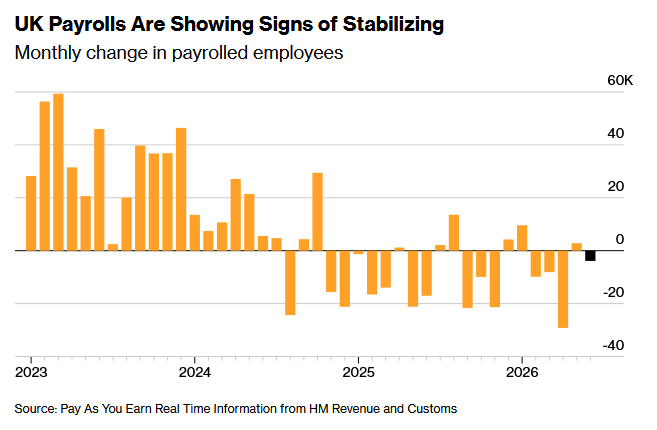
Changes in the number of UK payroll workers show signs of stabilization
Meanwhile, private sector wage growth fell to its lowest level since 2020. The UK Office for National Statistics said that in the three months up to May, salary growth, excluding bonuses, remained at 3.4% year on year. Private sector wages, which the Bank of England is most concerned about, increased 2.9% year-on-year in the three months ending May, the slowest growth rate since October 2020.
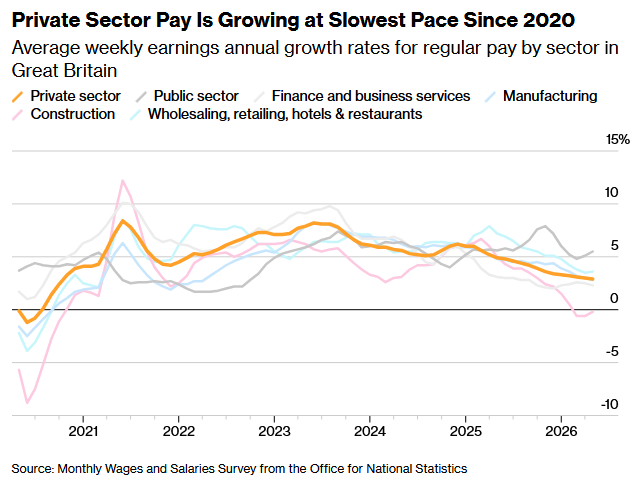
UK private sector wage growth falls to lowest level since 2020
The above data initially shows that on the eve of Andy Burnham entering 10 Downing Street, the previous downward trend in the British labor market may have reached the bottom. Andrew Hunt, senior economist at Moody's Analytics, said: “The UK labor market appears to be gradually stabilizing after a long period of weakness. This shows that the labor market has withstood the test of recent energy shocks, and that the long-term drag on employment caused by minimum wage increases and national insurance tax increases has finally begun to subside.”
For Burnham, the new prime minister has taken over a challenging economic environment — sluggish economic growth and rising unemployment in recent years. In his first speech since becoming prime minister on Monday, Burnham promised to create a “new economic model” and provide more “breathing space” for British families. He also said on Tuesday that VAT will be removed from energy bills.
Signs of stabilizing the UK labour market are expected to support the Bank of England remaining on hold next week. Labor market conditions are critical for Bank of England policymakers. Bank of England officials hope that weak labor demand will limit the effects of a second round of inflation triggered by soaring energy prices.
Since the last Labour government led by Kiel Stammer announced increases in employment taxes and minimum wages in its first year of administration, the number of payroll takers according to the UK Office for National Statistics has been declining. After entering 2026, the energy shock caused by the Middle East War and the British government's plans to further strengthen the protection of workers' rights and interests have brought new uncertainty to the labor market.
The economist said, “The overall number of payroll takers is still declining, and the number of job vacancies has further decreased, indicating that rising energy costs and tighter financing conditions may be dampening labor demand.” “These data provided the basis for the Bank of England to keep interest rates unchanged at the July meeting.”
The market currently generally expects the Bank of England to keep interest rates unchanged next week. Currently, traders believe that the probability that the Bank of England will raise interest rates by 25 basis points is only 14%. However, as tension between the US and Iran has once again escalated, investors still expect the Bank of England to raise interest rates before the end of the year.
Ruth Gregory, UK's Deputy Chief Economist at KITU Macro, said, “The labor market is still very weak. This continues to show that the current environment is not enough to have an obvious second-round inflation effect. The data released today does not change our benchmark judgment, that is, the Bank of England will not raise interest rates further from the current 3.75%.”