
- PRICING
- LIVE QUOTES
- LEARN
- HELP


EN
Cui Dongshu: Changsijiao Automobile Manufacturing Advantages Highlight Total Automobile Production Achieved Positive Growth of 4.99 Million Units in January-June
The Zhitong Finance App learned that on July 21, Cui Dongshu, Secretary General of the Passenger Transport Association, released an analysis of automobile production by province and region across the country. The automobile industry is rapidly iterative and upgraded. Relying on the transformation of electrification, the automobile industry structure is becoming increasingly clustered. From January to June 2026, the total domestic automobile production volume was 15.1 million units, down 3% year on year, with significant regional differentiation. The Yangtze River Delta and Pearl River Delta achieved positive growth, with 4.99 million units, leading the growth rate by 14%. Compared with data from previous years, Changsijiao's production capacity has expanded rapidly in recent years, breaking 1,000 in 2025, becoming the core growth pole; Northeast China continues to decline year by year, and the advantages of traditional industries have faded away. Production in central China, Chengdu and Chongqing fluctuates greatly, the regional industrial pattern is being restructured, and the concentration of new energy production capacity in the Yangtze River Delta and Pearl River Delta are the core reasons for the differentiation.
1. The concept of a long square and the overall characteristics of automobile production
The conventional geographical concept “Yangtze River Delta” refers only to Jiangsu, Zhejiang and Shanghai. To match the actual cluster pattern of the domestic automobile industry, Cui Dongshu integrated the four provinces and cities of Shanghai, Jiangsu, Zhejiang, and Anhui and named it the “Yangtze River Delta” automobile industry cluster, which is different from the traditional geographical Yangtze River Delta caliber.
Core logic: Vehicle and new energy production capacity has exploded in recent years in Hefei and Wuhu, Anhui. Projects such as NIO, BYD, Volkswagen Anhui, and Chery have been launched to form a complete collaborative industrial chain with Jiangsu, Zhejiang and Shanghai. Vehicles, components, and power batteries are highly linked, and can no longer be separated and counted separately.
Anhui has become the largest domestic automobile production province, and is deeply tied to Jiangsu, Zhejiang, and Shanghai. The “Yangtze Square” has become the core observation unit for investigating the transfer of domestic new energy production capacity and regional competition. If Anhui is placed in central China, it will not reflect the changes in industrial agglomeration in East China.
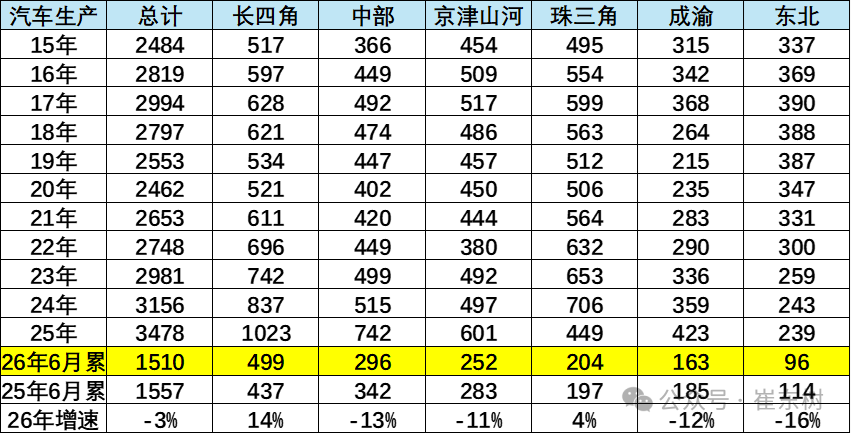
From January to June 2026, the total domestic automobile production volume was 15.1 million units, down 3% year on year, with significant regional differentiation. The Yangtze River Delta and Pearl River Delta achieved positive growth. The Yangtze River Delta had 4.99 million units, leading the growth rate by 14%; the Pearl River Delta had 2.04 million units, a slight increase of 4%. The central region, Beijing-Tianjin mountains and rivers, Chengyu, and Northeast China all declined year-on-year. The biggest decline in Northeast China was 16%, and production capacity in traditional automobile production areas shrunk significantly.
Compared with data from previous years, Changsijiao's production capacity has expanded rapidly in recent years, breaking 1,000 in 2025, becoming the core growth pole; Northeast China continues to decline year by year, and the advantages of traditional industries have faded away. Production in central China, Chengdu and Chongqing fluctuates greatly, the regional industrial pattern is being restructured, and the concentration of new energy production capacity in the Yangtze River Delta and Pearl River Delta are the core reasons for the differentiation.
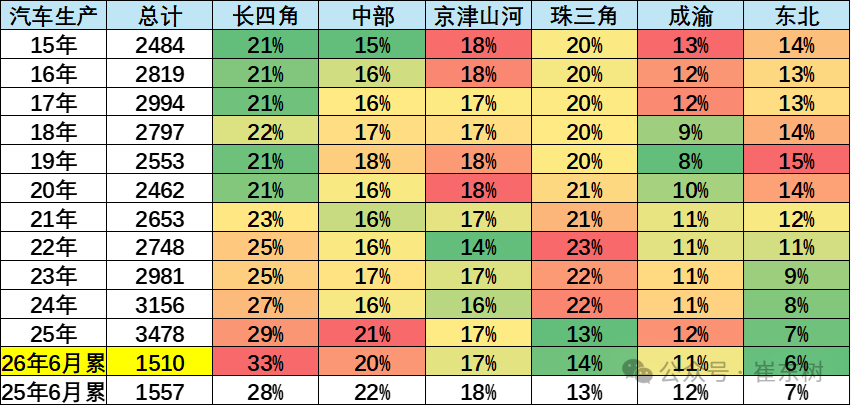
The regional share of the domestic automobile industry in 2015-2026 showed extreme differentiation. Changsijiao's share climbed all the way from 21% to 33% in the first half of 2026, ranking as the top growth pole; Northeast China's share continued to shrink, falling from 14% to only 6%, and traditional bases continued to lose ground. The share of the Pearl River Delta has declined relatively recently, reaching 14% in the first half of 2026; the share of central China rebounded to 20%, the Beijing-Tianjin mountains and rivers stabilized at 17%, and Chengdu and Chongqing remained around 11% for a long time.
The share shift reflects the main line of capacity transfer: production capacity from new energy sources continues to gather in the Changfour Corners, driving its share to rise year after year; production capacity of traditional fuel vehicle companies in Northeast China has shrunk, and their share continues to decline. In the first half of 2026, Changsijiao's share increased by 5 percentage points year on year, making it the only sector with significant capacity expansion; the shares of central China, Beijing-Tianjin mountains and rivers, and Northeast China all declined year over year, and the trend of restructuring the regional automobile industry was clear.
2. Characteristics of automobile production by province
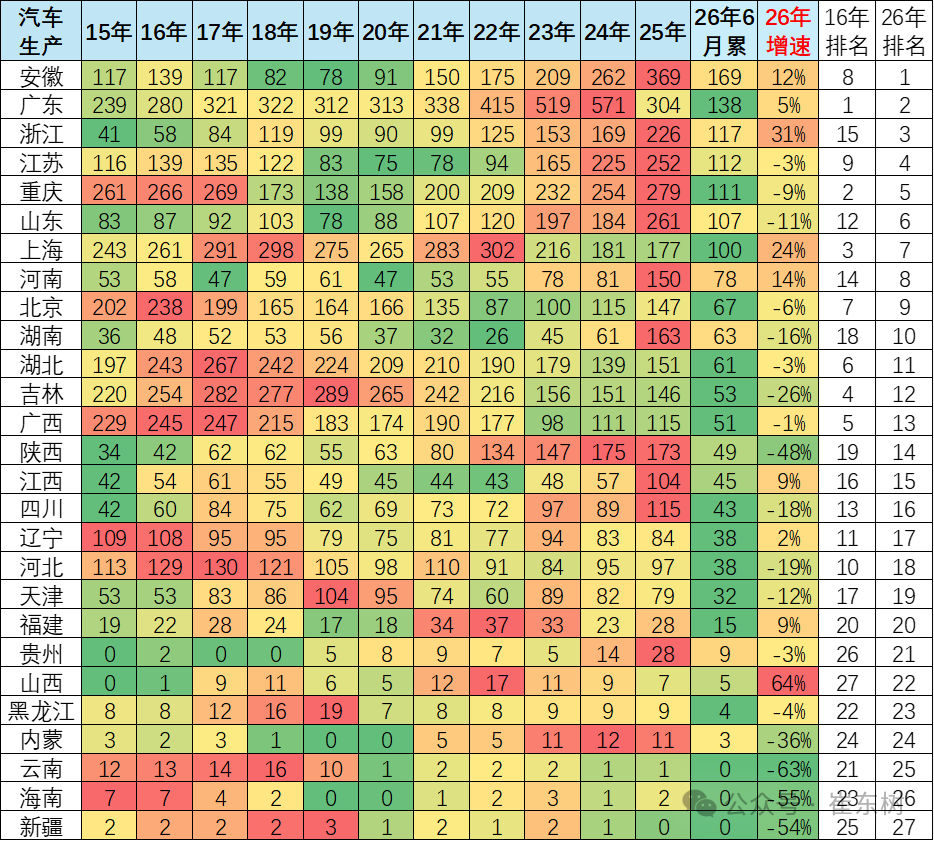
The automobile production rankings of various provinces in the first half of 2026 were drastically reshuffled compared to 2016. Anhui and Zhejiang jumped sharply in rank, and production capacity in Changsijiao Province expanded significantly. Production in Anhui grew by 12% to 1.69 million units, ranking first in the country; Zhejiang had the strongest increase of 31%; Shanghai increased 24% year on year, and the three provinces formed the domestic core production capacity cluster. Guangdong fell to second place, while production in the traditional Northeast and North China provinces generally declined sharply.
The decline in established automobile bases is prominent. Production in Jilin, Shaanxi, and Yunnan fell by more than 25%, and production in Heiliao, Tianjin, and Hebei continued to shrink. The central provinces were divided, with Henan growing 14% and Hubei falling slightly; Southwest Chengdu and Chongqing stabilized, but production in Sichuan fell 18%. In the past ten years, production capacity has continued to be concentrated in Changsijiao. Production capacity in traditional production areas for fuel vehicles has gradually been cleared, and the trend of industrial regional restructuring is clear.
3. Overall characteristics of NEV production
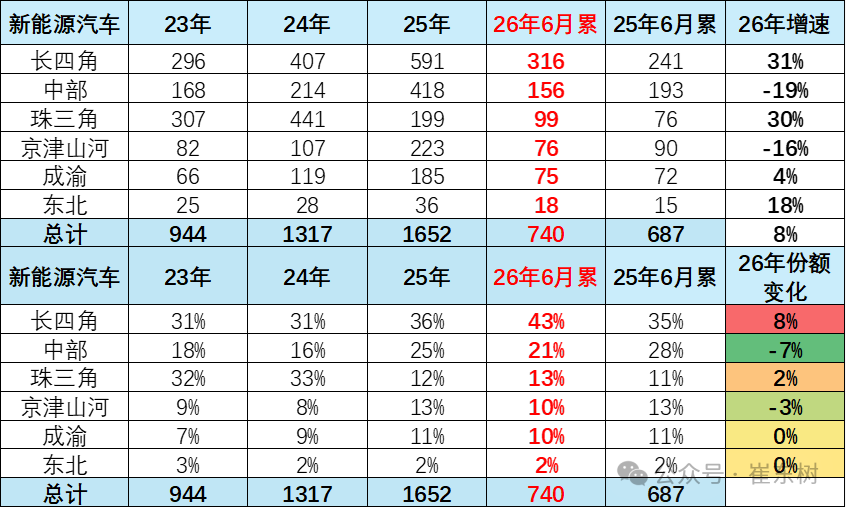
The total production of new energy vehicles in the first half of 2026 was 7.4 million units, an increase of 8% over the previous year. Regional growth is polarized. The Yangtze River Delta, Northeast China, Chengdu and Chongqing achieved positive growth, with 3.16 million units in the Yangtze River leading the growth rate by 31%; production in central China, Beijing-Tianjin mountains and rivers declined year on year, with the central region falling by 19%. The share of Changjiao increased by 8 percentage points over the same period last year, and is a core area for capacity expansion.
In the past three years, new energy production capacity has continued to be concentrated in Changsijiao, and its share has risen from 31% in 2023 to 43% in the first half of 2026. The Pearl River Delta expanded slightly, the share of central China fell by 7 percentage points, and the share of mountains and rivers in Beijing and Tianjin shrank by 3%; the share of Chengdu, Chongqing, and Northeast China remained basically the same. The growth of new energy production capacity in traditional central and northern bases is weak, and there is a marked trend of industrial agglomeration in the four corners.
4. Overall characteristics of NEV production by province
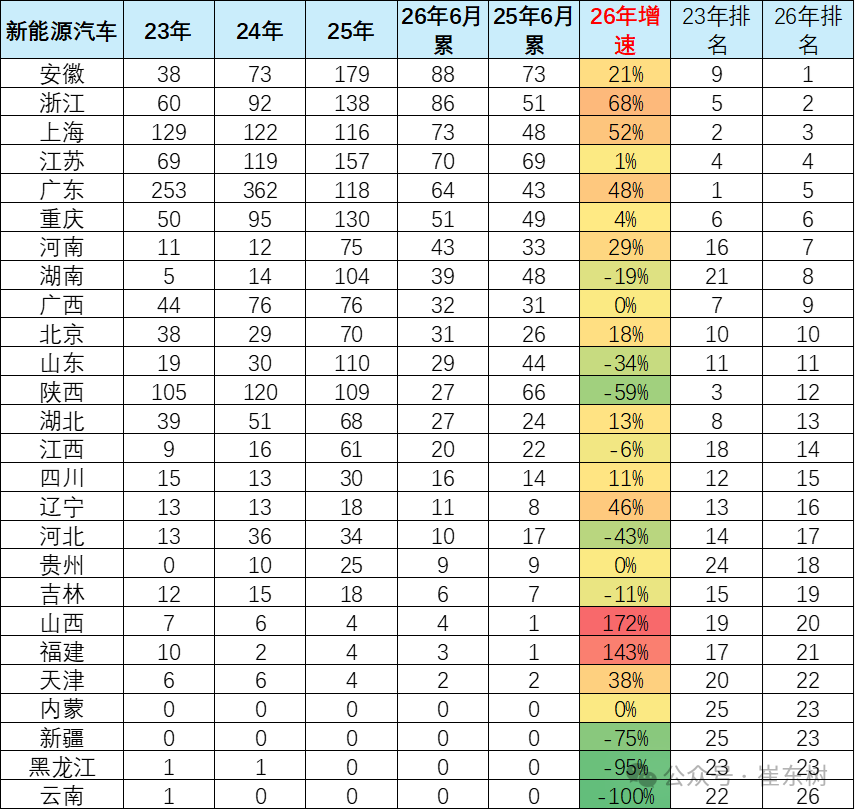
The ranking of NEV provinces was drastically reshaped in the first half of 2026, with Changsijiao leading the way across the board. Anhui rose to number one in the country with 880,000 units; Zhejiang grew rapidly at 68% and Shanghai grew rapidly at a 52% growth rate; although Guangdong's growth rate was 48%, production declined throughout the year, falling from top to fifth place in the ranking. The four provinces of Changfour have taken over the top four and have become the core production capacity bearing areas for domestic new energy sources.
Regional growth diverged markedly. Shanxi and Fujian had a low base growth rate of over 140%, but production capacity was small; Shaanxi, Yunnan, and Heilongjiang fell by more than 59%, and new energy production capacity shrank markedly in traditional production areas in the north. Central Henan and Hubei grew steadily, production declined year-on-year in most provinces in Northeast China and North China, and the new energy industry continued to gather in the Yangtze River.
5. Changes in automobile production in provinces and regions
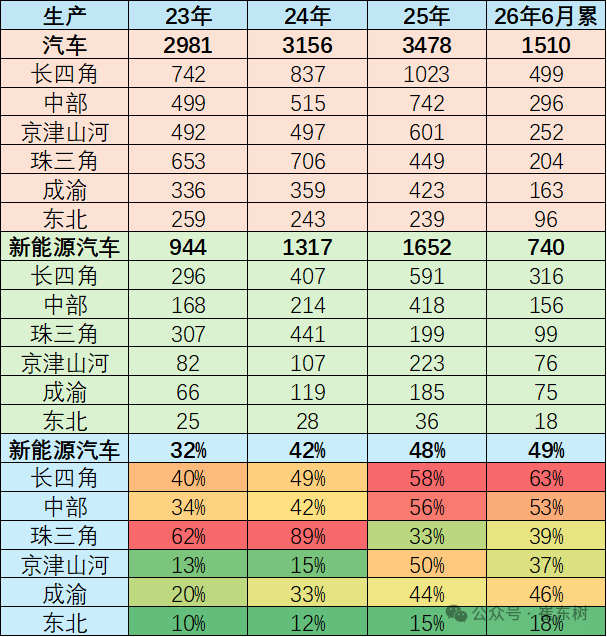
The domestic automobile electrification rate continued to rise in the first half of 2023-2026. Overall, it rose from 32% to 49%, and regional structural differentiation was obvious. The Yangtze River led the way in electrification, reaching 63% in the first half of 2026; the electrification rate in the Pearl River Delta dropped sharply from 89% to 39%, and the production capacity structure was significantly adjusted. Central China, Chengdu and Chongqing followed, with electrification rates exceeding 50% and 46%, and the pace of mountain and river transformation in Northeast China, Beijing, and Tianjin is slow.
In terms of production, the four-corner dual-track capacity was expanded simultaneously. In the first half of 2026, 4.99 million vehicles and 3.16 million new energy units were available, with high production capacity and electrification rates. Vehicle production in the Pearl River Delta has shrunk, and new energy production capacity has shrunk at the same time; vehicle and new energy production in Northeast China continues to decline, and the electrification rate is only 18%. The industry is concentrated in the Yangtze River and the central region is steadily following suit, and the pattern of lagging behind in the transformation of traditional bases is clearly evident.
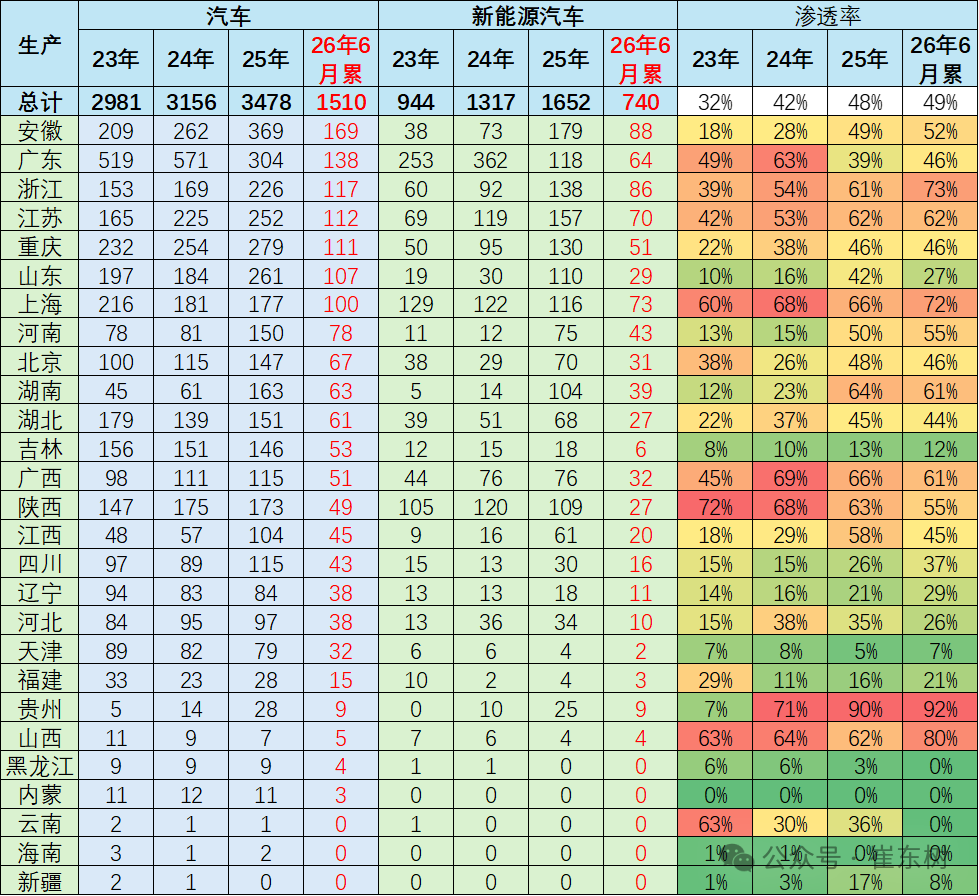
The national automotive energy penetration rate rose from 32% in 2023 to 49% in the first half of 2026, with significant provincial differentiation. Zhejiang and Shanghai lead the penetration rate in Changsijiao, with Zhejiang 73% and Shanghai 72%; Guizhou, Shanxi, and Guangxi are progressing ahead in electrification transformation, with penetration rates over 60%. The transformation of traditional automobile provinces in Northeast China and North China is slow, and the penetration rate of Tianjin and Heilongjiang is less than 10%.
Production and penetration rates are characterized by regional mismatches: Anhui has the highest vehicle production rate in the country, with a steady increase of 52%; Guangdong's vehicle production capacity shrank, and the penetration rate fell from 63% to 46%. Changsijiao Province has both high output and high penetration rate, forming an industrial advantage; in most northern provinces, vehicle and new energy production have both declined, and electrification transformation is lagging behind.