
- PRICING
- LIVE QUOTES
- LEARN
- HELP


EN
Is Vishay (VSH) Using Compact Automotive Components to Quietly Rewire Its Capacity‑Driven Strategy?
- Earlier this month, Vishay Intertechnology introduced an AEC‑Q102 qualified 1 MBd automotive optocoupler in a narrower SOP‑5 package and four new 40 V TrenchFET Gen IV n‑channel power MOSFETs for motor control and power conversion applications.
- By combining higher isolation ratings, improved noise immunity, and reduced PCB footprint, these releases strengthen Vishay’s positioning in EVs, industrial automation, and other demanding high‑reliability uses.
- Next, we’ll examine how this push into compact, high‑isolation automotive components could influence Vishay’s capacity‑driven investment narrative and risk profile.
AI is about to change healthcare. These 39 stocks are working on everything from early diagnostics to drug discovery. The best part - they are all under $10b in market cap - there's still time to get in early.
Vishay Intertechnology Investment Narrative Recap
To own Vishay, you need to believe its heavy capacity buildout will eventually be filled by demand in higher value automotive, industrial and power markets, while margins recover from today’s low base. The new optocoupler and TrenchFET MOSFETs play into that thesis, but they do not materially change the near term catalyst of improving utilization or the key risk that ongoing high CapEx and weak free cash flow could persist longer than expected.
Of the recent announcements, the automotive grade VOWA617A and VOWA618A high isolation optocouplers look most relevant. Together with the new VOMHA43A, they highlight a growing catalog of compact, high voltage isolation solutions that can deepen Vishay’s content in EVs and industrial automation. If demand in these segments tracks the capacity already in place, that could support the consensus view that higher margin products will eventually improve returns.
Yet, while the product story sounds encouraging, investors should be aware that Vishay’s high CapEx, negative free cash flow and margin pressure could...
Read the full narrative on Vishay Intertechnology (it's free!)
Vishay Intertechnology's narrative projects $4.8 billion revenue and $659.1 million earnings by 2029. This requires 14.3% yearly revenue growth and an earnings increase of about $657 million from $2.3 million today.
Uncover how Vishay Intertechnology's forecasts yield a $34.00 fair value, a 10% downside to its current price.
Exploring Other Perspectives
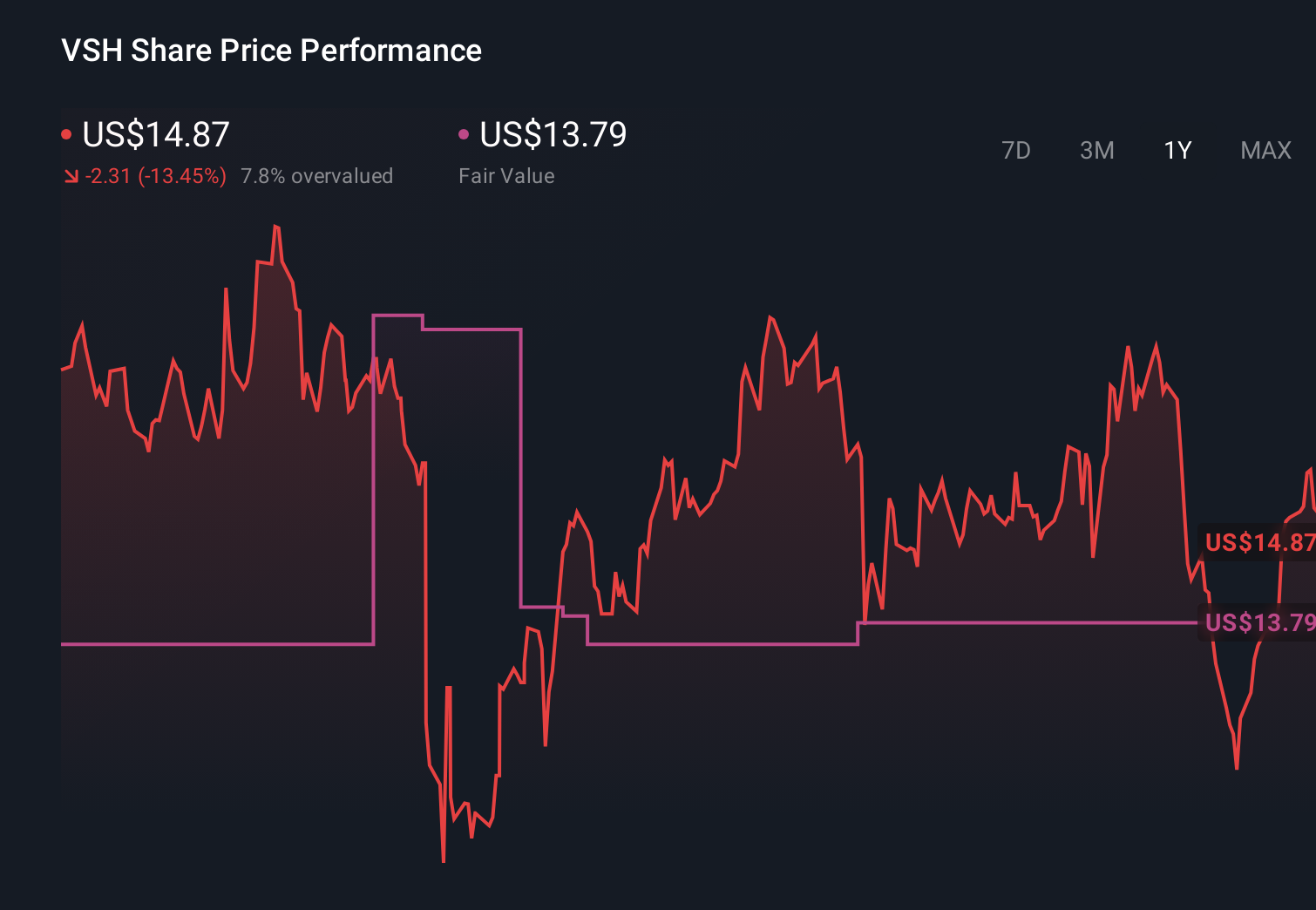
Compared with the baseline view, the lowest analysts were far more cautious, even while assuming revenue reaches about US$4.7 billion and earnings US$730 million by 2029, so you should weigh this pessimism against the new optocoupler push and consider how different future paths for margins and utilization might play out.
Explore 3 other fair value estimates on Vishay Intertechnology - why the stock might be worth as much as 41% more than the current price!
Decide For Yourself
Disagree with existing narratives? Extraordinary investment returns rarely come from following the herd, so go with your instincts.
- A great starting point for your Vishay Intertechnology research is our analysis highlighting 4 key rewards and 2 important warning signs that could impact your investment decision.
- Our free Vishay Intertechnology research report provides a comprehensive fundamental analysis summarized in a single visual - the Snowflake - making it easy to evaluate Vishay Intertechnology's overall financial health at a glance.
No Opportunity In Vishay Intertechnology?
These stocks are moving-our analysis flagged them today. Act fast before the price catches up:
- Find 47 companies with promising cash flow potential yet trading below their fair value.
- The best AI stocks today may lie beyond giants like Nvidia and Microsoft. Find the next big opportunity with these 16 smaller AI-focused companies with strong growth potential through early-stage innovation in machine learning, automation, and data intelligence that could fund your retirement.
- Rare earth metals are an input to most high-tech devices, military and defence systems and electric vehicles. The global race is on to secure supply of these critical minerals. Beat the pack to uncover the 29 best rare earth metal stocks of the very few that mine this essential strategic resource.
This article by Simply Wall St is general in nature. We provide commentary based on historical data and analyst forecasts only using an unbiased methodology and our articles are not intended to be financial advice. It does not constitute a recommendation to buy or sell any stock, and does not take account of your objectives, or your financial situation. We aim to bring you long-term focused analysis driven by fundamental data. Note that our analysis may not factor in the latest price-sensitive company announcements or qualitative material. Simply Wall St has no position in any stocks mentioned.
Have feedback on this article? Concerned about the content? Get in touch with us directly. Alternatively, email editorial-team@simplywallst.com