
- PRICING
- LIVE QUOTES
- LEARN
- HELP


EN
A Perfect Storm for Global Agriculture
(ZWU26) (WEAT) (ZCU26) (CORN) (ZSU26) (SOYB) (TAGS) (DBA) (XBX26)
“Perfect Storm for Global Agriculture”
Image designed by Scott Mathews and rendered by ChatGPT
by Jim Roemer - Meteorologist - Commodity Trading Advisor - Principal, Best Weather Inc. & Climate Predict - Publisher, Weather Wealth Newsletter and Climatelligence
Scott Mathews - Editor and Co-Producer of Climatelligence
- July 17, 2026
The Black Sea, Midwest & European Weather Convergence: Why Grain Markets Just Exploded
We are witnessing a perfect storm in global agriculture. A sudden combination of geopolitical escalation in the Black Sea and a critical weather window. Drought has expanded in Western Europe, while corn crops in parts of the western Midwest have begun to suffer from some heat and dryness. European corn futures soared more than 20% since we became concerned about a European drought. This is something we discussed three weeks ago in both our WeatherWealth Premium newsletter with trading ideas, and our more generic weather related newsletter, Climatelligence.
Here is my breakdown of exactly what is driving the markets this week, and what it means for the days ahead:
1. The Black Sea Escalation: Why Wheat Soared This Week
Wheat prices spiked by roughly 5% to 7% this week due to an abrupt shift in the Russia-Ukraine conflict. While the market had largely grown numb to previous updates, Ukraine's recent drone campaign has completely shifted the risk premium.
- The Targets: Ukrainian drone strikes targeted Russian vessels in the Sea of Azov and the Kerch Strait, reportedly hitting or threatening over 100 ships, including bulk grain carriers.
- The Logistics Chokepoint: In response, Russia suspended shipping in the Sea of Azov and closed the Kerch Strait. This is a massive blow to global supply, as this route handles roughly 25% to 30% of Russia’s total grain exports.
- The Market Impact: Because Russia is the world’s top wheat exporter, traders panicked. The risk of long-term shipping bottlenecks forced funds to instantly price back in a heavy war premium.
2. The Worst European Drought in Three Decades
While wheat is reacting to geopolitics, the European corn market is reacting to a severe climate crisis. Western Europe just recorded its hottest June on record, paired with a blistering July heatwave.
The data coming out of France—the European Union's top grain producer—is particularly alarming. Soil moisture has evaporated, and local corn production is currently on track to hit its lowest level in more than 30 years (since the early 1990s).
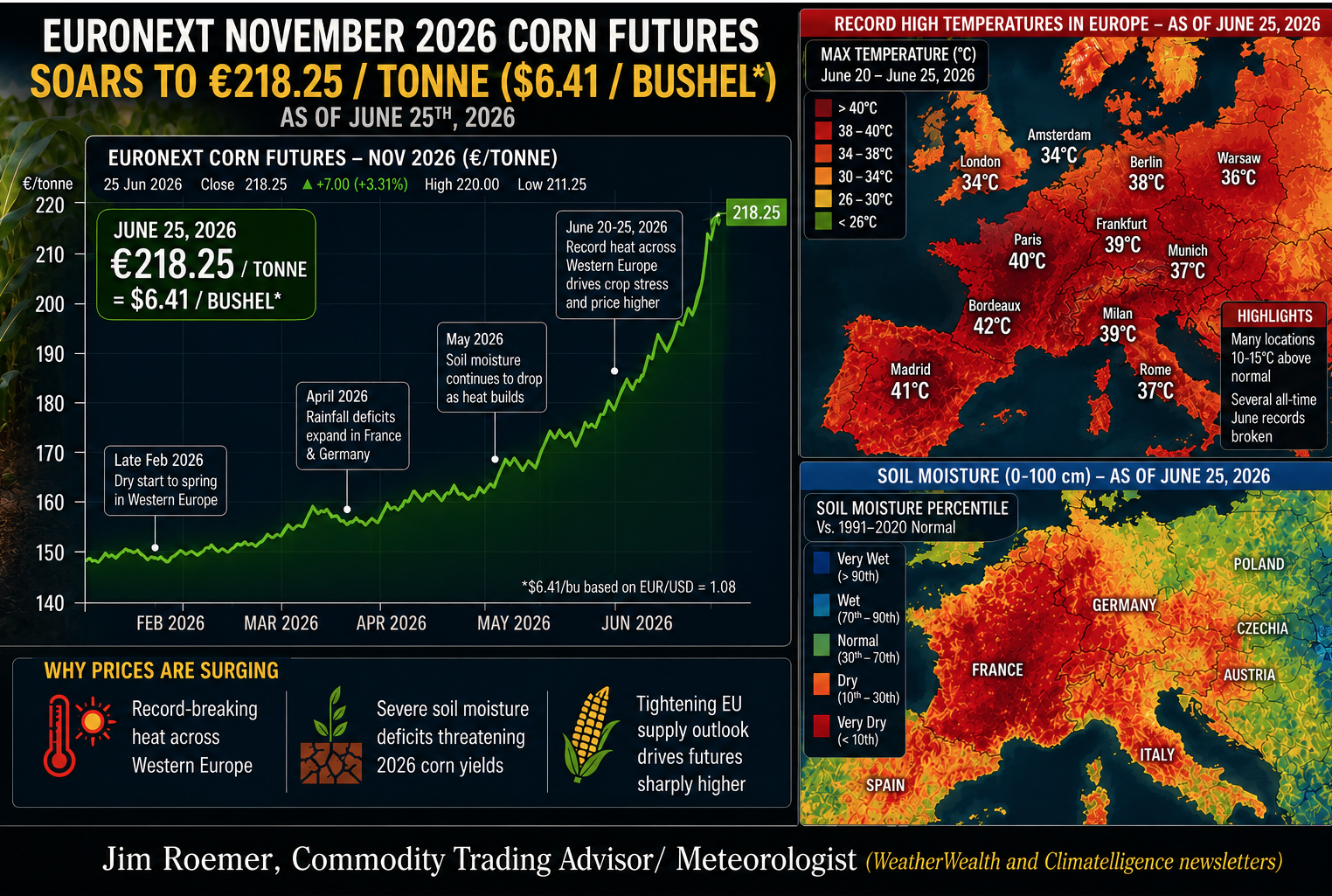
Image designed by Jim Roemer and rendered by ChatGPT
3. A Critical Window: Why the Timing Could Not Be Worse
The reason this drought is so catastrophic comes down to biology. July is the most sensitive month of the year for both the Midwestern and European corn crop.
- The Pollination Phase: Corn is currently going through its reproductive "silking" phase, when kernels are formed.
- Irreversible Damage: If a corn plant experiences extreme heat and moisture stress during this exact window, the pollen dries up and yield loss is permanent. Unlike other growth stages, rain in August cannot rescue a crop if pollination fails in July.
Bottom line: Any easing in the Ukraine-Russian tensions could send grain prices falling back sharply again. However, the European drought will continue and corn should remain in an uptrend overseas. The Midwest corn and soybean belt will watch the El Niño progress and process very carefully. Here is what usually happens during weak vs strong El Niño events:
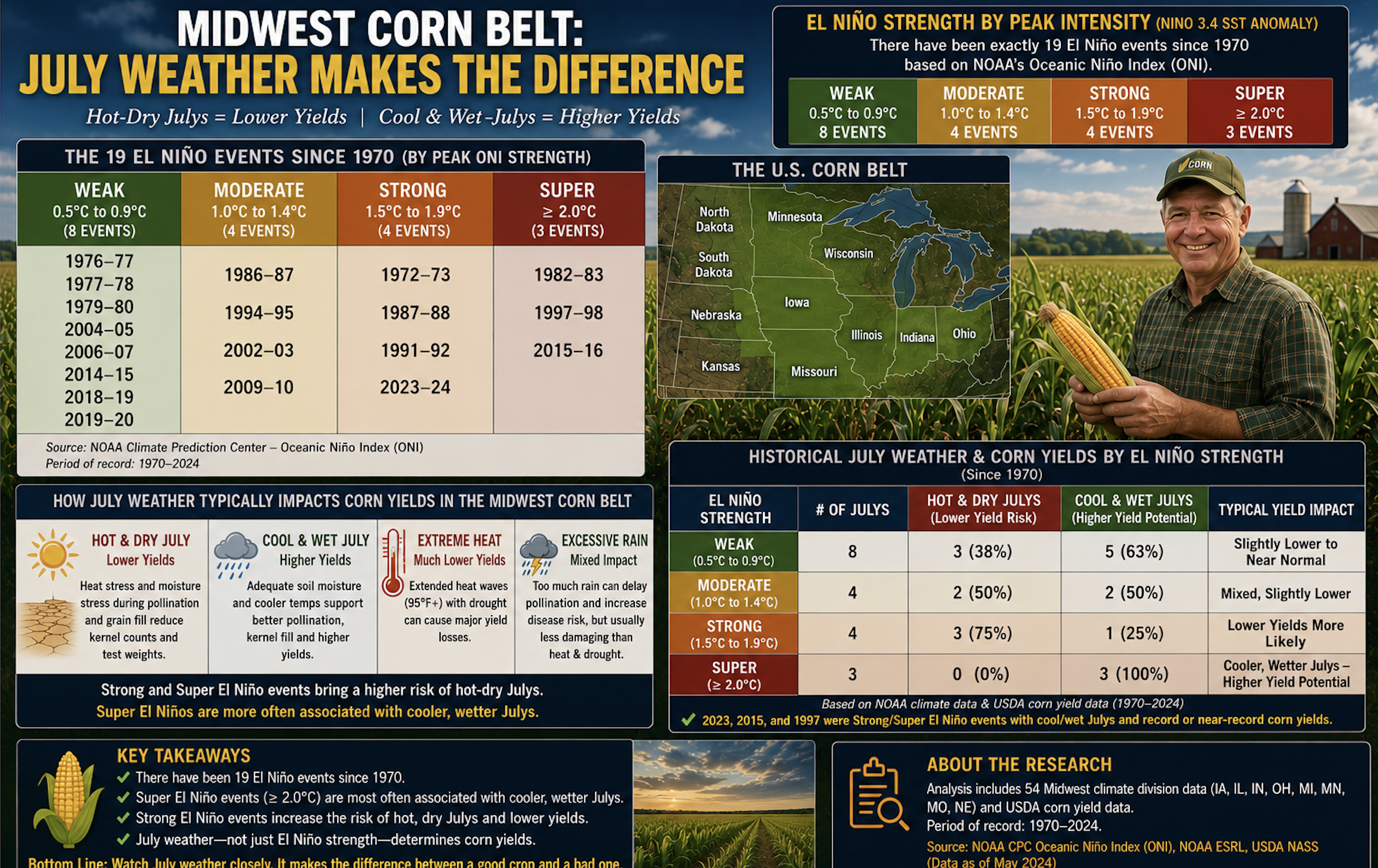
Image designed by Jim Roemer and rendered by ChatGPT
What is our weather forecast and what are out trading ideas moving forward? Will the Midwest and/or Europe finally begin to see a break from heat and some rains?
If you are not a subscriber to Climatelligence, our new inexpensive newsletter, we suggest you sign up here: https://www.bestweatherinc.com/climatelligence/
Logo designed by Scott Mathews and rendered by ChatGPT
Remember, when trading commodities, always apply risk management, such as stop-loss orders and position sizing, and consider using spreads to isolate the seasonal component of a particular market move.
We greatly appreciate your interest in Commodity Weather Intelligence!
Jim Roemer, Scott Mathews, and the BestWeather Team
Mr. Roemer owns Best Weather Inc., offering weather-related blogs for commodity traders and farmers. He is also a co-founder of Climate Predict, a detailed long-range global weather forecast tool. As one of the first meteorologists to become an NFA-registered Commodity Trading Advisor, he has worked with major hedge funds, Midwest farmers, and individual traders for over 35 years. With a special emphasis on interpreting market psychology, coupled with his short-term and long-term trend forecasting in grains, softs, and energy markets, he holds a unique standing among advisors in the commodity risk management industry.