
- PRICING
- LIVE QUOTES
- LEARN
- HELP


EN
The ultimate battle between long and empty will be held on July 30th! HSBC is leading the bullish market. Can Apple (AAPL.US) use end-side AI dividends to hit the $5 trillion market capitalization?
The Zhitong Finance App learned that HSBC upgraded the rating of Apple (AAPL.US) to “buy” and raised the target price from $260 to $366. This reflects Wall Street's growing optimism about the iPhone maker's position in the market at a time when many AI-related stocks are stagnating.
Analyst Nicholas Cott-Collison, who previously rated the stock as “holding,” wrote that the company “is now at a turning point in operations” because “not only can the company stay away from excessive capital expenditure arguments,” “but also because Apple can fully leverage its 2.5 billion existing equipment base with the upcoming revised version of Apple Intelligence.”
Tech stocks experienced a wider sell-off after Chinese startup Dark Side of the Moon released a new AI model, but Apple's stock price didn't change much in pre-market trading.
The stock has performed strongly recently, rising more than 20% since late June and hitting new highs this week. Apple is the best-performing stock among the so-called tech giants this year. With a market capitalization of $4.9 trillion, it has surpassed Nvidia to become the world's largest company by market capitalization.
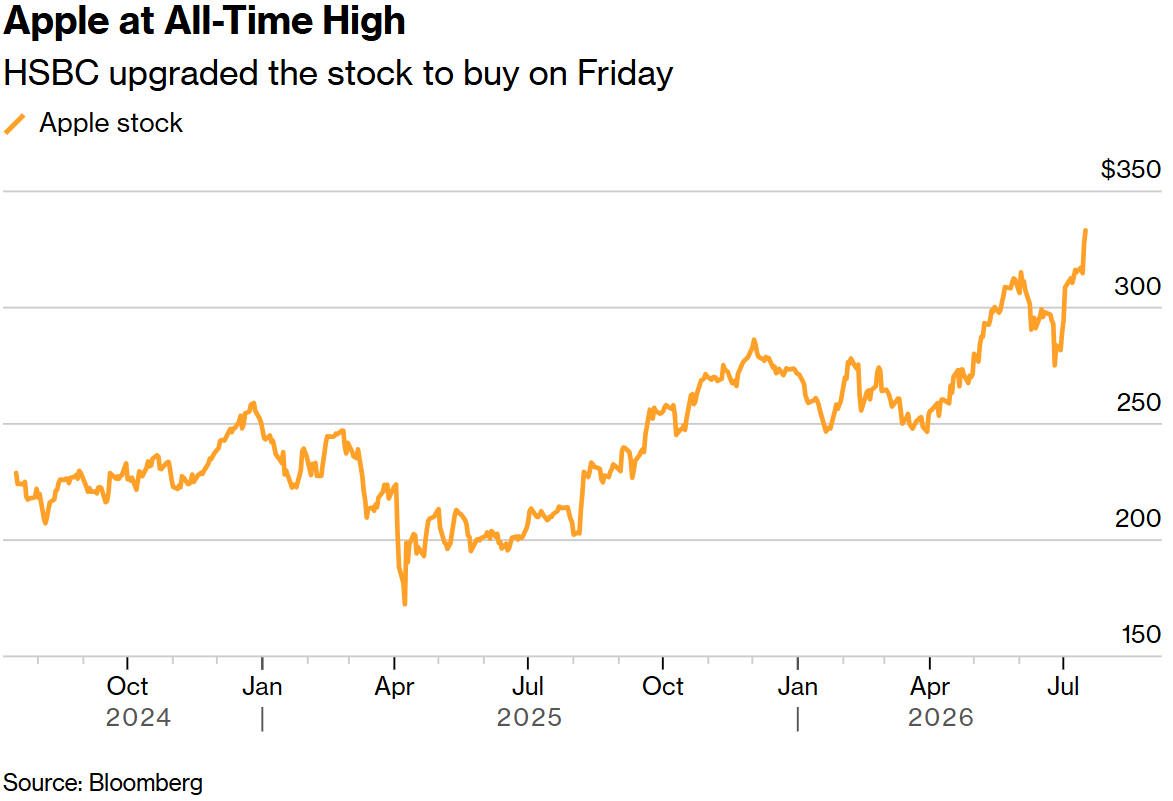
Apple's stock price hits a record high
At a time when many other sectors of the tech industry have been struggling, Apple's recent strong performance is particularly prominent. Notably, the Philadelphia Semiconductor Index has dropped 19% from its peak in June, and the trend has clearly reversed.
Although Apple's AI products have repeatedly frustrated investors, Kurt Collison is optimistic about the smart AI Siri digital assistant that it will deploy this year.
He wrote, “This AI boost came just in time because we think Apple has one of its most innovative product pipelines,” he wrote
Apple is expected to release a folding screen iPhone in September, which many see as a major potential catalyst, especially since the device is expected to carry a hefty price tag, which may help offset the impact of the high price of memory chips.
“Combined with better AI, this could trigger a strong switching (update) cycle,” the analyst wrote of Apple's hardware product pipeline.
Earlier this month, Japanese media reported that Apple had informed its suppliers that it was preparing to produce around 10 million folding iPhone units this year, up from the 7 million to 8 million previously forecast.
The “long and empty battle” on the financial report day of July 30
Despite receiving an increase in ratings, many analysts are still more skeptical about Apple compared to other mega-capitalization stocks. Currently, only slightly more than 60% of analysts recommend buying. By contrast, the data shows that 90% of analysts covering Microsoft, Amazon, Meta, and Nvidia gave these stocks a buy rating. However, the average price target for Apple is around $322, which means there is room for a decline of about 3% from Thursday's closing price.
Earlier this week, KeyBanc Capital Markets just downgraded the stock to “reduced holdings,” citing dual concerns about demand and valuation.
This month, the multi-headed faction, represented by HSBC Holdings and Morgan Stanley, launched a powerful song. The core logic of the bulls is that Apple is entering a “turning point in its operations.”
First, in terms of AI logic, Apple's unique “asset-light” model is beginning to show its power. Unlike cloud giants, which often invest 40% of their revenue in data center construction, Apple's capital expenditure in 2026 is expected to account for only 2.5% of sales. Apple doesn't need to get involved in an arms race of expensive computing power, but rather “sit back and enjoy” — using its huge installed capacity of 2.5 billion active devices around the world to directly commercialize end-side AI through “Apple Intelligence” and smart Siri, which will be launched in the second half of the year. Furthermore, Apple's AI function has recently cleared regulatory barriers in the key Chinese market, which has also greatly boosted the market's confidence in the global iPhone switching trend.
Second, an extremely strong product line is becoming the driving force for price increases. Although the global supply chain is facing a crisis of soaring memory chip prices (Apple's DRAM and NAND costs are expected to soar by 370% and 280% respectively from 2025 to 2027), Morgan Stanley points out that thanks to extremely high user loyalty and strong bargaining power, Apple is fully capable of passing on costs to consumers. The market expects the upcoming folding screen iPhone (which is rumored to have been added to 10 million units in stock during the year) and the future iPhone 18 series will bring significant room for price increases. Not only will this not disrupt demand, but it will also trigger an unprecedented round of ultra-high-end switching cycles.
Amidst all the praises, however, the ruthless rational analysts are resolutely sounding the alarm. KeyBanc Capital Markets unusually downgraded Apple's rating directly to “reduced holdings” this month, slashing the target price to $250, which means there is room for a drop of more than 20% compared to the current stock price. At the same time, some analysts have adjusted their ratings to “hold”, bluntly saying that the current risk-to-benefit ratio is no longer ideal.
The concerns of the bear camp are also hard to ignore: First, valuations are already extremely “afraid of being high.” Currently, Apple's transaction price is as high as 35 to 36 times its expected earnings for the 2026 fiscal year (far higher than the average of about 20 times the S&P 500 index). Technical indicators (such as RSI) have been seriously overbought, which means that the market has perfectly priced all future benefits (including AI expectations and switching waves), and the fault tolerance rate is extremely low. Once there is a slight flaw in the financial report at the end of July or subsequent sales, the stock price will face a sharp return to the average.
Second, concerns about the demand for underlying hardware and the decline in operator subsidies. Bearish analyst Brandon Nispel stressed that although overall iPhone shipments in the second quarter bucked the trend and gained 20% market share due to a strong refresh cycle, in the long run, the global smartphone replacement cycle is unavoidably lengthening. More fatally, America's top three mobile operators have publicly discussed phasing out expensive device subsidies. Once the operator's “bill of payment” is lost, the high terminal price will directly suppress consumers' desire to upgrade, which in turn will slow down the expansion of Apple's high-margin businesses (such as iCloud and Apple Music).
Furthermore, the accelerated distribution of the supply chain to places such as India and Vietnam has reduced geographical risks, but will continue to “gradually encroach on” Apple's gross margin in the medium term. Some analysts put it bluntly: “The golden age of profits brought by Apple's efficient operation through globalization is coming to an end.”
Currently, Apple is in a tug-of-war between “stable fundamentals” and “lack of AI narrative.” The increase from major banks such as HSBC and Citibank is essentially gambling that Apple can use “pricing power” and “stock ecology” to get through the “empty window period” of AI. However, the concerns of bears such as KeyBanc are not unfounded — if AI does not bring about a substantial wave of switching, it will be difficult to maintain high valuations. The July 30 earnings report will be the first litmus test for this big gamble.