
- PRICING
- LIVE QUOTES
- LEARN
- HELP


EN
Korea's AI transaction shock has triggered a global style shift! At a time when leveraged capital is declining, “quantitative safe trading” returns to Wall Street
As the risk of selling around AI computing power infrastructure and popular semiconductor stocks swept through global financial markets, neglected quantitative security transactions returned strongly. Recently, stock market investors' concerns about AI computational power-themed transactions have continued to increase, and investors have begun to seek refuge in a simpler corner of the stock market: companies with long-term stable financial conditions.
Themed transactions around AI seem to have moved from the unilateral momentum stage of “capital development to support renewal and liquidity easing” to a period of re-examination of valuation, return, and interest rate paths. As a result, quantitative capital was withdrawn from crowded high-beta winners to a “quality factor” with strong balance sheets, stable profits, and relatively lagging valuations.
The Zhitong Finance App noticed that the quality strategy has risen 3.8% in the past two months, and continued to achieve positive returns at a time when chip stocks were sold off and the Nasdaq 100 fell. It reflected not that investors were completely bearish on US stocks, but rather a shift within the market from “chasing growth” to “screening profit quality.” The recent global stock market momentum factor can be described as having experienced a sharp reversal rarely seen since the beginning of this century, yet the market remains resilient and is closer to capital rotation rather than a systemic stock market bear market.
The so-called Quant Safety Trade (quantitative safety trade), which has recently become popular, is not simply buying utilities, gold, or low-volatility ETFs. Instead, it uses a regular model to increase “high quality” companies and short low quality companies at the same time when necessary to extract quality factor benefits independent of market ups and downs. Common screening indicators include high return on equity, stable profit growth, low debt and financial leverage, healthy cash flow, and sustainable business models; the index compiling company MSCI also defines quality factors as companies with low leverage, stable profits, and high profitability, and indicates that they usually have defensive properties during periods of economic contraction. It is worth noting that “safety” means that enterprises are basically more able to withstand economic slowdown, tightening financing environments, and capital expenditure deceleration; it does not mean that stock prices will not fall.
There is a fundamental difference between quantitative safe trading and momentum stocks that are currently being sold off: the momentum strategy continues to buy winners based on strong prices over the past 6 to 12 months. Essentially, it believes in the continuation of the trend, and generally does not require companies to be cheap, have low debt, or sufficient cash flow; MSCI defines it as a “sustainability factor” for recent strong stocks to continue to outperform.
When AI semiconductors, data centers, and highly leveraged technology stocks become joint positions, momentum strategies can easily form positive feedback of “price increase — capital pursuit — more crowded positions”. Once AI capital return expectations, interest rates, or risk appetite change, it will also transform into simultaneous stop-loss and rapid deleveraging. The quality strategy starts from corporate financial resilience. Currently, the 90-day correlation coefficient with momentum has dropped to about -0.63, so it is more like a factor hedging against crowded AI transactions: it does not deny the long-term prospects of AI, but rather prioritizes holding companies that can finance themselves, continue to make profits, and withstand valuation compression when the market shifts from narrative pricing to cash flow verification.
Statistics from major Wall Street banks show that in the past two months, the investment strategy and style index for buying high-quality stocks has risen 3.8%, which is the best performance among the eight segments that Barclays Plc (Barclays Plc.) has tracked for a long time. On Thursday, the combination of long and short quality factors compiled by Barclays rose 1.9%; on the same day, chipmakers experienced a sell-off, driving the Nasdaq 100 index down 1.6%.
Momentum stalled, cash flow picked up at an accelerated pace: the decline in AI transactions spawned a “balance sheet safe haven”
Last year, Wall Street institutional investors obsessed with AI-themed transactions basically abandoned undervalued basic high-quality stocks with abundant cash flow, causing a valuation index to fall close to the lowest level in history, according to a data compiled by Barclays. Today, this investment style is being revived as the market's concerns about overcrowded and leveraged AI positions and the Federal Reserve's interest rate path increase.
Recently, the South Korean stock market, which has the title of an “AI computing power weather vane,” has frequently fallen into upside failure and collapse. The Philadelphia Semiconductor Index in the US stock market plummeted nearly 19% from the June high, only one step away from the technical bear market. In addition, global AI computing-power-themed stocks and the semiconductor sector have fallen into extreme sharp sell-off due to overcrowded and highly leveraged long positions. The market investment trend seems to be shifting to the high quality, low momentum, abundant cash flow, and strong fundamental defense cycles and this year's increase far less than that of popular technology stocks Shares.
Alex Altman, head of global equity tactical strategy at Barclays, said that momentum trading, which investors are focusing on, previously benefited from favorable factors such as AI capital expenditure and loose monetary policies, but “many of these effects are now beginning to subside.” If the investment cycle weakens, these high-quality stocks based on “quantitative safe transactions” will become a “safe haven in the midst of the storm.”
As the strongest performing sector on Wall Street this year, the semiconductor sector of the US stock market fell sharply by 4.3% on Thursday, extending its decline to 19% since the record high in June. While the market is concerned about huge investment in artificial intelligence, the vague investment return prospects will be enough to support high valuations.
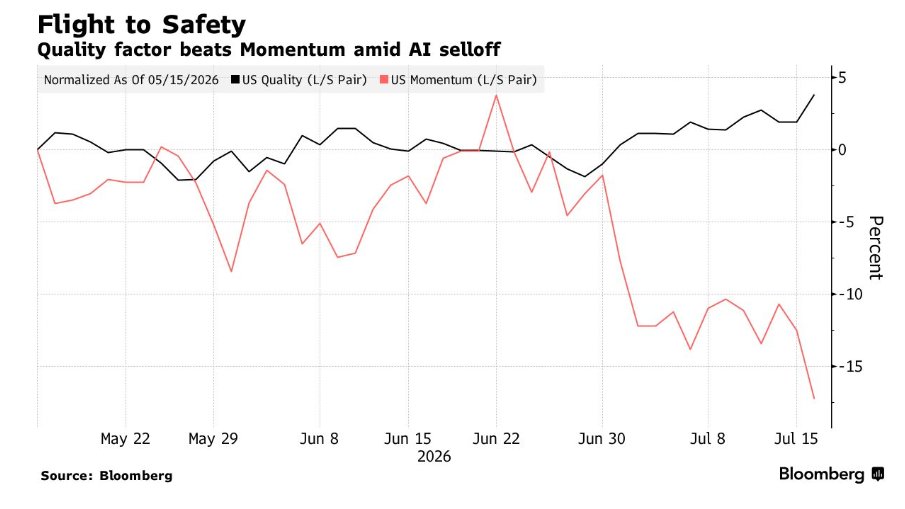
As shown in the chart above, global capital is flocking to safe assets — when the AI theme is being sold off, the quality factor outperforms the momentum factor.
“Quality” is Wall Street's abbreviation for a company with a strong balance sheet, high return on equity, and continuous profit growth. While momentum trading is weakening, the quality factor continues to rise, indicating that the market is undergoing a reversal, and concerns surrounding AI are constantly disrupting existing investment strategies.
In fact, according to one measure, the quality factor has become a type of reactionary trading. The 90-day inverse correlation coefficient between this factor and the momentum factor has risen to -0.63, one of the highest levels in Barclays history. A reading of -1 means the two portfolios are moving in complete opposite directions.
Barclays's quality factor portfolio mainly includes stocks such as Dekang Healthcare, Williams-Sonoma, Kohl's, Quick Lock, Seagate, Planet Fitness, Morgan Stanley, and Moderna.
If historical experience can be used as a reference, there may be more room for growth in this strategy in the future. The “quality factor” theme suffered a severe setback earlier this year, reducing its ratio of corporate value to sales to the lowest eleventh percentile of all observed values over the past 20 years. According to a statistic compiled by Barclays, when the valuation multiplier fell to such a low level, it recorded an increase of 92% over the next six months.
Altman from Barclays said, “Investors usually want to buy quality stocks, so this style has historically often enjoyed valuation premiums — but that's not the case today. This is a very rare occurrence.”
From a historical perspective, when economic growth slows and the financial environment tightens, high-quality stocks tend to perform better. Barclays strategists believe that the possibility of such a scenario is increasing as the differences among Fed policymakers over future policy direction intensify and the economy's dependence on AI computing power infrastructure spending continues to rise.
Altman pointed out that current capital continues to rotate to high-quality stocks, which does not necessarily mean that investors are bearish on the US stock market. Since 2004, the quality factor has increased at the same time as the S&P 500 index, accounting for more than 45% of the time. “The quality factor cycle often indicates that investors are moving to a relatively late stage of the economic cycle, which does not necessarily mean that the bull market is over.”
From Seoul's chip deleveraging frenzy to Wall Street's quantitative safe haven, strong balance sheet stocks are about to become a well-deserved “C position” in the stock market
The core of this round of global stock market turmoil is not the sudden collapse of the fundamentals of the AI industry, but rather the reverse operation of a trading structure formed by high momentum, high concentration, and high leverage. Korea became the epicenter because Samsung Electronics and SK Hynix together account for more than half of the weight of KOSPI. Retail guarantee financing once reached a record amount of 38.6 trillion won, and single-stock leveraged ETFs also formed positive feedback through daily rebalancing of “forced to buy when they rise and sell machines when they fall.”
Korea's benchmark stock index, the Kospi Index, has withdrawn about 20% since July, but it still rose about 62% during the year; doubling the size of the Hong Kong-listed SK Hynix ETF increased more than 20 times to about 7.78 billion US dollars during the year, which is enough to significantly affect the price of the underlying stock and index. This shows that South Korea was not the first to prove that AI profit logic failed, but was the first to reveal the fragility of the market microstructure after price momentum and financing leverage were far faster than profits were realized.
This pressure is spreading along the chain of “Korean memory chips - Asian technology stocks - US semiconductors and high beta momentum combinations.” The path dependency of leveraged ETFs means that even if the underlying index falls 10% and then rises 11.1% to the starting point, triple leveraged products will still have a net loss of about 7% due to compound interest losses; therefore, the shock itself is a passive deleveraging mechanism.
South Korea's single-stock leveraged ETFs are still falling due to daily rebalancing, and financing purchases are reaching extreme levels; J.P. Morgan believes that the world's largest stock market — the US stock market is also experiencing almost the same mindset as South Korea — that is, the normalization of leveraged ETFs, retail bullish options, and margin accounts has not yet been completed, and it may still take about three months to return to the state it was before April.
According to J.P. Morgan Chase's strategic estimates, the asset size of memory chip leveraged ETFs has shrunk by about 34%, and all stock leveraged ETFs have declined by about 13%, but their leverage ratio relative to the underlying market value has not returned to normal. It may take about three months of high-fluctuation range trading to return to pre-April levels. Retail small call option purchases were previously close to the extreme value of 14 million shares, and margin account leverage is still at an all-time high near the peak in mid-2018 and late 2021, which means that marginal buying of technology stocks is weakening, but the risk of forced liquidation has not completely disappeared.
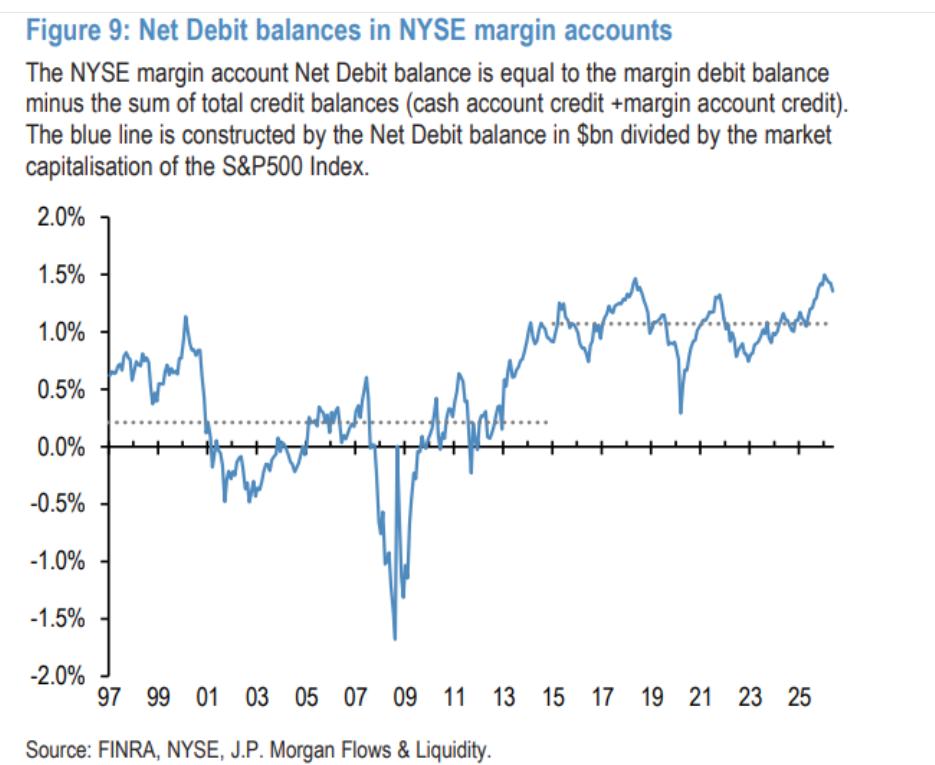
The return of what Barclays calls “quantitative safe trading” is a mirror image of this structural reversal: capital is shifting from a momentum factor that relies on continuing price trends to a quality factor of high profitability, low financial leverage, stable cash flow, and strong balance sheets. It is not simply increasing utility holdings or essential consumption in the traditional sense, but rather increasing financial resilience and shorting low-quality assets through a systematic combination of long and short, in order to isolate the market beta and obtain a quality premium. The current 90-day correlation between quality and momentum has dropped to about -0.63, indicating that the quality factor is becoming a natural hedge for crowded AI transactions; this does not mean the end of the bull market, but rather a shift in the market pricing function from “rising the fastest in the past” to “who can afford tight financing, slowing capital expenditure, and continuing to generate free cash flow.”
Michael Wilson (Michael Wilson), a top Wall Street strategist from Morgan Stanley, also emphasized that the AI cycle is not over; only that the breadth of semiconductor profit expectations and position congestion have reached extreme values. Investors are beginning to demand that return on capital expenditure continue to accelerate without being satisfied that absolute performance is still strong. In terms of investment strategy, single-share leveraged ETFs, short-term bullish options, and highly congested AI hardware positions should be reduced in stages, and the financial, industrial, medical, and consumer sectors with low leverage, high free cash flow, rising profit expectations, and clearly lagging behind this year.