
- PRICING
- LIVE QUOTES
- LEARN
- HELP


EN
After three-quarters of the stock price evaporated, Circle (CRCL.US) was hit again: Visa and BlackRock formed a group to besiege, Mizuho was bearish on $50
The Zhitong Finance App learned that since the initial public offering (IPO) last year and peaked for a while, the stock price of Circle Internet Group Inc. (CRCL.US) has now evaporated by more than three-quarters. And as more stablecoins pour into the market, some analysts have warned that the worst may not yet come.
This week, Dan Doleev, an analyst at Mizuho Securities America, downgraded Circle's rating from “neutral” to “outperforming the market, and gave the lowest price target on Wall Street today — $50 per share, which means there is still about 18% downside from Thursday's closing price. This price is also far below the $123 average target price given by analysts who have followed the stock.
Although USDC, a stablecoin owned by Circle, ranks second in global market capitalization, after Tether Holdings SA's USDT, Doleev believes it is facing increasingly intense competitive pressure. Currently, more than 100 fintech companies, payment networks, cryptocurrency companies, and banking institutions — including Visa Inc. (V.US), Stripe LLC, Coinbase Global Inc. (COIN.US), and BLK.US (BLK.US) — are supporting the open source project Open Standard, which will issue a new stablecoin Open USD (OUSD).
In an interview, Dorev said, “These partners can be called an 'all-star lineup'. They have huge asset management scale and customer resources, and will inevitably drive the popularity of OUSD at any cost. I think other Wall Street peers aren't fully aware of this risk, so their profit forecasts seem too optimistic.”
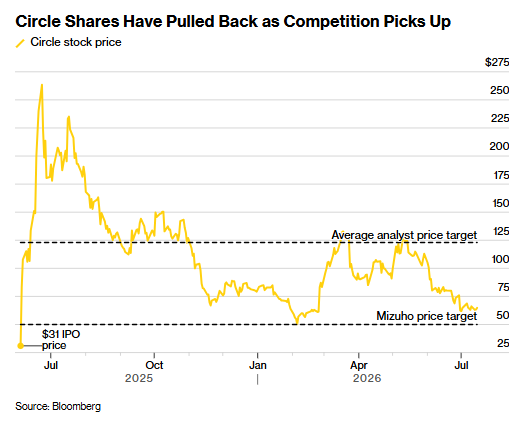
Circle's stock price closed down 7.7% on Thursday after Visa announced the launch of a platform that allows financial institutions to issue, transfer and manage stablecoins.
Back in June 2025, Circle's stock price once soared 750% within a few weeks after the IPO. At that time, market enthusiasm for the US “GENIUS Stablecoin Act” was high, and investors poured into this one of the few stablecoin listed companies. However, as more stablecoins linked to the US dollar were introduced one after another, and overall pressure on cryptocurrency assets, Circle's stock price has declined sharply from its high point.
It's undeniable that Circle is also actively building a line of defense against new players — for example, it has been approved as a bank for limited purposes. However, pricing pressures and growing interest demands from partners continue to follow. Emerging stablecoin business models have the potential to “rip away” Circle's partners with more attractive revenue sharing mechanisms.
Circle's revenue mainly comes from revenue generated from its USDC reserve assets. Emerging stablecoins such as OUSD, on the other hand, plan to share reserve earnings with partners and charge only a small management fee — which means partners may receive higher returns.
Dorev said bluntly, “I don't think Circle's situation is optimistic.” He expects Circle's adjusted profit before interest, tax, depreciation and amortization (EBITDA) to reach US$699 million in 2027, far below the market's consensus estimate of US$907 million, based on concerns that the company is in a dilemma.
Furthermore, Doleev also pointed out that the USDC distribution agreement between Circle and Coinbase also has short-term risks — the two sides will renegotiate the agreement in August this year.
Doleev said, “Since Circle is currently under pressure from OUSD, it is likely that Coinbase will use this as a bargaining chip to obtain a more favorable share ratio and get a bigger share of the pie.”
He further stated, “This will inevitably erode Circle's profitability and is the main reason we lowered our performance expectations.”