
- PRICING
- LIVE QUOTES
- LEARN
- HELP


EN
Space Stocks Facing Post IPO Pressure After SpaceX Slide
SpaceX’s post IPO slide, from a market value above $2.6 trillion to about $1.72 trillion within days, has sent a clear message to anyone watching new listings closely. When a flagship space stock stumbles after listing and short sellers walk away with an estimated $3.9 billion, it can rattle confidence well beyond one ticker. This article looks at three stocks exposed to the same news shock, each facing its own version of post debut volatility risk. You will see where the pressure points are and where caution may be warranted before committing fresh capital.
ARK ETF Trust - ARK Space & Defense Innovation ETF (ARKX)
Overview: ARK ETF Trust - ARK Space & Defense Innovation ETF is a US domiciled fund that pools investors’ money into a basket of global companies tied to space exploration, aerospace and defense, satellites and related technologies, using both fundamental and quantitative research to pick stocks across different sizes and styles.
Market Cap: US$833.3 million
ARK ETF Trust - ARK Space & Defense Innovation ETF sits in the blast zone of the SpaceX sell off, with heavy exposure to space related stocks at a time when post IPO enthusiasm has shifted to concern about leverage, sector risk and fund outflows. The ETF has a short track record, patchy data on growth and governance, and is currently unprofitable with a return on equity at or below zero. It also relies fully on external borrowing for funding, which can magnify stress when sentiment sours. Despite trailing the broader US market, ARKX has recently held up better than some capital markets peers, so it remains on the radar for investors assessing whether the recent shock is a temporary shakeout or the start of a deeper reset for space themed funds.
ARK Space & Defense Innovation ETF’s short track record, zero return on equity and reliance on borrowing could be masking deeper stress points for holders. Before assuming the recent resilience is reassuring, review the ARK ETF Trust - ARK Space & Defense Innovation ETF financial health report

Virgin Galactic Holdings (SPCE)
Overview: Virgin Galactic Holdings is an aerospace and space travel company that designs, builds, tests, and operates reusable spaceships to provide suborbital flights for private passengers, researchers, and government customers from its facilities in Tustin, California and associated spaceports.
Operations: Virgin Galactic currently generates around US$1.31 million in revenue from its Aerospace & Defense segment, reflecting very early stage commercial activity.
Market Cap: US$301.3 million
Virgin Galactic Holdings sits squarely in the firing line of the SpaceX post IPO selloff, with a small revenue base, ongoing heavy losses and less than one year of cash runway just as investor appetite for highly speculative space stocks is being tested. The company is still pre scale, relies on external funding, and has diluted shareholders while working toward commercial flights planned around 2026. This leaves little room for setbacks if testing or ticket sales slip. Analysts have noted that sentiment on the stock can swing sharply as each new test, funding move, or delay reaches the headlines.
Virgin Galactic’s tiny revenue base and heavy cash burn leave little margin for error, especially if sentiment keeps cooling on space stocks. Before assuming the story recovers smoothly, read the 3 key rewards and 4 important warning signs (2 are major!)

Commonwealth Bank of Australia (ASX:CBA)
Overview: Commonwealth Bank of Australia is a large retail and commercial bank that provides everyday banking, home loans, business finance, wealth products, and insurance to households and companies across Australia, New Zealand, and selected international markets.
Operations: Commonwealth Bank of Australia generates most of its revenue from Retail Banking Services (A$13.1b) and Business Banking (A$9.3b), with additional income from Institutional Banking and Markets (A$2.9b) and its New Zealand operations (A$3.0b).
Market Cap: A$289.5b
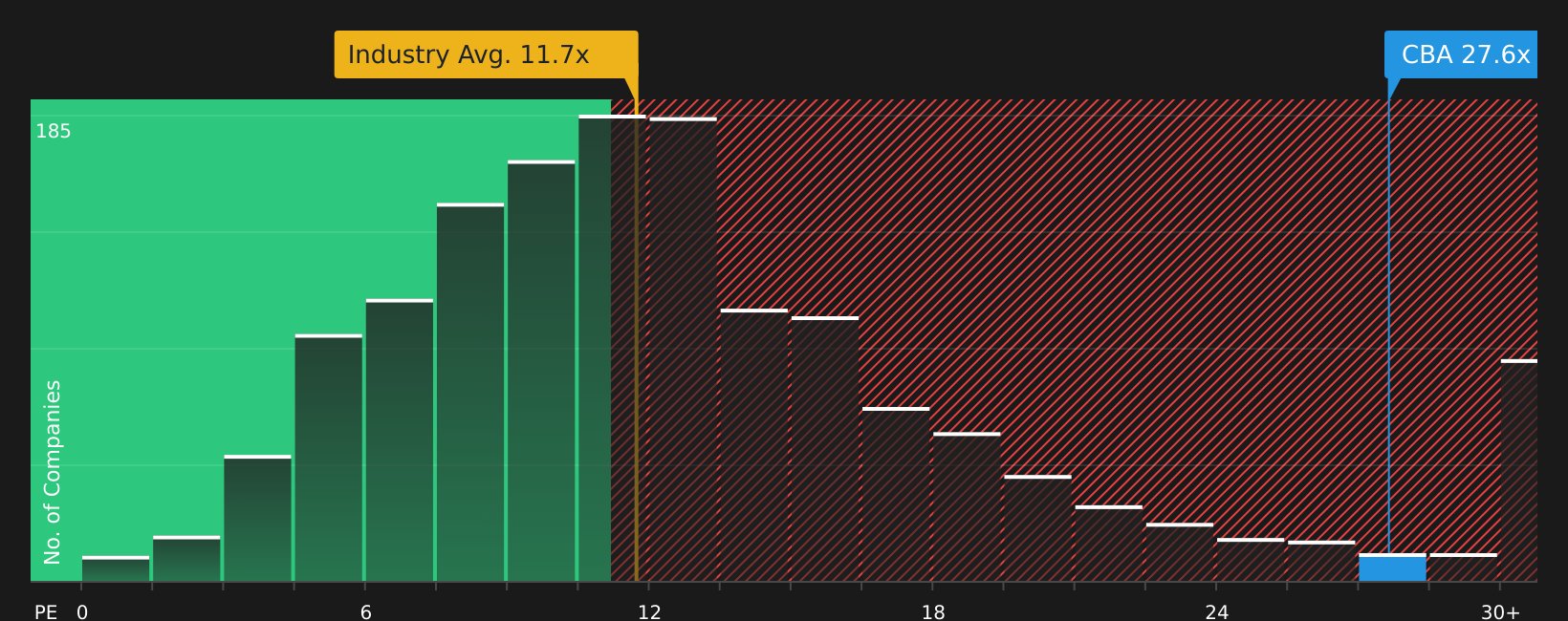
Commonwealth Bank of Australia might look like a safe harbour after the SpaceX fallout, but the picture is more complicated: earnings are growing and margins are still healthy at 36.5%. At the same time, the stock trades on a P/E of 27.6x, above both global and local bank peers, while analysts’ average price target sits below the current share price. Heavy reliance on Australian mortgages, rising technology and AI spend, and concerns about loan provisioning add pressure just as retail trading enthusiasm through CommSec could cool if clients pull back from IPOs after early SpaceX losses. For investors, the key question is whether this premium-valued bank is priced for smoother conditions than its own risk profile really supports.
Commonwealth Bank of Australia’s rich P/E multiple could be masking more fragile trends beneath the headline margins. Before assuming this premium is secure, read the 1 key reward and 2 important warning signs
Take Control of Your Investment Journey
If Virgin Galactic Holdings or any of these companies are making you feel more cautious, register for FREE with Simply Wall St and add your companies to a Watchlist to monitor the share price against the fair value and track any new developments as they happen. Once you've made your move, manage your holdings with our Portfolio Command Center that filters out the noise to deliver only the most critical, actionable updates. Throughout your journey, our Community allows you to filter the best ideas from thousands of investor perspectives. By uncovering hidden catalysts and risks early, you'll accelerate your decision-making and stay one step ahead of the market.
Seeking Alternatives Before The Crowd?
Fresh opportunities do not wait around. While attention sticks to SpaceX and related stocks, other themes are gathering momentum under the radar for now, so consider them before they become widely followed.
- Look for potential breakouts in overlooked small caps by scanning the curated 20 high quality undiscovered gems before broader interest increases and momentum builds.
- Explore resilient income opportunities by reviewing the hand picked 8 dividend fortresses while yields still look appealing and prices have not yet fully reflected additional demand.
- Follow the long term infrastructure theme by tracking curated 35 power grid technology and infrastructure stocks that may be positioned to benefit if grid upgrades increase and capital flows into the sector.
This article by Simply Wall St is general in nature. We provide commentary based on historical data and analyst forecasts only using an unbiased methodology and our articles are not intended to be financial advice. It does not constitute a recommendation to buy or sell any stock, and does not take account of your objectives, or your financial situation. We aim to bring you long-term focused analysis driven by fundamental data. Note that our analysis may not factor in the latest price-sensitive company announcements or qualitative material. Simply Wall St has no position in any stocks mentioned.
Have feedback on this article? Concerned about the content? Get in touch with us directly. Alternatively, email editorial-team@simplywallst.com